Quick answers
- What is a moon garden?
- A garden designed to be enjoyed in the evening and at night, using white, cream and pale flowers, silver and grey foliage and fragrant plants that release their scent after dark.
- Which plants work best in a moon garden?
- White roses, jasmine, moonflower, evening primrose, nicotiana, white cosmos, lamb's ears, artemisia, dusty miller, white hydrangea and night-scented species such as raat ki rani (night-blooming jasmine) and tuberose.
- Do I need lighting in a moon garden?
- Not much. Pale plants reflect moonlight and ambient light. A few soft, warm lights near seating and paths are enough; too much light spoils the effect.
- Will a moon garden attract wildlife?
- Yes. Night-scented flowers attract moths and other night-flying pollinators, which in turn feed bats and birds. Avoid pesticides to support them.
Key takeaways
- Think pale. White, cream, pale yellow and silver show up best in low light.
- Choose night-scented plants. Fragrance is half the magic after dark.
- Place the garden near where you sit in the evening, so you actually enjoy it.
- Use very soft lighting and let pale foliage reflect the moon.
- Mix flower and foliage. Silver leaves provide structure when flowers fade.
- Support moths and other night pollinators by avoiding insecticides.
Table of contents9 sections
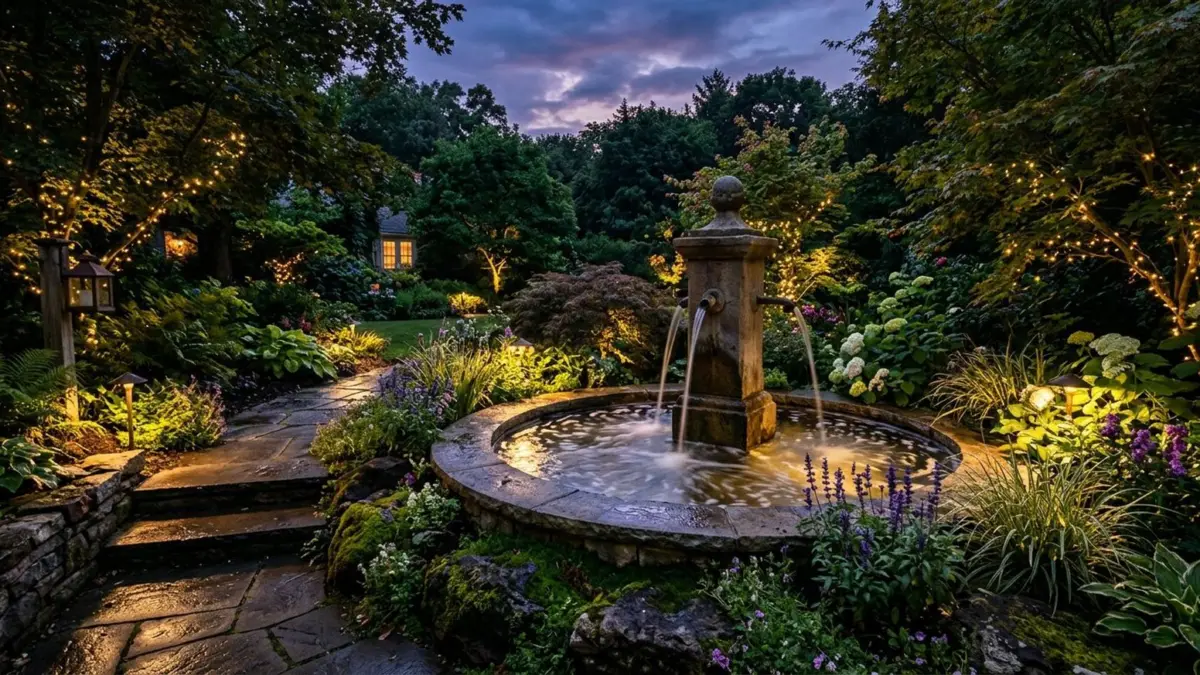
Most gardens are designed for midday. A moon garden is designed for the hours that follow, when you have finished work, the heat has eased and the garden finally becomes a place to sit. In the half-light of dusk, white flowers seem to float, silver leaves shimmer and scent drifts through the air. It is one of the most atmospheric and rewarding ways to plant a small space.
This guide gives you plant lists, layout ideas and lighting advice for creating a moon garden. It belongs to the Water Features & Lighting pillar and combines with Garden Lighting Design, Water Features for Small Gardens and Garden Color Theory.
The principles of a moon garden
- Pale colour: the eye sees white, cream, pale yellow, pale pink and silver far longer than reds and blues as light fades.
- Silver and grey foliage: reflects light and gives the garden structure through the year.
- Fragrance after dark: many flowers release their strongest scent in the evening to attract moths.
- Texture and shape: with colour muted, form matters: spires, rounded domes, feathery grasses.
- Reflection: water, pale paving, light gravel and a whitewashed wall bounce light around.
Plants for a moon garden
| Plant | Type | Why it works | Notes |
|---|---|---|---|
| Moonflower (Ipomoea alba) | Annual climber | Large white flowers open at dusk | Needs warmth and support; seeds are toxic |
| Night-blooming jasmine, “raat ki rani” (Cestrum nocturnum) | Shrub | Strong night fragrance | Frost-tender; plant away from bedroom windows as scent is very strong |
| Jasmine (Jasminum sambac, J. officinale) | Climber/shrub | Scented white flowers | Train on trellis |
| Tuberose (Polianthes tuberosa) | Bulb | Heavy evening scent | Plant in warm weather |
| Evening primrose (Oenothera biennis) | Biennial | Yellow flowers open at dusk | Self-seeds freely |
| Nicotiana alata (flowering tobacco) | Annual | White tubular flowers, scent at night | All parts toxic if eaten |
| White cosmos, white zinnia | Annual | Pale, long-flowering | Easy from seed |
| White roses | Shrub/climber | Glow in low light, scented | Choose repeat-flowering varieties (see How to Grow Roses) |
| Lamb’s ears (Stachys byzantina) | Perennial | Soft silver foliage | Prefers dry, sunny, well-drained soil |
| Artemisia (Silver Mound, Powis Castle) | Perennial | Fine silver foliage | Drought tolerant |
| Dusty miller (Jacobaea maritima) | Annual/tender perennial | Silver lace leaves | Excellent edging |
| White hydrangea (Annabelle, panicle types) | Shrub | Big pale heads, visible at night | Needs moisture |
| Hostas with white or cream variegation | Perennial | Brighten shady spots | Protect from slugs |
| Ornamental grasses (Stipa, Miscanthus) | Perennial | Movement and silvery seed heads | Cut back in late winter |
Step by step: design your moon garden
- Choose the place. Pick the area you use in the evening: beside a patio, bench or window, with a view from indoors as well.
- Make a pale backdrop. A whitewashed wall, white trellis or light-coloured fence reflects light; dark backdrops make white flowers pop even more.
- Build the framework. Plant a few evergreens or silver shrubs (lavender, santolina, silver olive, artemisia) for structure.
- Add the scent layer. Plant jasmine, roses, tuberose and nicotiana near seating where you will smell them.
- Fill with flowers. Use white and pale perennials and annuals in drifts, mixing heights and shapes.
- Add reflection. A small pool, a mirror ball or light gravel and pale stone enhance the glow.
- Light very gently. Use two or three warm uplights on a specimen tree or fragrant climber and a lantern on the table.
Lighting a moon garden
The aim is a hint of light, not a glare. Use warm white (2700K) low-lumen fixtures, hide the bulbs and avoid lighting every plant. A single spotlight on a silver tree or a pair of lanterns often suffices. Solar lanterns with warm light suit the theme (see Installing Solar Garden Lights). Turn lights off to see the plants glow on bright moonlit nights.
Wildlife and the night garden
Night-scented flowers evolved to attract moths, which are important pollinators and a food source for bats and birds. Avoid insecticides, leave some wild corners, and consider a shallow dish of water for visitors. Keep light levels low to avoid disrupting nocturnal wildlife.
Care and maintenance
- Deadhead white flowers promptly; browning petals look shabby in low light.
- Prune silver shrubs lightly in spring to keep them compact (see Shrub Maintenance and Renewal Pruning).
- Water deeply and mulch with pale gravel for Mediterranean-type plants.
- Take cuttings of tender perennials such as dusty miller in late summer (see Propagation by Cuttings).
Common errors and how to avoid them
- Putting the garden where you never sit in the evening
- Over-lighting, which destroys the effect
- Choosing only flowers; foliage keeps the garden interesting in daylight and in winter
- Planting silver plants in wet, shady soil where they rot
- Planting very strong-scented shrubs right beneath bedroom windows
Shortcuts worth knowing
- Include some flowers that open in the evening so there is always something new to see at dusk.
- A white pot or urn as a focal point glows even in faint light.
- Visit your garden at dusk and on moonlit nights each season, and adjust plantings to fill gaps.
Keep going from here
Add movement and reflection with Water Features for Small Gardens, light the scene with Garden Lighting Design, and explore planting palettes in Flower Gardening. Back to Water Features & Lighting.
More in Water Features & Lighting
Outdoor Electrical Safety: GFCI, Weatherproofing and When to Call a Professional
Garden lighting, pumps and sockets mix electricity with water. Learn the essentials: RCD/GFCI protection, IP ratings, low-voltage systems, cable protection and which jobs must be left…
Seasonal Lighting Displays: Festive Lights Without the Clutter
Create beautiful festive lighting for Christmas, Diwali, Eid, Ramadan, New Year or any celebration: plan a restrained design, choose outdoor-rated LEDs, wrap trees safely and keep…
Garden Lighting Design: Types, Placement and Mood
Plan a garden lighting scheme in layers: path, accent and ambient light. Learn the main techniques (uplighting, moonlighting, grazing), warm colour temperatures, fixture spacing and how…