Quick answers
- How many lights does a garden need?
- Fewer than most people think. Light a few key features (a tree, a path, a seating area) rather than everything. Over-lighting flattens the garden and wastes energy.
- What colour temperature is best for gardens?
- Warm white, 2700K to 3000K. It flatters foliage, wood and stone and is less disruptive to wildlife than cool white or blue-toned light.
- What is the difference between uplighting and moonlighting?
- Uplighting aims a fixture upward from the ground to highlight a tree or wall. Moonlighting places fixtures high in a tree, pointing down, to create soft, dappled light like moonlight.
- Should I choose low-voltage or mains lighting?
- Low-voltage 12V LED systems are safer, easier to install and adjust, and use little power. Mains lighting is for large, fixed fittings and must be installed by a qualified electrician.
Key takeaways
- Think in layers. Combine path light, accent light and soft ambient glow.
- Light features, not the whole garden. Darkness makes the lit parts stand out.
- Choose warm white (2700–3000K) LEDs for natural colour and less wildlife disturbance.
- Hide the fixture, show the effect. Position lights to avoid glare at eye level.
- Use 12V low-voltage systems for flexibility, and test the layout before fixing anything.
- Add timers or sensors. Lights that switch off at night save energy and respect neighbours.
Table of contents10 sections
- The three layers of garden lighting
- Lighting techniques and where to use them
- Choose the right light colour and brightness
- Step by step: plan your scheme
- Placing path and border lights
- Low-voltage versus mains versus solar
- Respect wildlife and neighbours
- Pitfalls to watch for
- Quick wins to try first
- Continue with these guides
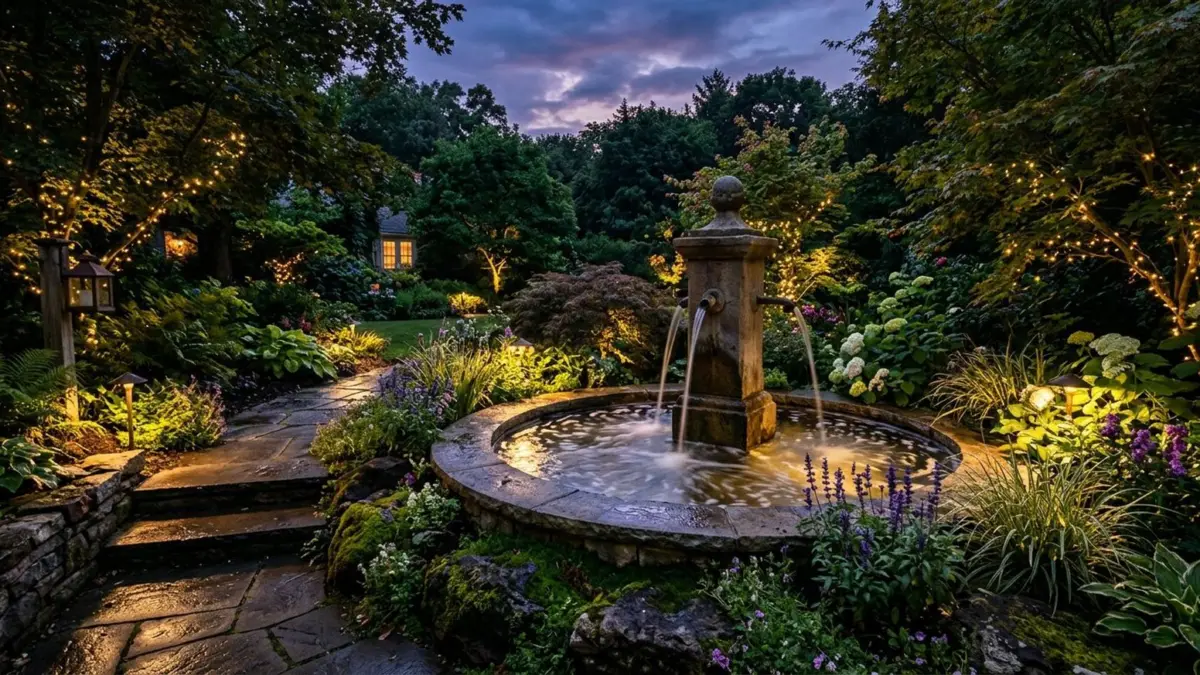
A well-lit garden is a second garden. The same space that is green and busy by day becomes mysterious and calm after dusk, and the way you light it decides whether it feels magical or like a car park. Good garden lighting is rarely about brightness. It is about choosing what to reveal, what to leave in shadow and how to make the transition between the two feel natural.
This guide explains the types of garden light, the main lighting techniques, how to plan a scheme and how to avoid common mistakes. It belongs to the Water Features & Lighting pillar and goes with Installing Solar Garden Lights and Outdoor Electrical Safety.
The three layers of garden lighting
Professional designers think in layers, exactly as they do with planting. A scheme with all three feels rich; a scheme with only one feels flat.
- Ambient light: soft background glow that lets you move and feel comfortable, such as festoon lights over a patio or lanterns on a table.
- Task and path light: practical light for steps, paths, doors and cooking areas (see Lighting for Safety and Security).
- Accent light: focused light on trees, sculpture, walls, water and architectural plants, which creates depth and drama.
Lighting techniques and where to use them
| Technique | How it works | Best for |
|---|---|---|
| Uplighting | Spotlight at ground level aimed up | Trees with interesting trunks and canopies, tall grasses, walls |
| Downlighting / moonlighting | Fixture mounted high, aimed down through branches | Soft pools of light on paths, patios and lawns with dappled shadows |
| Grazing | Light placed close to a textured surface | Stone, brick and bark walls, which reveals texture |
| Silhouetting | Light placed behind a plant, aimed at a wall | Spiky or sculptural plants such as agave, grasses and palms |
| Spread / path lighting | Low fixtures casting a pool of light | Paths, borders, steps |
| Underwater lighting | Submersible LEDs | Ponds, fountains and pools (see Pond and Water Garden Basics) |
| String and festoon lights | Warm bulbs on a wire or pergola | Dining areas, pergolas, trees |
Choose the right light colour and brightness
- Warm white (2700–3000K) makes greens look natural and wood and stone glow. Avoid 4000K+ “daylight” bulbs, which look harsh and clinical outside.
- Brightness is measured in lumens: path lights usually need 50–150 lumens, accent spots 100–300, and security lights 300–700.
- Beam angle matters: narrow beams (15–25°) pick out a single trunk; wide beams (60°) wash over a hedge or wall.
- Prefer LED: they use around 80% less energy, last for tens of thousands of hours and come in warm colours.
Step by step: plan your scheme
- Walk the garden at dusk. Note what you see from the windows and the terrace. Those are the views to light.
- Choose 3–5 focal points: a specimen tree, a sculpture, a water feature, a handsome wall.
- Plan the routes. Mark where you walk: paths, steps, doors, the way to the shed or gate.
- Decide the mood. Relaxed dining? Dramatic entertaining? Quiet reading corner? This sets the brightness.
- Sketch a layout with fixture types, positions and cable runs, and note where you need power.
- Test before you fix. After dark, hold or place temporary fixtures where planned and adjust angle and distance.
- Install and tweak. Fine-tune once plants have grown or the seasons have changed.
Placing path and border lights
- Space path lights 2–3 m (6–10 ft) apart; stagger them on both sides for even, soft light.
- Keep them back from the path edge so light falls onto the path, not into your eyes.
- Use taller shielded fixtures in borders so the source is hidden by planting.
- Light steps from the side or underneath each tread rather than from the front.
Low-voltage versus mains versus solar
| System | Pros | Cons |
|---|---|---|
| 12V low-voltage LED | Safe to handle, flexible, cheap to run, easy to add to | Needs a transformer and cable runs; voltage drop on long runs |
| Mains (230V/120V) | Powerful for large or fixed fittings | Needs a qualified electrician, armoured cable and RCD/GFCI protection |
| Solar | No cables, no running cost, quick to install | Lower, less reliable output; needs sun (see Installing Solar Garden Lights) |
For most homeowners, a 12V LED system is the sweet spot. Size the transformer to at least 20% more than the total wattage of all fixtures. See Outdoor Electrical Safety before you start.
Respect wildlife and neighbours
- Use shielded, downward-facing fixtures to prevent light spilling upward or into neighbouring windows.
- Switch lights off late at night with a timer; most gardens do not need lighting after midnight.
- Choose warm colours; blue-rich light disrupts insects, birds and bats.
- Avoid lighting hedges and ponds continuously, since wildlife uses those as dark corridors.
Pitfalls to watch for
- Lighting everything evenly, which flattens the garden
- Pointing bright fixtures at eye level so they dazzle
- Choosing cool white lamps that make plants look grey
- Skipping a test run before fixing positions
- Forgetting to plan for growth: shrubs soon hide low lights
- Installing mains cabling without protection or professional help
Quick wins to try first
- Use dimmers and zones so you can change the mood between dinner and quiet evenings.
- Light water from within and light the planting around it from the side for the best reflections.
- Photograph your garden at night each season and adjust fixtures as plants mature.
Continue with these guides
Combine light with water in Water Features for Small Gardens, create a night-time planting scheme with Creating a Moon Garden, and plan celebrations with Seasonal Lighting Displays. For the wider picture see Water Features & Garden Lighting in the Garden Design pillar. Back to Water Features & Lighting.
More in Water Features & Lighting
Installing Solar Garden Lights: Where, How and When They Work
Solar lights are the easiest way to add evening glow. Learn where to place them for full charge, how to choose quality fixtures, how to install…
Water Features for Small Gardens: Fountains, Bubblers and Bird Baths
You do not need a pond to enjoy water in the garden. Learn how to choose and install bubble fountains, wall spouts, container water gardens and…
Pond and Water Garden Basics: Planning, Plants and Maintenance
Build a wildlife pond or ornamental water garden that stays clear and balanced. Learn site choice, depth zones, liners, plants, fish, a simple filter setup and…