Quick answers
- How do I decorate the garden with lights without it looking cluttered?
- Choose one or two ideas, such as a lit tree, a lantern-lined path or a warm string of lights over a pergola. Use a single warm colour and repeat it.
- Are LED string lights safe for trees and shrubs?
- Yes, if they are outdoor-rated. LEDs run cool and use little power. Wrap loosely, avoid wires cutting into bark, and remove them after the season.
- How many light strings can I connect together?
- Check the maker's limit on the packaging; LED strings often allow 10–40 sets end to end, but incandescent ones only 3–5. Overloading causes overheating and fires.
- When should I take lights down?
- Remove tree wraps soon after the festival; leaving them for months can damage bark and plants. Store lights coiled on a reel or card in a dry box.
Key takeaways
- Edit your display. One or two focal ideas look classier than lights everywhere.
- Use warm white or a single festive colour for a consistent, elegant effect.
- Choose outdoor-rated LEDs. They are cooler, cheaper to run and last for years.
- Wrap loosely and temporarily. Keep wires from cutting into trees.
- Use timers and safe, RCD-protected power. Never overload sockets.
- Store carefully after the season and test before putting up next year.
Table of contents10 sections
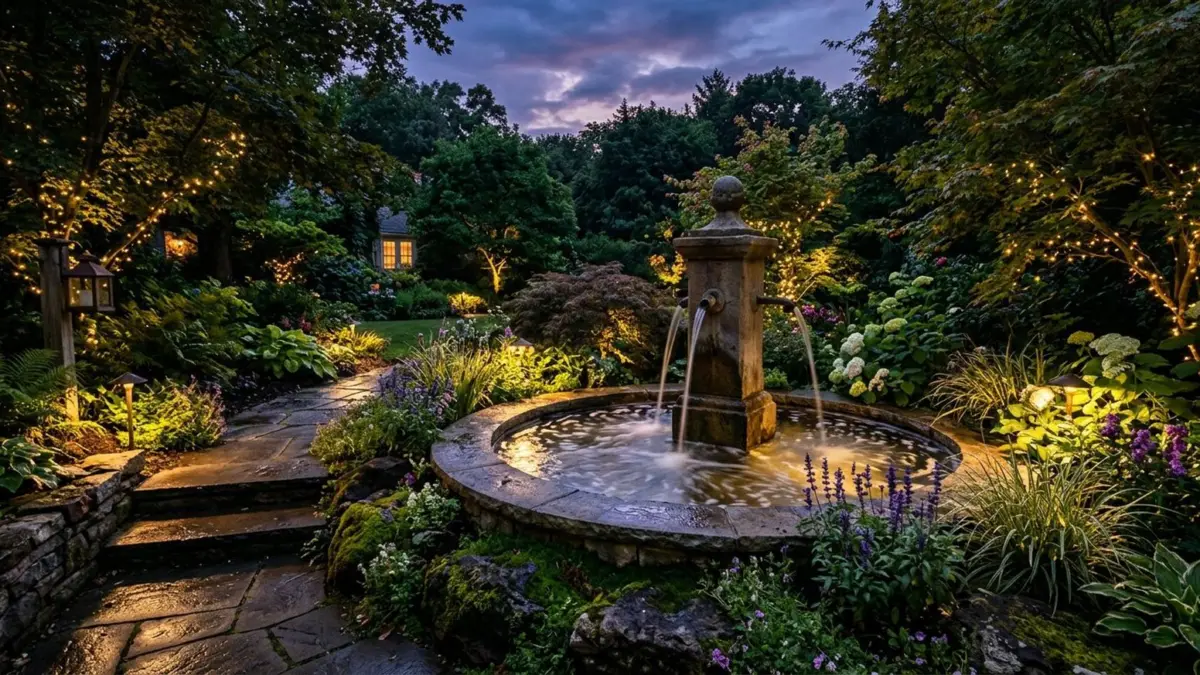
Festivals, weddings, Ramadan and Eid, Diwali, Christmas, New Year: across cultures, light is how people mark celebration. A garden is a wonderful stage for it, and you do not need to cover every surface to make an impression. The most beautiful displays are often the simplest: a single tree wrapped in warm lights, a path lined with lanterns or a canopy of fairy lights over the dining table.
This guide shows how to plan, install and store festive garden lighting safely and stylishly. It is part of the Water Features & Lighting pillar and uses the ideas from Garden Lighting Design and Outdoor Electrical Safety.
Plan before you plug in
- Decide the story. Is it a welcome at the gate, a dinner under a canopy of lights or a tree as the centrepiece? Choose one or two ideas.
- Pick a palette. Warm white suits every occasion; add one accent colour (gold, amber, green or red) rather than a rainbow.
- Walk the garden at dusk and choose where the lights will be seen: from windows, the street and the seating area.
- Measure. A tree trunk and main branches need roughly 100–200 lights per metre of height for a rich look; a pergola needs strings spaced about 30–40 cm apart.
- Plan power. Mark socket positions, add an RCD/GFCI adapter and calculate the total load.
- Set timers. Switch on at dusk and off at a sensible hour, saving electricity and respecting neighbours and wildlife.
Ideas that always work
- Lit tree: wrap the trunk and larger branches with warm LED strings, or hang curtain lights from the lower canopy.
- Lantern path: line a path with lanterns, jars with tea-lights (LED for safety) or solar fairy lights.
- Canopy of lights: string festoon lights in zigzags over a pergola or dining area.
- Fence and wall: a simple line of lights under the top rail or along a wall creates a glowing frame.
- Pots and planters: tuck battery or solar lights into pots of evergreens and winter plants.
- Water and reflection: floating LED candles or underwater lights make a pond or bowl glow (see Water Features for Small Gardens).
Choosing the lights
| Type | Best for | Notes |
|---|---|---|
| LED fairy / string lights | Trees, shrubs, fences | Cool to touch, efficient; check outdoor rating (IP44+) |
| Festoon (bulb string) lights | Pergolas, patios | Larger bulbs, warm glow; need robust support |
| Curtain / icicle lights | Walls, canopies, eaves | Quick to hang; dense light |
| Net lights | Hedges and shrubs | Fast coverage; keep hedge healthy |
| Lanterns and candle holders | Paths, tables, steps | Use LED candles outdoors in dry vegetation |
| Solar string lights | Places without power | Dimmer and shorter run time (see Installing Solar Garden Lights) |
| Projectors and spotlights | Quick effects on walls | Use sparingly; can look gaudy |
Always check the box for an outdoor rating (usually IP44 or higher), the maximum number of sets that can be connected and whether the plug and transformer are weatherproof.
Installing safely
- Test each string indoors before you hang it, and discard damaged or frayed sets.
- Use outdoor extension leads and plug into an RCD/GFCI-protected socket.
- Keep connections off the ground, in a weatherproof box or hung with a drip loop.
- Do not overload. Respect the maximum number of strings and the socket rating.
- Secure with plastic clips or ties, not metal staples or nails, which can damage wires and trees.
- Use a stable ladder with a helper when lighting trees, and never climb in wet or windy weather.
Wrapping trees and shrubs without harm
- Start at the base. Anchor the plug end near the trunk bottom and work upward in loose spirals about 10–15 cm apart.
- Do not pull tight. Leave room for growth; tight wire cuts bark, especially on young trees.
- Follow branches out from the trunk, keeping lights on the upper surface rather than hanging underneath.
- Remove promptly after the celebration, ideally within 4–8 weeks, to avoid damage and nesting issues.
Be considerate
- Turn lights off by a reasonable hour; birds and insects are disturbed by continuous light.
- Aim lights so they do not shine into neighbours’ windows.
- Choose LED to keep energy use low; an LED string uses a fraction of the power of old bulbs.
- Avoid flashing patterns, which are tiring and can disturb neighbours.
Clean-up and storage
- Take lights down on a dry day; coil them loosely around a card or reel to avoid tangles.
- Test each set and mark any that need replacement.
- Store in a labelled, dry container away from heat and rodents.
- Keep spare bulbs and fuses with each set.
Mistakes that cost the most
- Using indoor lights outdoors
- Daisy-chaining too many sets so cables overheat
- Leaving tree wraps for months or years
- Using many colours and effects at once, which looks chaotic
- Hanging connections in puddles or against wet walls
Tips that make it easier
- Use smart plugs or timers; they let you schedule lights without going outside.
- Photograph the display at dusk and keep a note of how many strings you used, for next year.
- Combine a few permanent warm lights with seasonal accents so the garden always feels welcoming.
What to read next
Learn core lighting principles in Garden Lighting Design, protect your circuits with Outdoor Electrical Safety, and use Seasonal Gardening to plan the whole year. Back to Water Features & Lighting.
More in Water Features & Lighting
Garden Lighting Design: Types, Placement and Mood
Plan a garden lighting scheme in layers: path, accent and ambient light. Learn the main techniques (uplighting, moonlighting, grazing), warm colour temperatures, fixture spacing and how…
Installing Solar Garden Lights: Where, How and When They Work
Solar lights are the easiest way to add evening glow. Learn where to place them for full charge, how to choose quality fixtures, how to install…
Water Features for Small Gardens: Fountains, Bubblers and Bird Baths
You do not need a pond to enjoy water in the garden. Learn how to choose and install bubble fountains, wall spouts, container water gardens and…