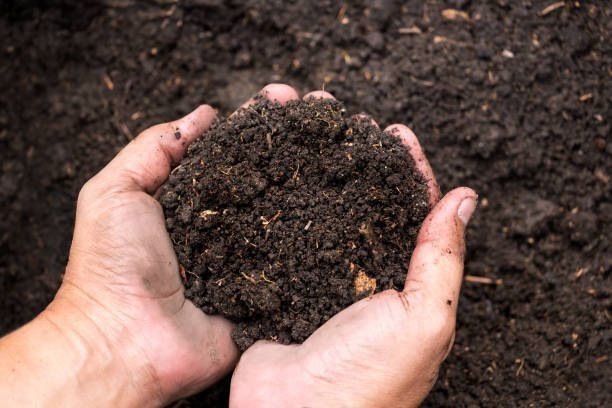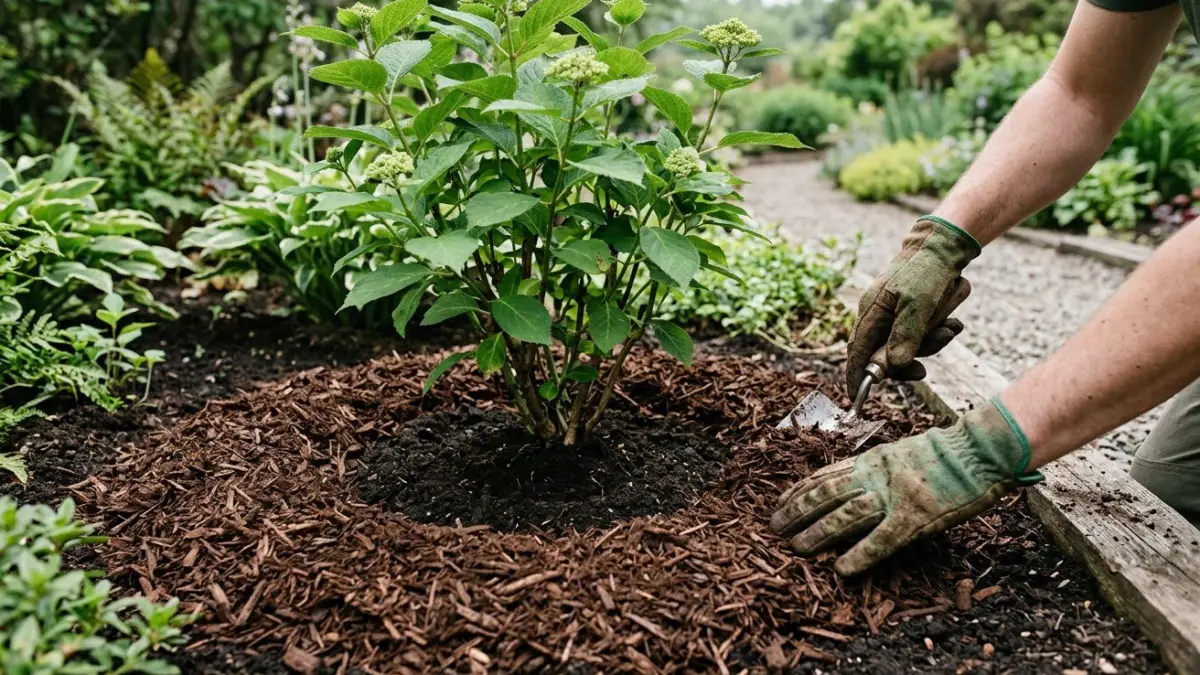
If gardening allowed only one habit, professionals would choose mulching. A correct 5–8 cm layer simultaneously cuts watering, suppresses weeds, buffers soil temperature, prevents disease splash and — with organic mulches — feeds the soil for free. No other investment returns this much.
Mulch Rules of Thumb
- Depth: 5–8 cm organic; 2–3 cm fine; stone 2–4 cm
- Keep 10 cm clear around stems and trunks — donut, never volcano
- Replenish organic mulch yearly — it is feeding your soil
- Mulch after rain or deep watering to lock moisture in
Choose by Job
Organic (straw, wood chips, bark, leaves, compost)
Feeds soil as it breaks down, moderates temperature beautifully, needs annual topping. Wood chips for beds and trees, straw for vegetables (seed-free only), leaf mold for woodland and shade gardens — the making of leaf mold is a variant of our compost method.
Inorganic (gravel, pebbles, landscape rock)
Permanent, tidy, heat-retentive — excellent in arid and Mediterranean-style schemes and around succulents, wrong for hungry vegetable beds since it feeds nothing. Dark stone in full sun cooks shallow roots; choose light colors in hot climates.
Apply It Correctly (Most People Don’t)
Water deeply first, weed the area, then spread mulch like a donut — generous everywhere except the 10 cm collar around stems and trunks where bark must breathe. Volcano mulch against trunks rots bark and hosts rodents: it is the most common mulch crime, and it kills trees slowly per our tree care guide. On vegetables, keep mulch back from young stems and add it only after soil warms in spring — early mulch insulates cold soil, delaying the crops in our calendar.
The Compound Interest Effect
Organic mulch decomposes into worm food and fungal highways — the soil life celebrated in our allies guide — which improves structure per our soil type guide, which holds more water, which reduces watering further. Three years of mulching visibly transforms clay or sand.
Common Mistakes to Avoid
- Using dyed construction-waste mulch on food beds.
- Fresh wood chips dug into soil — they rob nitrogen at the roots; mulch on top only.
- 2 cm “sprinkle mulching” — too thin to suppress weeds; depth is the mechanism.
Frequently Asked Questions
Does mulch attract termites?
Wood chips near foundations can — keep mulch 30 cm+ from house walls and prefer gravel in that band. In open beds, termites pose little added risk.
Can I mulch with grass clippings?
Thin layers, dry, herbicide-free only — wet clumps mat and slime. Compost them first for best results, per our compost guide.
You have completed the foundation path! Revisit the hub anytime — everything you grow above it will thank you.
The Irrigation Walk-Through for mulching
Monthly, walk the system end to end in fifteen minutes: filter opened and rinsed, first and last emitter compared (rate mismatch = pressure or clog), line ends flushed until clear, timer battery and program checked against the season, and one probe-test at the far bed to confirm depth wetted. Log runtimes and rainfall beside the timer.
The walk’s payoff is invisible until the heatwave, when the system that was verified keeps watering while the system that was assumed quietly strangles its far end.
The Amendment Safety Rules for mulching
Soil amendments are medicine — dosing matters. Compost: 2–3 cm top-dressing, up to 30% of a bed’s volume when digging new; more ties up nitrogen and loads phosphorus. Lime and sulfur: only after a test, only in the dose the test names, only retested after a season. Manure: composted or aged, never fresh on food beds. Wood ash: a liming agent, not a generic fertilizer — alkaline soils get worse, not better.
The meta-rule: change one variable, measure one season. Soil rewards patience with compounding and punishes enthusiasm with lockout.
Deep Dive: What Experienced Growers Know About mulching
Mulch depth is the mechanism, not decoration: five centimeters blocks light weed seeds need, buffers soil temperature swings, and slows evaporation measurably; two centimeters does none of it. But depth has a ceiling — buried stems and flares rot under generosity. The professional’s calibration: 5–8 centimeters everywhere, zero within ten of any stem or trunk. Measure it once with a ruler; most ‘mulched’ gardens turn out to be sprinkled.
Key Takeaways
- Matric Potential: The tension with which soil particles hold water; texture decides it.
- Browns/Greens: Carbon materials vs nitrogen materials; the compost ratio's two hands.
- Dripline Irrigation: Tubing with built-in emitters at fixed spacing — beds and hedges.
- Top-Dressing: Compost layered on soil surface, worked in by worms, not shovel.
More Questions About Mulching
Should soil be wet before mulching?
Yes — mulch locks existing moisture in or out. Water deeply first, then mulch; dry-soil mulching seals drought in.
Can I mulch with fresh grass clippings?
Thin, dry, herbicide-free layers only — wet clumps mat into slime. Composted clippings are the better form.
Does mulch attract termites?
Wood chips near foundations can. Keep a 30 cm gravel band at the house wall; in open beds the risk is minor.
Field Questions Answered
Do I need to test before every fertilizer purchase?
Plants are the test: read symptoms first, buy second. The soil lab test every 2–3 years keeps the purchases honest.
How do I improve soil without digging?
Top-dress compost twice yearly, mulch 5–8 cm deep, and let worms do the incorporation — no-dig beds build structure faster than forked ones.
Is rainwater really better for plants?
Yes — soft, slightly acidic, unchlorinated, and at ambient temperature. Every collector pays for itself in seedling health and acid-loving plants.
What's the fastest legal way to compost?
Hot composting: one cubic meter minimum, finely chopped materials, balanced greens-browns, turned weekly — finished in 6–10 weeks.
Common Mistakes to Avoid with Mulching
- Working clay soil wet — one spadeful bakes into pottery for the season.
- Sand plus clay 'to fix' clay: the recipe is brick. Compost is the fix.
- Liming 'just in case', locking out a new set of nutrients.
- Fertilizing a mystery problem instead of diagnosing it first.
- Bloom-booster phosphorus everywhere; most soils already hold decades' worth.
Further Field Questions
How do I improve soil without digging?
Top-dress compost twice yearly, mulch 5–8 cm deep, and let worms do the incorporation — no-dig beds build structure faster than forked ones.
Is rainwater really better for plants?
Yes — soft, slightly acidic, unchlorinated, and at ambient temperature. Every collector pays for itself in seedling health and acid-loving plants.
What's the fastest legal way to compost?
Hot composting: one cubic meter minimum, finely chopped materials, balanced greens-browns, turned weekly — finished in 6–10 weeks.
Can I fertilize and water at once?
Yes — fertigation through dilute feed in the watering can suits containers especially. Half-strength, weekly, after a plain-water flush monthly.
How deep should mulch be on clay vs sand?
Clay: 5 cm — thicker stays wet too long. Sand: up to 8 cm — every millimeter of protection counts against the strainer effect.
Do I need to test before every fertilizer purchase?
Plants are the test: read symptoms first, buy second. The soil lab test every 2–3 years keeps the purchases honest.
Further Field Questions
How do I improve soil without digging?
Top-dress compost twice yearly, mulch 5–8 cm deep, and let worms do the incorporation — no-dig beds build structure faster than forked ones.
Is rainwater really better for plants?
Yes — soft, slightly acidic, unchlorinated, and at ambient temperature. Every collector pays for itself in seedling health and acid-loving plants.
What's the fastest legal way to compost?
Hot composting: one cubic meter minimum, finely chopped materials, balanced greens-browns, turned weekly — finished in 6–10 weeks.
Can I fertilize and water at once?
Yes — fertigation through dilute feed in the watering can suits containers especially. Half-strength, weekly, after a plain-water flush monthly.
How deep should mulch be on clay vs sand?
Clay: 5 cm — thicker stays wet too long. Sand: up to 8 cm — every millimeter of protection counts against the strainer effect.
Do I need to test before every fertilizer purchase?
Plants are the test: read symptoms first, buy second. The soil lab test every 2–3 years keeps the purchases honest.
Further Field Questions
How do I improve soil without digging?
Top-dress compost twice yearly, mulch 5–8 cm deep, and let worms do the incorporation — no-dig beds build structure faster than forked ones.
Is rainwater really better for plants?
Yes — soft, slightly acidic, unchlorinated, and at ambient temperature. Every collector pays for itself in seedling health and acid-loving plants.
What's the fastest legal way to compost?
Hot composting: one cubic meter minimum, finely chopped materials, balanced greens-browns, turned weekly — finished in 6–10 weeks.
Can I fertilize and water at once?
Yes — fertigation through dilute feed in the watering can suits containers especially. Half-strength, weekly, after a plain-water flush monthly.
How deep should mulch be on clay vs sand?
Clay: 5 cm — thicker stays wet too long. Sand: up to 8 cm — every millimeter of protection counts against the strainer effect.
Do I need to test before every fertilizer purchase?
Plants are the test: read symptoms first, buy second. The soil lab test every 2–3 years keeps the purchases honest.
Further Field Questions
How do I improve soil without digging?
Top-dress compost twice yearly, mulch 5–8 cm deep, and let worms do the incorporation — no-dig beds build structure faster than forked ones.
Is rainwater really better for plants?
Yes — soft, slightly acidic, unchlorinated, and at ambient temperature. Every collector pays for itself in seedling health and acid-loving plants.
What's the fastest legal way to compost?
Hot composting: one cubic meter minimum, finely chopped materials, balanced greens-browns, turned weekly — finished in 6–10 weeks.
Can I fertilize and water at once?
Yes — fertigation through dilute feed in the watering can suits containers especially. Half-strength, weekly, after a plain-water flush monthly.
How deep should mulch be on clay vs sand?
Clay: 5 cm — thicker stays wet too long. Sand: up to 8 cm — every millimeter of protection counts against the strainer effect.
Do I need to test before every fertilizer purchase?
Plants are the test: read symptoms first, buy second. The soil lab test every 2–3 years keeps the purchases honest.
Further Field Questions
How do I improve soil without digging?
Top-dress compost twice yearly, mulch 5–8 cm deep, and let worms do the incorporation — no-dig beds build structure faster than forked ones.
Is rainwater really better for plants?
Yes — soft, slightly acidic, unchlorinated, and at ambient temperature. Every collector pays for itself in seedling health and acid-loving plants.
What's the fastest legal way to compost?
Hot composting: one cubic meter minimum, finely chopped materials, balanced greens-browns, turned weekly — finished in 6–10 weeks.
Can I fertilize and water at once?
Yes — fertigation through dilute feed in the watering can suits containers especially. Half-strength, weekly, after a plain-water flush monthly.
How deep should mulch be on clay vs sand?
Clay: 5 cm — thicker stays wet too long. Sand: up to 8 cm — every millimeter of protection counts against the strainer effect.
Do I need to test before every fertilizer purchase?
Plants are the test: read symptoms first, buy second. The soil lab test every 2–3 years keeps the purchases honest.
Further Field Questions
How do I improve soil without digging?
Top-dress compost twice yearly, mulch 5–8 cm deep, and let worms do the incorporation — no-dig beds build structure faster than forked ones.
Is rainwater really better for plants?
Yes — soft, slightly acidic, unchlorinated, and at ambient temperature. Every collector pays for itself in seedling health and acid-loving plants.
What's the fastest legal way to compost?
Hot composting: one cubic meter minimum, finely chopped materials, balanced greens-browns, turned weekly — finished in 6–10 weeks.
Can I fertilize and water at once?
Yes — fertigation through dilute feed in the watering can suits containers especially. Half-strength, weekly, after a plain-water flush monthly.
How deep should mulch be on clay vs sand?
Clay: 5 cm — thicker stays wet too long. Sand: up to 8 cm — every millimeter of protection counts against the strainer effect.
Do I need to test before every fertilizer purchase?
Plants are the test: read symptoms first, buy second. The soil lab test every 2–3 years keeps the purchases honest.