Quick answers
- How do I know if my new tree is established?
- An established tree shows new root growth and the ability to go a week without watering in summer without wilting. This typically takes 1-3 years.
- When should I stake a newly planted tree?
- Only when the tree is in a windy location or the root ball is unstable. Most trees establish better without stakes. Remove stakes after one year.
- How much should I prune a young tree?
- Remove only what is clearly wrong: broken, diseased, crossing, and narrow-angle branches. Do not over-prune.
- Why are my tree leaves yellowing?
- Yellow leaves have many causes: overwatering, underwatering, nutrient deficiency, root problems, or natural aging. The pattern tells the story.
Key takeaways
- Right plant, right place is non-negotiable. A tree in the wrong conditions will fail no matter how carefully you care for it.
- Root establishment in the first three years defines the tree future. Prioritise roots over height.
- Plant at the root flare. Too deep is the most common cause of tree decline in home landscapes.
- Pruning follows bud biology, not calendar dates. Cuts heal from surrounding wood.
- Disease prevention beats treatment. Vigorous trees with minimal wounds rarely need sprays.
- Mycorrhizal fungi are partners, not additives. Most landscape trees arrive colonised.
- Autumn is the best planting season in most climates. Warm soil and cool air align perfectly.
- Watch the tree, not the calendar. A tree will tell you what it needs through its appearance.
Table of contents51 sections
- The Longest Decision in Gardening
- How to Use This Hub
- The Seasonal Rhythm of Trees
- Your First 30 Days with Trees
- The Science, Briefly
- 10 Mistakes That Sink Gardeners in This Topic
- Myths Worth Retiring
- The Toolkit: What You Actually Need
- Plain-Language Glossary
- Regional Notes
- How This Hub Connects to the Rest of the Site
- The Deeper Why: Planting Time You Cannot Buy Back
- Advanced Field Notes
- Common Objections, Answered
- Three Field Confessions
- The 7-Day Starter Plan
- When is the very best time to plant a tree?
- How often should a newly planted tree be watered?
- Can I fix a tree that was planted too deep years ago?
- Is it too late to prune an overgrown tree this year?
- Why did my tree not leaf out this spring?
- Which fruit tree gives harvest soonest?
- How close to a wall is safe for planting?
- Do palms need special fertilizer or is that marketing?
- Should I remove the burlap and wire basket?
- What kills more trees than pests?
- Is it safe to change the soil grade around a mature tree?
- Why is my tree dropping green leaves?
- Do tree wound dressings help after storm damage?
- How long do tree stakes stay on?
- What's the best single tree investment?
- Can I grow fruit trees in shade?
- Guides at a Glance
- Revision Cards: The Guides at a Glance
- Seasonal Checklist, Condensed
- Pace Yourself: The Long View
- Advanced Vocabulary, Applied
- Study Notes: The Guides in Brief
- Frequently Asked: The Index
Ask any experienced gardener what they wish they had planted first, and the answer is almost always the same: the trees. Trees cool your home, feed your family, hold your soil and raise the value of everything around them, but only if they start life right.
This hub is the complete tree path: planting a tree the professional way, choosing shade trees, starting a home orchard, pruning safely, caring for palms and tropicals and watering and mulching for deep roots. Each guide stands alone, and each links back to this hub and to its siblings.
New to gardening? Warm up first with the core growing guides, then return here to plant something that will still be giving shade to your grandchildren.
The Longest Decision in Gardening
Every other plant in your garden offers an annual reset. Trees do not: they are a decision you live inside for decades, the bones of the property, the shade your children will argue under. That permanence is exactly why tree skills pay the highest interest in all of gardening, a correct planting echoes for fifty years, and so does a mistake.
The encouraging news is that tree care is a small set of non-negotiables, not an encyclopedic science. Find the root flare. Dig wide, not deep. Water the dripline. Prune outside the branch collar. Mulch like a donut, never a volcano. Each rule in this hub exists because trees fail predictably when it is broken, and each is fully explained, with the reasoning attached, in the guides below.
Trees also repay patience with use. One healthy shade tree cools a west wall by several degrees, drinks gallons of storm water that would otherwise flood, and lifts property values more than any other single planting. No other garden investment keeps compounding while you sleep.
Start with the planting guide even if your trees are already in the ground, the root-flare rule retrofits to every tree you own, then choose your path: shade, orchard, palms or the watering discipline that holds it all together.
How to Use This Hub
| Guide | What you will learn | Time to apply |
|---|---|---|
| How to Plant a Tree Properly | The root-flare rule, wide holes, and staking that actually helps | One morning per tree |
| Best Shade Trees for Home Gardens | Matching mature size, roots and litter to your real space | One planning session |
| Fruit Trees for Beginners | Chill hours, pollination pairs, and the fastest path to harvest | A season of setup |
| How to Prune Trees Safely | Thinning vs heading, the three-cut method, and timing | Ongoing, light annual touch |
| Palm & Tropical Tree Care | Palm-specific feeding, frond rules and frost rescue | Seasonal rounds |
| Tree Watering and Mulching | The deep-root method and the donut that halves stress | A season to establish |
The Root-Flare Rule
Every woody plant has a visible widening where trunk becomes root, and every year, millions of trees are sold and planted with that flare buried in nursery soil or, worse, by their owners. Buried flare bark slowly suffocates; the tree compensates by growing secondary roots upward, which circle and eventually girdle the trunk. Decline appears three to five years later, by which point no fertilizer connects the cause. Finding the flare before backfilling, and keeping it exposed for life, is the single highest-value skill in this hub.
Matching Tree to Space
Mature size is destiny: the cute sapling under the bedroom window is a 12-meter actor auditioning for your roof and drains. The shade guide filters by mature height and spread, root aggressiveness, litter and water demand, then splits candidates into fast shade (moringa, neem-type toughies), legacy shade (oaks, mahogany) and small-garden dapplers (olive, crape myrtle, frangipani). The quiet principle: plant for the tree’s 20-year self, and let speed be a bonus, never the deciding vote.
Orchard Economics for Beginners
Fruit trees are the rare purchase that pays rent in produce. The beginner guide compresses the decision into three questions: climate fit (chill hours for stone fruit, frost tolerance for mangoes), pollination (self-fertile or partner needed) and graft status (grafted = predictable, early; seedling = lottery). It then names the forgiving seven, led by banana and papaya for speed, guava, lemon, fig, mulberry and pomegranate for toughness, and sets expectations honestly: strip year-one fruit, thin year-two, harvest properly by year three.
Pruning as Conversation
Trees respond to cuts with predictable growth: thinning opens and calms, heading thickens and invigorates locally. The guide teaches both plus the three-cut method that keeps heavy limbs from tearing bark down the trunk, and anchors everything to the branch collar, the tree’s own healing chemistry. Just as important is the no-list: no topping, no flush cuts, no sealant paint, no more than 25% of canopy per year, and never a ladder plus chainsaw combination.
Palms Are Not Trees
One growing point, no bark, no repair cambium, palms demand their own playbook. Potassium and magnesium deficiencies drive most yellow-frond panic; palm-specific feeds with micronutrients fix what general fertilizer worsens. Green fronds are solar panels, so over-trimming (hurricane cutting) starves the crown and weakens the trunk. Transplanting is warmer-season work with intensive early watering, and frost rescue is patience: leave damaged fronds until heat returns and let the spear testify.
Watering Where Roots Actually Are
The dripline, the circle under the outermost leaves, is where feeder roots roam, and where deep water belongs. New trees need the root ball itself kept moist for a season; established trees want a long weekly soak in drought, delivered slowly at the dripline, not a sprinkler kiss at the trunk. Mulch is the second half of the method: an 8 cm organic donut that buffers temperature, feeds soil life and blocks mower string, kept religiously clear of bark.
The Seasonal Rhythm of Trees
Late winter. Structural pruning while bones are visible; plant bare-root and container trees as soil allows. Inspect stakes, ties and mulch rings. Plan orchard orders before nurseries sell out of good stock.
Spring. Establishment watering begins: keep new root balls moist through the first leaf-out. Feed fruit trees lightly once taken. Watch for aphid flush on fresh growth and let the allies work.
Summer. Deep-soak established trees weekly in drought; check young trees twice weekly. No pruning beyond the three D’s in peak heat. Net fruit at first color; thin overloaded branches before they snap.
Autumn. The great planting season: warm soil, cool air, roots grow until the ground chills. Renovate mulch rings, remove spent stakes, and water evergreens deeply before the ground freezes in cold climates.
Your First 30 Days with Trees
Weekend one: audit every tree you own for buried flares, volcano mulch, forgotten stakes and mower wounds. Fixing existing trees outranks buying new ones.
This season: plant one tree correctly, wide hole, flare exposed, berm basin, mulch donut, and set a weekly watering reminder for its first year. Log rainfall so irrigation follows need.
This year: learn one pruning cycle on a tolerant species (mulberry and fig forgive generously). Master the three-cut method on a real branch. Draft your five-year tree map: what you will plant, where, and why against the mature-size filters.
The Science, Briefly
Two pieces of tree physiology explain most of this hub. First, roots need oxygen as much as water: fine roots die in saturated soil within days, which is why deep-planting, compaction and volcano mulch kill slowly and invisibly, symptoms surface years after the cause. Second, trees compartmentalize rather than heal: they seal damaged wood behind chemical barriers at the branch collar, which is why flush cuts and sealant paint backfire, and why correct cuts at the collar close fast and clean. The arborist’s craft is not repairing trees; it is arranging cuts and conditions so trees can seal themselves.
10 Mistakes That Sink Gardeners in This Topic
- Planting with the root flare buried under backfill or mulch.
- Dug a deep narrow hole instead of a wide shallow one.
- Staking tight and forgetting it, sway builds trunk taper; rigid stakes build dependency.
- Amending only the planting hole, creating a pot in the ground roots refuse to leave.
- Pruning more than a quarter of the canopy in one year, forcing weak regrowth.
- Topping tall trees: the regrowth is dangerous, ugly and structurally doomed.
- Heaping mulch against bark, inviting rot, fungus and rodents to the trunk.
- Watering daily sprinkles at the trunk instead of deep soaks at the dripline.
- Choosing species by nursery-row beauty rather than mature size and root habit.
- Ignoring fruit thinning, then losing branches to the weight they were never built for.
Myths Worth Retiring
“Trees should be pruned hard to invigorate them.” Severe reduction forces water-sprout regrowth that is weakly attached. Trees invigorate themselves when roots and flare are right; pruning is correction, not stimulant.
“Wound paint protects cuts.” Research shows sealed cuts trap moisture and slow the compartmentalization trees evolved. Clean cuts at the collar need nothing.
“Deep-burying helps trees resist drought.” Buried flare bark dies; replacement roots circle and girdle. Drought resilience comes from deep-soak training and mulch, not depth.
The Toolkit: What You Actually Need
- A sharp spade and mattock for wide planting holes in tough ground
- Two sturdy stakes plus soft tree ties, used loosely, removed within a year
- Bypass loppers and a pruning saw (folding) sized to real branches, not bravado
- A 15-20 liter bucket with pin-holes as a slow-release watering basin
- A soil probe or long screwdriver to read moisture 30 cm down
- Arborist-grade mulch (wood chips) by the trailer-load, not the boutique bag
- A measuring tape for mature-size planning before, not after, purchase
- Safety glasses and gloves: branches are spring-loaded, eyes are not
Plain-Language Glossary
- Root flare
- The trunk's widening where it meets roots; must stay visible for life.
- Girdling root
- A circling root that strangles the trunk as both widen; prevented by root spreading at planting.
- Dripline
- The ground circle under the outermost foliage where feeder roots concentrate.
- Branch collar
- The swollen junction tissue holding the tree's sealing chemistry; cuts go outside it.
- Compartmentalization
- The process by which trees wall off decay behind chemical barriers.
- Chill hours
- Winter hours below ~7°C that stone fruits count before spring bloom.
- Water sprout
- Vigorous vertical regrowth after heavy topping cuts; weakly attached.
- Thinning cut
- A whole-branch removal to its origin; opens canopy and calms growth.
- Heading cut
- Shortening a branch to a bud; thickens growth below, used sparingly on trees.
- Berm basin
- A low soil ring at the planting edge that holds irrigation water over the roots.
- Hurricane cutting
- Over-trimming palm fronds; starves the crown and weakens the trunk.
- Sunscald
- Bark injury on thin-barked trunks exposed suddenly by over-pruning.
Regional Notes
Hot and dry: autumn planting and first-summer shade protection decide survival; deep-root watering training from year one; species choices lean on drought natives (mesquite, olive, acacia-types). Humid tropics: fast growth means fast structural pruning: form the leader early or wind does it for you; fungal pressure favors open canopies and dry foliage. Cold climates: spring planting after thaw, mulch for root insulation, and thin-barked trunks wrapped against winter sunscald. Coastal and windy: stake longer but looser, choose flexible-wood species, and salt tolerance outranks every ornamental trait.
How This Hub Connects to the Rest of the Site
Trees anchor every other hub: their shade redraws the design plan, their drip line defines the lawn’s edge, their mulch ring feeds the soil hub’s ambitions, and orchard care borrows the pest hub’s scouting discipline. Plant a tree and you have enrolled in every other subject on this site.
The Deeper Why: Planting Time You Cannot Buy Back
The Chinese proverb about planting trees twenty years ago is really an arithmetic lesson: trees are the only garden purchase where time itself is the expensive ingredient. A shrub replaces itself in a season; a tree’s canopy cannot be purchased at any price, only grown. This asymmetry should reorganize every gardener’s priorities: the tree you plant this autumn is the single highest-use act available to you, dwarfing any bed, border or hardscape in eventual effect.
It also explains why tree failures hurt differently. A dead perennial costs a season; a dead tree costs the decade you invested in it, which is why this hub spends so long on the few rules that keep trees alive. The flare, the wide hole, the dripline water, the donut mulch: none is difficult, and together they are the entire difference between the tree that shades your children and the stump you explain to them.
Advanced Field Notes
- Buy in autumn, plant in autumn: nurseries discount as season ends, and warm-soil cool-air planting establishes roots while top growth sleeps.
- The scratch test reads dormancy: green under bark bark-scratch means alive; brown-dry means dead wood, the honest answer before any removal decision.
- Girdling roots announce themselves at the flare: trunk that flares into one side only, or straightens like a telephone pole, means circling roots below, excavate before the trunk thickens into them.
- Fruit thinning is next year’s buds: overloaded branches not only snap this year, the tree, spending everything on seed, sets almost no flower buds for the following spring.
- Watering rings remember: a berm basin built at planting makes every future watering efficient for a decade, build it once, well.
Common Objections, Answered
“Trees are too slow: I want a garden now.” Plant the fast shade for this decade and the legacy tree for the next, in the same hole-season. The combination is the oldest trick in the landscape book.
“My yard is too small for trees.” Multi-trunk and dappled species, olive, crape myrtle, frangipani, cast sitting-height shade under six meters. Small gardens need trees more than large ones; they have no other shade to borrow.
“Professional care is expensive.” One structural consultation at year five costs a fraction of the emergency removal at year fifteen, and the arborist’s corrections compound exactly like the tree does.
Three Field Confessions
The maple I planted deep. My first tree, planted with the root ball two fingers proud, because it looked stable. Five years of thinning crown later, the excavation found the flare six inches under and circling roots starting their girdle. It survived the surgery; I have never buried a flare since, and I excavate every tree I meet now, professionally or otherwise.
The stakes that outlived their welcome. A staked sapling, ties forgotten for three years, grew a waist where the tie held while the trunk above swelled, and snapped in the first real storm at exactly that ring. Stakes are training wheels: on briefly, off early.
The mulch volcano at the rental. Eight inches of bark heaped against a mature magnolia’s trunk by a well-meaning crew. Rot set in quietly over two seasons. The tree taught me that trees die of kindness more often than neglect, and that advising the landlord promptly is cheaper than watching history.
The 7-Day Starter Plan
Day 1: audit every tree you own, flare visible? mulch a donut? stakes forgotten? Then fix the worst finding. Day 2: mark each tree’s dripline with a hose; this is where its water belongs. Day 3: build or refresh one mulch ring properly. Day 4: deep-water the youngest tree and probe to confirm the depth it reached. Day 5: identify one tree’s species and look up its mature size against its site. Day 6: practice the three-cut method on a dead branch. Day 7: draft the five-year tree plan; what you will plant, where, and at what mature size it must succeed.
A week of tree work outlasts a decade of shrub shopping; this is the slowest, largest lever in the garden.
When is the very best time to plant a tree?
Autumn, once heat breaks, wherever winters are mild; late winter to early spring where ground freezes. Cool air, warm soil and rain do the establishment work for you.
How often should a newly planted tree be watered?
Two to three times weekly for the first season, directly on the root ball, then taper to deep weekly soaks that train roots outward and down.
Can I fix a tree that was planted too deep years ago?
Sometimes: carefully excavate the flare (a 'root collar excavation'), remove girdling roots, and keep the flare exposed. Large specimens deserve an arborist.
Is it too late to prune an overgrown tree this year?
Start with dead and crossing wood only, never more than 25%, and spread renovation over three years. Trees forgive patience, not shortcuts.
Why did my tree not leaf out this spring?
Scratch-test twigs: green under the bark means alive and waiting; brown and dry means dead wood. Check for buried flare and recent herbicide or grade changes before blaming weather.
Which fruit tree gives harvest soonest?
Fig or dwarf citrus in warm climates, often year two. Banana and papaya are faster 'trees' if frost allows.
How close to a wall is safe for planting?
At least half the mature canopy width; deep-rooted, well-mannered species (olive, crape myrtle, mahogany) for anywhere near foundations.
Do palms need special fertilizer or is that marketing?
Real need: potassium and magnesium at ratios ordinary feeds get wrong. Deficiency patterns on older fronds confirm it within a season.
Should I remove the burlap and wire basket?
Yes: at least the top third of burlap and all wire from the upper root ball; both persist underground and strangle or shed water for years.
What kills more trees than pests?
Buried flares, mower-string wounds and over-watering. The quiet killers of this hub, not the dramatic ones.
Is it safe to change the soil grade around a mature tree?
Rarely: adding even 10 cm over the flare suffocates roots. Raise beds away from the dripline or build around the trunk zone.
Why is my tree dropping green leaves?
Stress response: drought, waterlogging, or root injury. Read the season's weather before blaming disease: green drop is a water story.
Do tree wound dressings help after storm damage?
Clean torn bark edges with a sharp knife; sealants slow healing. The tree's own compartmentalization is the medicine.
How long do tree stakes stay on?
One year maximum, loose enough to sway. Longer staking builds dependency and the tie eventually girdles.
What's the best single tree investment?
A professional structural prune at year five, cheaper than any correction at year fifteen, and it sets the architecture for life.
Can I grow fruit trees in shade?
Fruiting demands sun: six hours minimum. In shade, plant for foliage and structure instead; the harvest will disappoint honestly.
Guides at a Glance
- How to Plant a Tree Properly: The root-flare rule, wide holes, and staking that actually helps
- Best Shade Trees for Home Gardens: Matching mature size, roots and litter to your real space
- Fruit Trees for Beginners: Chill hours, pollination pairs, and the fastest path to harvest
- How to Prune Trees Safely: Thinning vs heading, the three-cut method, and timing
- Palm & Tropical Tree Care: Palm-specific feeding, frond rules and frost rescue
- Tree Watering and Mulching: The deep-root method and the donut that halves stress
What does “Root flare” mean in practice?
The trunk's widening where it meets roots; must stay visible for life.
What does “Girdling root” mean in practice?
A circling root that strangles the trunk as both widen; prevented by root spreading at planting.
What does “Dripline” mean in practice?
The ground circle under the outermost foliage where feeder roots concentrate.
What does “Branch collar” mean in practice?
The swollen junction tissue holding the tree's sealing chemistry; cuts go outside it.
What does “Compartmentalization” mean in practice?
The process by which trees wall off decay behind chemical barriers.
What does “Chill hours” mean in practice?
Winter hours below ~7°C that stone fruits count before spring bloom.
Revision Cards: The Guides at a Glance
How to Plant a Tree Properly: The root-flare rule, wide holes, and staking that actually helps. Budget: One morning per tree.
Best Shade Trees for Home Gardens: Matching mature size, roots and litter to your real space. Budget: One planning session.
Fruit Trees for Beginners: Chill hours, pollination pairs, and the fastest path to harvest. Budget: A season of setup.
How to Prune Trees Safely: Thinning vs heading, the three-cut method, and timing. Budget: Ongoing, light annual touch.
Palm & Tropical Tree Care: Palm-specific feeding, frond rules and frost rescue. Budget: Seasonal rounds.
Tree Watering and Mulching: The deep-root method and the donut that halves stress. Budget: A season to establish.
Seasonal Checklist, Condensed
- Late winter. Structural pruning while bones are visible; plant bare-root and container trees as soil allows.
- Spring. Establishment watering begins: keep new root balls moist through the first leaf-out.
- Summer. Deep-soak established trees weekly in drought; check young trees twice weekly.
- Autumn. The great planting season: warm soil, cool air, roots grow until the ground chills.
Pace Yourself: The Long View
- Weekend one: audit every tree you own for buried flares, volcano mulch, forgotten stakes and mower wounds.
- This season: plant one tree correctly, wide hole, flare exposed, berm basin, mulch donut, and set a weekly watering reminder for its first year.
- This year: learn one pruning cycle on a tolerant species (mulberry and fig forgive generously).
Advanced Vocabulary, Applied
- Water Sprout: Vigorous vertical regrowth after heavy topping cuts; weakly attached.
- Thinning Cut: A whole-branch removal to its origin; opens canopy and calms growth.
- Heading Cut: Shortening a branch to a bud; thickens growth below, used sparingly on trees.
- Berm Basin: A low soil ring at the planting edge that holds irrigation water over the roots.
- Hurricane Cutting: Over-trimming palm fronds; starves the crown and weakens the trunk.
- Sunscald: Bark injury on thin-barked trunks exposed suddenly by over-pruning.
Study Notes: The Guides in Brief
- The Root-Flare Rule: Every woody plant has a visible widening where trunk becomes root, and every year, millions of trees are sold and planted with that flare buried in nursery soil or, worse, by their owners.
- Matching Tree to Space: Mature size is destiny: the cute sapling under the bedroom window is a 12-meter actor auditioning for your roof and drains.
- Orchard Economics for Beginners: Fruit trees are the rare purchase that pays rent in produce.
- Pruning as Conversation: Trees respond to cuts with predictable growth: thinning opens and calms, heading thickens and invigorates locally.
- Palms Are Not Trees: One growing point, no bark, no repair cambium, palms demand their own playbook.
- Watering Where Roots Actually Are: The dripline, the circle under the outermost leaves, is where feeder roots roam, and where deep water belongs.
Frequently Asked: The Index
- When is the very best time to plant a tree?
- How often should a newly planted tree be watered?
- Can I fix a tree that was planted too deep years ago?
- Is it too late to prune an overgrown tree this year?
- Why did my tree not leaf out this spring?
- Which fruit tree gives harvest soonest?
- How close to a wall is safe for planting?
- Do palms need special fertilizer or is that marketing?
- Should I remove the burlap and wire basket?
- What kills more trees than pests?
- Is it safe to change the soil grade around a mature tree?
- Why is my tree dropping green leaves?
- Do tree wound dressings help after storm damage?
- How long do tree stakes stay on?
- What's the best single tree investment?
- Can I grow fruit trees in shade?
All Trees guides
How to Plant a Tree Properly (The 10-Minute Professional Method)
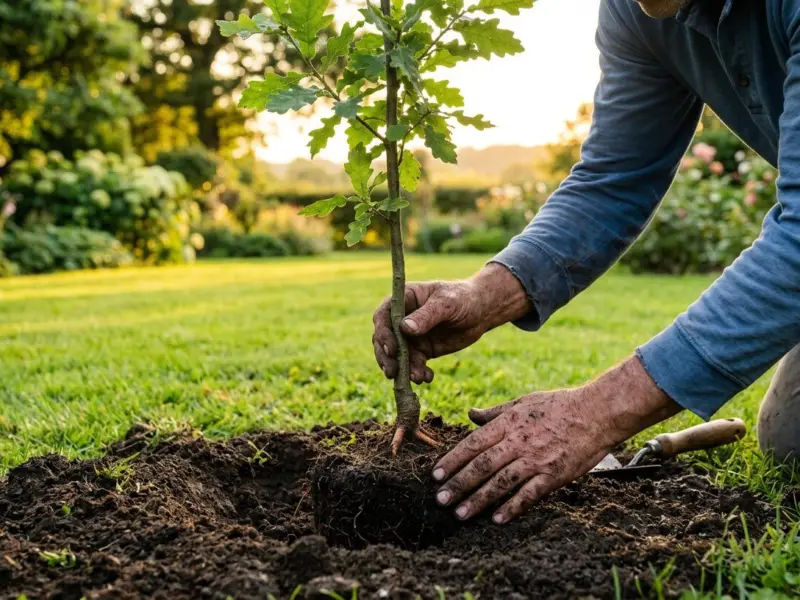
Most trees die from being planted too deep. Learn the exact hole size, root-flare rule, staking and aftercare that nursery professionals actually use.
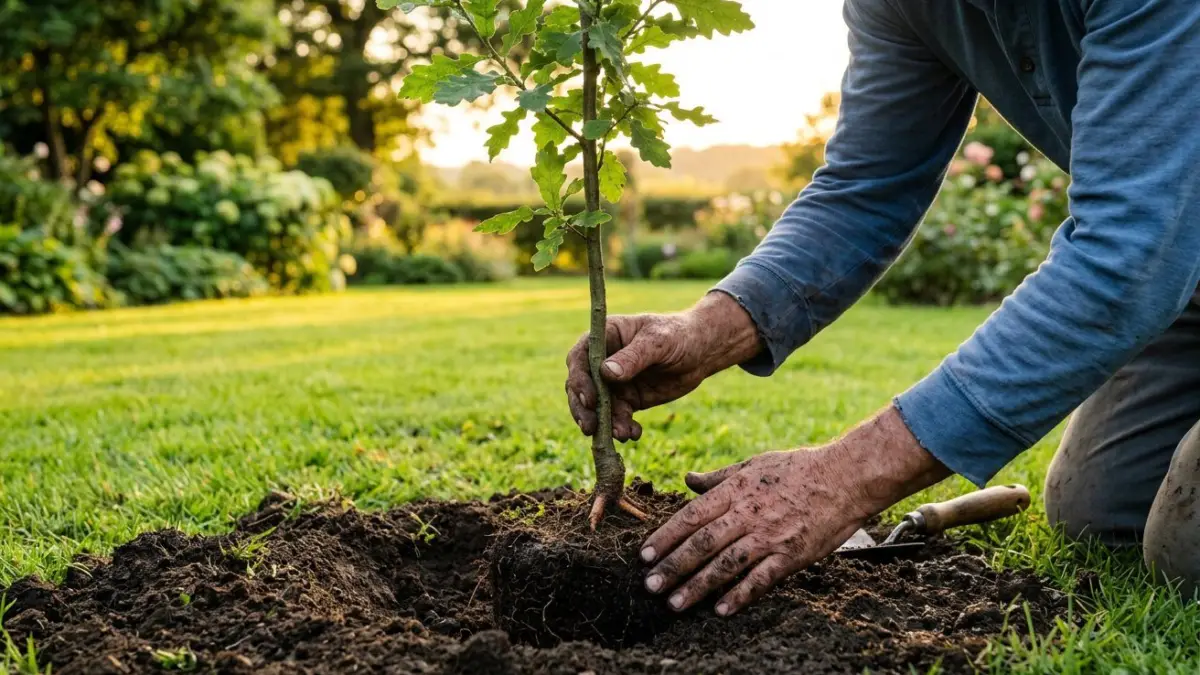
Best Shade Trees for Home Gardens (Fast, Clean, Beautiful)
The smartest shade trees for yards: fast growers that don't crack pipes, drop sticky fruit on cars, or eat your water bill, plus how to match…
Fruit Trees for Beginners: 7 That Almost Grow Themselves
Which fruit trees forgive beginner mistakes, how many years to first harvest, chill hours and pollination decoded: start your orchard the smart way.
How to Prune Trees Safely: Cuts, Timing and Tools
Where to cut, when to cut and the three-cut method for big branches, prune like a professional without killing your tree or yourself.
Palm & Tropical Tree Care: Fertilizing, Fronds and Frost
Palms and tropical trees are a different species of gardening. Correct feeding, frond rules, transplanting tips and frost rescue, the tropical plant-care playbook.
Tree Watering & Mulching: The Deep-Root Method
Trees drink differently than lawns. Build a deep-root watering habit and a correct mulch ring that halves stress and doubles growth rate.
Shrub Maintenance and Renewal Pruning: Keep Shrubs Dense, Healthy and in Bloom
Prune shrubs at the right time and they flower more, stay compact and live for decades. Learn the three-year renewal method, the after-flowering rule, and a…
Tree Diseases: Identification and Organic Treatment
Spot the common tree diseases early, from powdery mildew and leaf spot to fire blight, canker and root rot, and treat them with sanitation, pruning and…