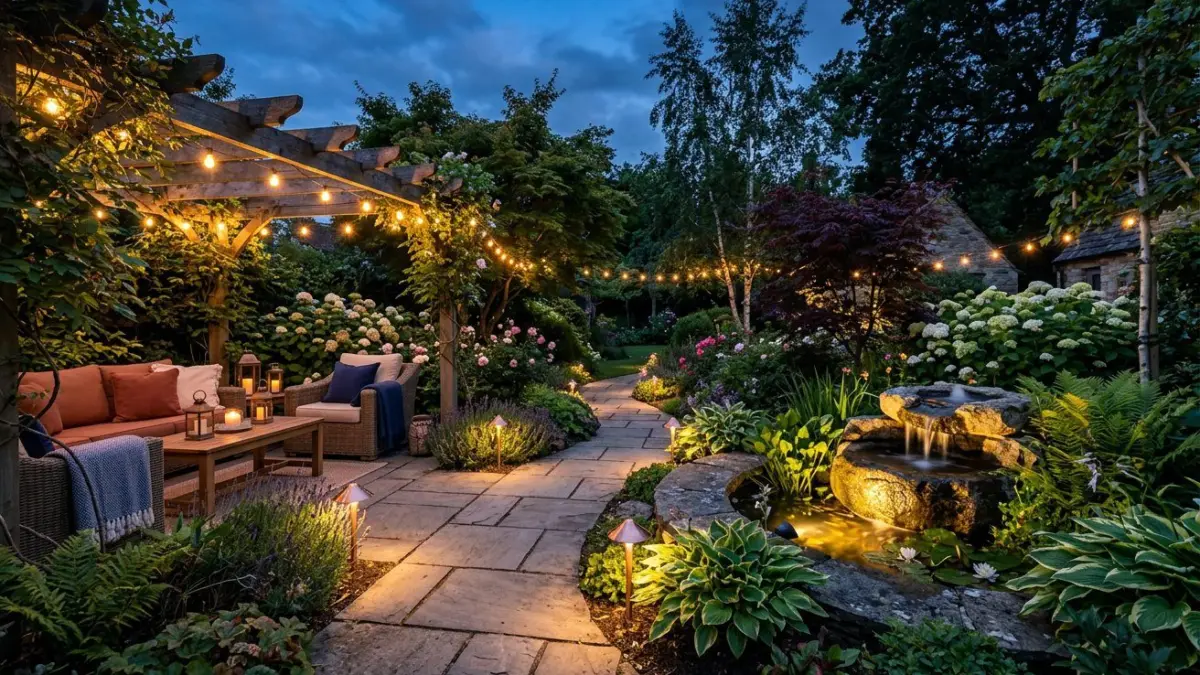
Most gardens are used after work — which is after the light is gone. Lighting and water are the two ingredients that turn an invisible evening garden into your favorite room, and both are simpler than they look.
Lighting Principles
- Layer three kinds: path, accent, ambient
- Warm white (2700–3000K) always — cool white kills mood
- Light less, better: dark gaps create drama
- Water sound masks traffic — the cheapest luxury in gardening
The Three Lighting Layers
Path lights — safety first
Low, warm, spaced 2–3 m along routes and steps. Aim for pools of light with gaps, not an airport runway.
Accent lights — drama second
Uplight one tree or architectural plant (the statement picks from our styling logic, outdoors edition) and graze a textured wall. One well-lit tree outperforms ten scattered spotlights.
Ambient — the layer everyone forgets
String lights, lanterns, a candle cluster: this is the layer you actually sit in. Keep it below eye level and warm.
Solar or Wired?
Modern solar path and accent lights handle most gardens — position panels where sun actually lands, per the light-mapping habit from our design guide. For high-output uplighting and reliability, low-voltage wired systems (12V, safe to DIY) win; everything mains-side stays in an electrician’s hands.
Choosing a Water Feature You Won’t Regret
Match feature to effort: a bubbler urn or wall spillway gives sound with a bucket-sized footprint; a small pond is an ecosystem project — choose deliberately. Regardless of size: moving water stays clean, still water grows algae and mosquitoes; a small pump solves both, and a mosquito ring or a couple of goldfish solve the rest (larvae are dinner, as the predators in our allies guide would attest). Site it where you see and hear it — from the sofa, not the shed window.
Common Mistakes to Avoid
- Cool-white floodlights — security-lab vibes; save brightness for the driveway.
- Lighting everything — the eye needs dark between brights.
- Placing water where leaves drop in — maintenance doubles; choose open sky.
Frequently Asked Questions
Do solar lights really last?
Decent ones run 6–10 hours on a sunny day’s charge and 2–3 seasons before battery replacement. Reserve wired power for the few lights that must never fail.
How small can a water feature be and still sound good?
Surprisingly small — a bubbler in a half-barrel produces genuine sound. Volume comes from fall height, not basin size.
You have completed the design path! Return to the garden design hub, or get planting with the growing guides hub.
The Maintenance Budget for garden lighting and water
Every design carries a hidden operating cost measured in weekly minutes. Lawn: the highest at 30–60. Flower borders: 15–30 in season. Trees and mulched shrub beds: minutes. Hardscape with container accents: near zero. Honest designers budget this column first — a beautiful plan demanding hours you do not have becomes a source of guilt, not joy.
The working formula: list the plan’s elements, write each one’s weekly minutes, total them against your true availability, then trade down elements until the budget balances. The garden that gets tended is the one designed to be tended.
The Desire-Line Audit for garden lighting and water
Before any path or patio is planned, watch where feet actually go: worn shortcuts across lawns, the gate people really use, the corner that collects chairs. Desire lines are the garden’s own design document, written by use. Professional redesigns begin by photographing these traces for a week — then either paving the line the feet chose or building a destination worth rerouting them for.
Fighting desire lines with fences and signs never works for long. Every element placed against them requires maintenance forever; every element placed along them maintains itself.
Deep Dive: What Experienced Growers Know About garden lighting and water
Layer lighting the way cinemas light scenes: safety pools along the path, one drama note — a single uplit tree or textured wall — and the ambient cluster where people sit. The composition rule is dark gaps: the eye needs rest between notes, and the garden reads larger when its edges stay in shadow. Warm-white only, below eye level where possible, and dimmers or low-lumen fixtures over brightness. Ten well-aimed low lights outperform fifty floods.
Key Takeaways
- Advance/Recede: Hot colors pull forward, cool colors push back — space-shaping by hue.
- Dripline: The outer leaf circle of trees; the lawn's shade boundary.
- Topdressing: A thin compost layer over lawns or beds that feeds without digging.
- Scalping: Mowing too low; the original lawn sin.
More Questions About Garden Lighting And Water
Are solar garden lights worth buying now?
For path and ambient layers, yes — modern panels handle it. Reserve wired low-voltage for the few lights that must never fail.
How small can a water feature be and still sound good?
A bubbler urn in a half-barrel produces genuine sound — volume comes from fall height, not basin size.
How do I keep mosquito larvae out?
Movement or predators: a small pump keeps water turning, or a couple of goldfish eat every larva. Still, fishless water is a nursery.
Field Questions Answered
When should trees be part of the design?
First — they take longest and shape everything: shade, views, scale. The tree decision is the plan's opening move, not its decoration.
Where should the seating go?
Where the evening light falls and the best view faces — then build the garden toward that chair. The seat is the design's center of gravity.
How do I design on a slope?
Terraces, steps, and water-wise planting bands; never fight water downhill — route it, slow it, and plant the bands it crosses.
Is it worth hiring a designer for a small garden?
For one consultation with a master plan, often yes — small gardens concentrate every mistake. The plan guides years of your own labor.
Common Mistakes to Avoid with Garden Lighting And Water
- Buying plants before the light map exists.
- One of everything at the nursery; no repetition, no rhythm.
- Hardscape laid flat — puddles, ice, mosquitoes.
- Paths too narrow, then cut across forever after.
- Tiny pots and fussy décor shrinking an already small garden.
Further Field Questions
Where should the seating go?
Where the evening light falls and the best view faces — then build the garden toward that chair. The seat is the design's center of gravity.
How do I design on a slope?
Terraces, steps, and water-wise planting bands; never fight water downhill — route it, slow it, and plant the bands it crosses.
Is it worth hiring a designer for a small garden?
For one consultation with a master plan, often yes — small gardens concentrate every mistake. The plan guides years of your own labor.
What paving suits hot climates?
Light colors that stay walkable, permeable joints that cool, and shade from a structure or tree over the main seating surface.
How do I make a rental garden portable?
Containers, trellis panels in freestanding frames, and a lighting kit on solar. Design everything to survive the move — because it must.
When should trees be part of the design?
First — they take longest and shape everything: shade, views, scale. The tree decision is the plan's opening move, not its decoration.
Further Field Questions
Where should the seating go?
Where the evening light falls and the best view faces — then build the garden toward that chair. The seat is the design's center of gravity.
How do I design on a slope?
Terraces, steps, and water-wise planting bands; never fight water downhill — route it, slow it, and plant the bands it crosses.
Is it worth hiring a designer for a small garden?
For one consultation with a master plan, often yes — small gardens concentrate every mistake. The plan guides years of your own labor.
What paving suits hot climates?
Light colors that stay walkable, permeable joints that cool, and shade from a structure or tree over the main seating surface.
How do I make a rental garden portable?
Containers, trellis panels in freestanding frames, and a lighting kit on solar. Design everything to survive the move — because it must.
When should trees be part of the design?
First — they take longest and shape everything: shade, views, scale. The tree decision is the plan's opening move, not its decoration.
Further Field Questions
Where should the seating go?
Where the evening light falls and the best view faces — then build the garden toward that chair. The seat is the design's center of gravity.
How do I design on a slope?
Terraces, steps, and water-wise planting bands; never fight water downhill — route it, slow it, and plant the bands it crosses.
Is it worth hiring a designer for a small garden?
For one consultation with a master plan, often yes — small gardens concentrate every mistake. The plan guides years of your own labor.
What paving suits hot climates?
Light colors that stay walkable, permeable joints that cool, and shade from a structure or tree over the main seating surface.
How do I make a rental garden portable?
Containers, trellis panels in freestanding frames, and a lighting kit on solar. Design everything to survive the move — because it must.
When should trees be part of the design?
First — they take longest and shape everything: shade, views, scale. The tree decision is the plan's opening move, not its decoration.
Further Field Questions
Where should the seating go?
Where the evening light falls and the best view faces — then build the garden toward that chair. The seat is the design's center of gravity.
How do I design on a slope?
Terraces, steps, and water-wise planting bands; never fight water downhill — route it, slow it, and plant the bands it crosses.
Is it worth hiring a designer for a small garden?
For one consultation with a master plan, often yes — small gardens concentrate every mistake. The plan guides years of your own labor.
What paving suits hot climates?
Light colors that stay walkable, permeable joints that cool, and shade from a structure or tree over the main seating surface.
How do I make a rental garden portable?
Containers, trellis panels in freestanding frames, and a lighting kit on solar. Design everything to survive the move — because it must.
When should trees be part of the design?
First — they take longest and shape everything: shade, views, scale. The tree decision is the plan's opening move, not its decoration.
Further Field Questions
Where should the seating go?
Where the evening light falls and the best view faces — then build the garden toward that chair. The seat is the design's center of gravity.
How do I design on a slope?
Terraces, steps, and water-wise planting bands; never fight water downhill — route it, slow it, and plant the bands it crosses.
Is it worth hiring a designer for a small garden?
For one consultation with a master plan, often yes — small gardens concentrate every mistake. The plan guides years of your own labor.
What paving suits hot climates?
Light colors that stay walkable, permeable joints that cool, and shade from a structure or tree over the main seating surface.
How do I make a rental garden portable?
Containers, trellis panels in freestanding frames, and a lighting kit on solar. Design everything to survive the move — because it must.
When should trees be part of the design?
First — they take longest and shape everything: shade, views, scale. The tree decision is the plan's opening move, not its decoration.
Further Field Questions
Where should the seating go?
Where the evening light falls and the best view faces — then build the garden toward that chair. The seat is the design's center of gravity.
How do I design on a slope?
Terraces, steps, and water-wise planting bands; never fight water downhill — route it, slow it, and plant the bands it crosses.
Is it worth hiring a designer for a small garden?
For one consultation with a master plan, often yes — small gardens concentrate every mistake. The plan guides years of your own labor.
What paving suits hot climates?
Light colors that stay walkable, permeable joints that cool, and shade from a structure or tree over the main seating surface.
How do I make a rental garden portable?
Containers, trellis panels in freestanding frames, and a lighting kit on solar. Design everything to survive the move — because it must.
When should trees be part of the design?
First — they take longest and shape everything: shade, views, scale. The tree decision is the plan's opening move, not its decoration.