Quick answers
- When should I start planning next year's garden?
- In late autumn and winter, when the season is fresh in your mind and the garden is quiet. Order seed in winter, before the best varieties sell out.
- What should I record in a garden journal?
- Sowing and planting dates, varieties, weather, pests, diseases, yields, successes and failures, with photographs. These notes become your own calendar.
- How do I plan crop rotation?
- Divide vegetables into four groups (legumes, brassicas, roots, and fruiting/onion families) and move each group to a new bed every year, so the same family returns to a bed only once every 3–4 years.
- How much seed should I order?
- Order only what you can sow and tend. Check what is left from last year, test old seed for viability, and share packets with a friend.
Key takeaways
- Review while it is fresh. Write down what worked and what did not.
- Draw a plan. A sketch of beds, crops and rotation prevents costly mistakes.
- Order seed early. Popular varieties sell out in late winter.
- Plan soil as well as plants: compost, mulch and rest.
- Start small. A manageable plan beats an ambitious one you cannot finish.
- Keep a journal. It is the single best gardening tool.
Table of contents11 sections
- Step 1: review the year
- Step 2: keep a garden journal
- Step 3: design beds and rotation
- Step 4: choose and order seeds
- Step 5: plan soil and structure
- Step 6: set a realistic budget and workload
- Step 7: build a calendar
- Planning in hot and subtropical climates
- What usually goes wrong
- Small habits that pay off
- What to read next
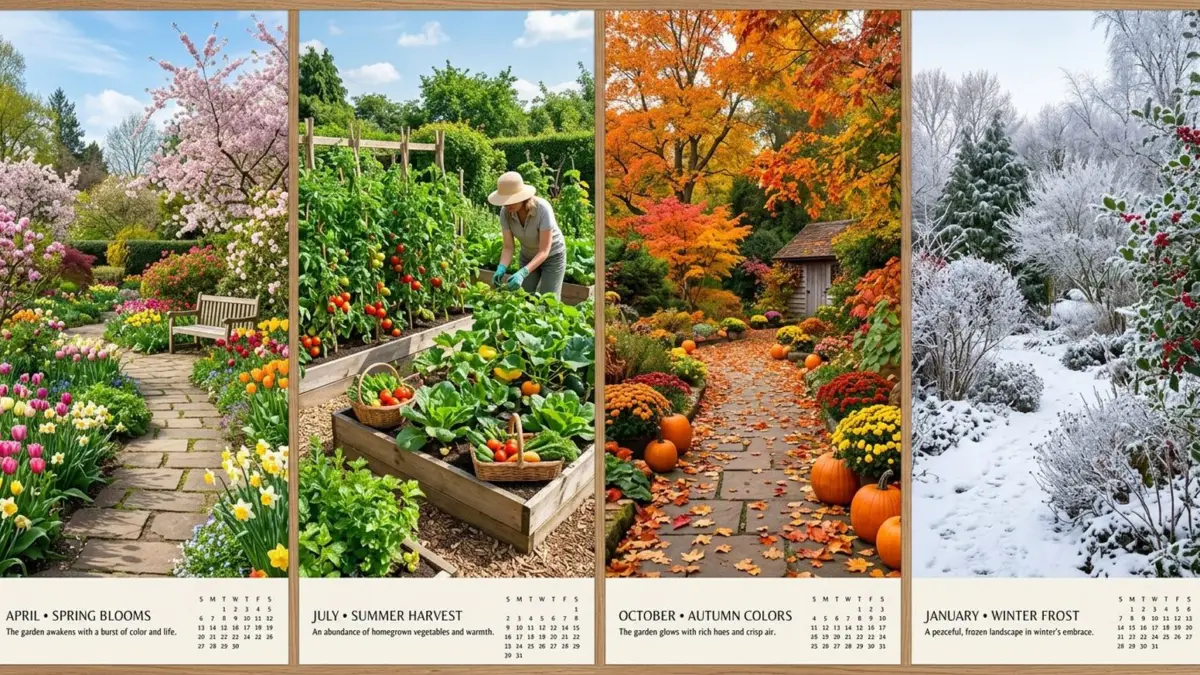
Many of the best gardens are made on winter evenings, with a notebook, a pencil and a pile of seed catalogues. Planning is where mistakes are cheap and ideas are free. A few hours spent reviewing last year, sketching beds and ordering the right seed will shape the next twelve months more than any amount of work in the middle of summer.
This guide gives a simple planning process. It is the final guide in the Seasonal Gardening pillar and follows Winter Garden Care. It works with The Seasonal Planting Calendar and The Year-Round Checklist.
Step 1: review the year
Sit down with your photos, notes and memories, and answer a few honest questions.
- What thrived? Which plants, varieties and areas were a success?
- What failed, and why? Was it timing, weather, pests, disease, soil or neglect?
- What was too much work? Reduce or redesign high-maintenance areas.
- What was missing? Gaps in colour, harvest or seasonal interest.
- How did the space work? Paths, seating, sun and shade, water access.
Write the answers down. If you did not keep a journal this year, start now with what you remember and keep notes from now on.
Step 2: keep a garden journal
A simple notebook, spreadsheet or phone note is enough. Record:
- Sowing, transplanting and harvesting dates
- Varieties and where you got them
- Weather events: first and last frost, heatwaves, floods
- Pests and diseases, with photos (see Troubleshooting Wilt, Yellowing and Mystery Symptoms)
- Yields and what you actually ate
- Ideas and mistakes to avoid
Step 3: design beds and rotation
- Draw a scale plan of your garden with beds, paths, trees and structures.
- Mark sun and shade. Place sun-loving crops where they will get at least six hours of light.
- Group vegetables by family: legumes (peas, beans), brassicas (cabbage, broccoli), roots (carrots, beet) and the fruiting/onion group (tomatoes, potatoes, onions, squash).
- Rotate. Move each group one bed along every year so the same family returns only after 3–4 years. This reduces soil-borne disease and pests.
- Add flowers and companions (see Companion Planting).
- Plan succession sowings so beds are never idle (see Succession Planting).
Step 4: choose and order seeds
- Check your stock. Test old seed with the paper-towel method (see How to Plant Seeds Step by Step).
- Choose varieties that are reliable for your climate and disease-resistant.
- Order early, in winter, for the best choice.
- Try one new thing each year rather than many.
- Share packets with friends to reduce waste and cost.
- Order plants and bulbs for spring and autumn planting in advance.
Step 5: plan soil and structure
| Task | When | Why |
|---|---|---|
| Test soil and pH | Late winter | Know what to add (see Reading Your Soil) |
| Make or order compost | Winter | Have it ready for spring (see Composting at Home) |
| Repair beds, trellises and fences | Winter dry days | Avoid rushing in spring |
| Install irrigation or water butts | Late winter | Ready before summer (see Drip Irrigation) |
| Prune dormant trees and shrubs | Late winter | Shape and health |
| Service and sharpen tools | Winter | Be ready for the busy season |
Step 6: set a realistic budget and workload
- Estimate the time you can spend each week, then size the garden to match.
- List the big expenses (beds, trees, tools, irrigation) and spread them over seasons.
- Choose two or three priorities for the year, for example a new bed, a pollinator border or a compost system.
Step 7: build a calendar
Turn the plan into dates. Use your frost dates and the planting calendar to schedule sowings, planting out, feeding and pruning, and add reminders. Link it with the Year-Round Checklist. A visible calendar prevents last-minute panic.
Planning in hot and subtropical climates
Plan around two main seasons and a heat or monsoon break: which crops to grow in the cool season, which to start before the heat and what to rest or protect during the hottest months. Plan shade, mulch and irrigation first, and use the heat period to improve soil and propagate plants.
What usually goes wrong
- Planning too much and doing too little
- Ordering seed without checking last year’s stock
- Planting the same crop family in the same bed year after year
- Ignoring soil health in the plan
- Not keeping notes, so lessons are forgotten
Small habits that pay off
- Take photographs of the garden each month; they make planning easier than memory.
- Walk the garden in late winter and imagine each bed in summer.
- Keep one “wild card” bed for experiments.
What to read next
Start the new year with Spring Garden Tasks, protect early plantings with Frost Protection Methods and plan harvests through Succession Planting. Back to Seasonal Gardening.
More in Seasonal Gardening
Spring Garden Tasks: Clean-Up, Planting, Feeding and Pest Watch
A practical spring checklist: tidy beds, wake up the soil, prune at the right time, sow and plant out, feed and mulch, and start your pest…
Summer Garden Maintenance: Watering, Pruning, Deadheading and Harvest
Keep the garden thriving through heat and growth: water deeply, mulch, deadhead, feed containers, prune after flowering, harvest regularly and manage pests and shade.
Autumn Garden Tasks: Bulbs, Clean-Up and Winter Preparation
Autumn is the best time for planting trees, shrubs and spring bulbs. Follow this checklist for clearing beds, collecting leaves, feeding soil, protecting tender plants and…