A lawn sprinkler wets the top 5 cm; a tree drinks from the top 60. That single fact explains why trees surrounded by happy grass still die of thirst, and why the “deep and infrequent” method is the professional standard for everything with a trunk.
The Deep-Root Method
- New trees: 20–30 liters, 2× per week for the first year
- Established trees: a deep soak weekly in drought
- Water where the roots are: the dripline ring, not the trunk
- Mulch ring: 8 cm deep, 1 m wide, never touching bark
Watering by Tree Age
Year one — keep the root ball moist
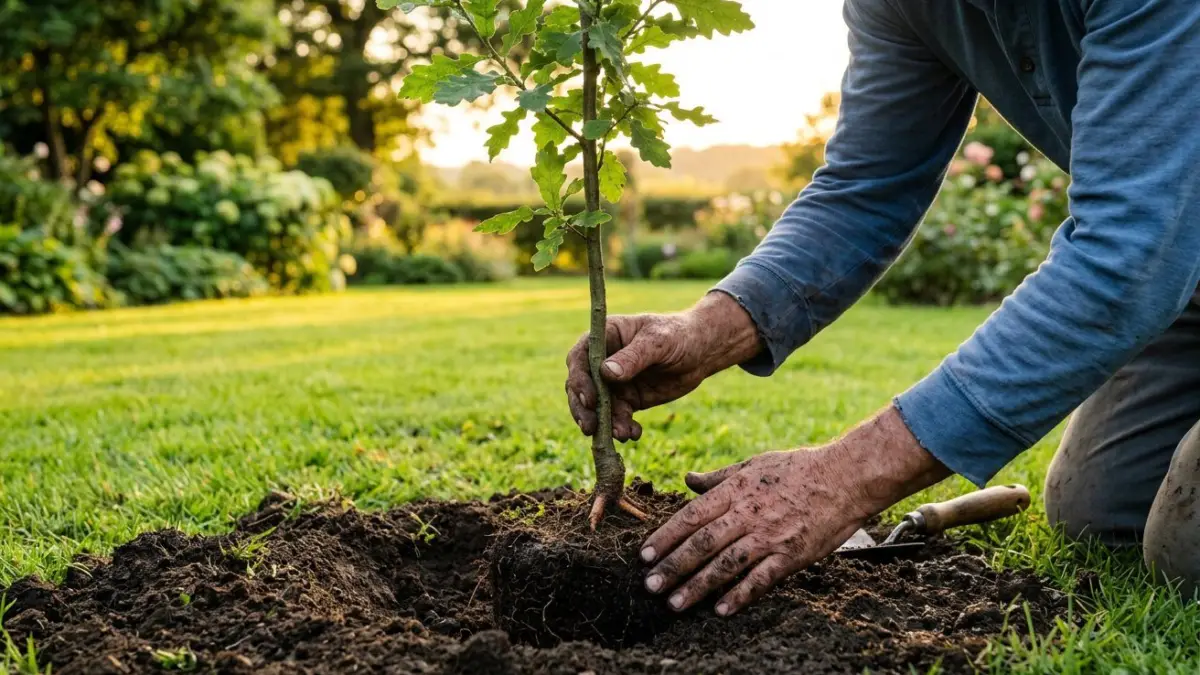
A new tree’s roots live entirely in its nursery ball, which dries faster than surrounding soil. Water it directly, two or three times a week for the first season, using a slow trickle for 20–30 minutes or a bucket with pin-holes. Consistency now prevents the establishment failures we flag in the planting guide.
Years two onward — train roots downward
Shift to one thorough weekly soak in dry weather, out at the dripline where feeder roots actually roam. A cheap deep-watering spike, or five minutes of hose on a slow trickle moved around the ring, beats every sprinkler for efficiency — the same principle scaled up from our general watering guide.
Mulching: The Tree’s Natural Armor
Forests mulch themselves; your garden should copy them. An organic mulch ring — wood chips, bark, dried leaves — regulates soil temperature, feeds soil life, blocks mower injury and holds moisture precisely where roots feed.
The donut, not the volcano
Sometimes called the “mulch volcano” disease: heaping mulch against bark rots the trunk and invites rodents and fungus. Spread it 8 cm thick but pull it back 10 cm from the trunk, exposing the root flare — the same flare rule from planting. Full technique lives in our mulching mastery guide.
Common Mistakes to Avoid
- Daily light sprinkles that grow lazy surface roots.
- Lawn fertilizing right up to the trunk — herbicide injury is a top tree killer; see our fertilizer guide for safe separation.
- Plastic sheet under mulch — it seals out the air roots need.
Frequently Asked Questions
How do I know a mature tree needs water?
Look up: leaves smaller than usual, early yellowing, or thinning at the crown top. Probe 30 cm down at the dripline — dry there means a long, slow soak is overdue.
Is it too late to mulch an old tree?
Never. Even a ring added this season relieves mower damage and heat stress within weeks — trees respond quickly to improved roots.
You have reached the end of this learning path! Revisit the trees hub anytime, or explore soil, water and fertilizer fundamentals next.
Reading Tree Stress Before It Shows for tree watering and mulch
Trees telegraph trouble a season early to anyone reading: smaller-than-normal leaves mean roots struggling; early autumn color in late summer means stress banking; sparse bud set in spring announces last summer’s drought; epicormic shoots (sprouts along the trunk) mean the canopy is failing to feed itself. Walk each tree monthly with those four signals in mind — ten seconds per tree — and problems arrive as adjustments rather than emergencies.
The one signal that overrides everything: the flare. Soil or mulch creeping over it undoes years of health silently, so the monthly walk ends where the tree begins.
The First-Year Calendar for tree watering and mulch
New trees run on a twelve-month contract. Months 1–3: root ball moisture checks twice weekly; berm basin watering deep; zero fertilizer; mulch ring maintained. Months 4–6: weekly checks; first flush of growth inspected for pests; stakes inspected and loosened if tight. Months 7–9: heat is the exam — deep soaks at the first morning wilt, never daily sprinkles; no pruning beyond broken wood. Months 10–12: taper watering to train roots outward; remove stakes; first formative corrections only if a leader or crossing branch demands it.
The calendar’s quiet genius is subtraction: every month you successfully do less, the tree does more.
Deep Dive: What Experienced Growers Know About tree watering and mulch
The dripline is where the money is: feeder roots concentrate in a doughnut under the outermost leaves, which is why a hose trickling at the trunk waters almost nothing. Deep watering means moving the slow trickle around the dripline ring — or using a soaker ring — long enough that a probe slides 30 cm down. Mulch completes the system: 8 cm of wood chips at the dripline intercepts evaporation exactly where feeder roots drink, and its slow decay builds the fungal-dominated soil woody roots prefer.
Key Takeaways
- Chill Hours: Winter hours below ~7°C that stone fruits count before spring bloom.
- Water Sprout: Vigorous vertical regrowth after heavy topping cuts; weakly attached.
- Thinning Cut: A whole-branch removal to its origin; opens canopy and calms growth.
- Heading Cut: Shortening a branch to a bud; thickens growth below, used sparingly on trees.
More Questions About Tree Watering And Mulch
How do I water a tree in a lawn?
Lawn irrigation never reaches tree depth. One deep soak weekly in drought, delivered at the dripline, supplements the grass's schedule without merging with it.
Is gravel better than wood chips under trees?
Wood chips — they feed the fungal soil woody roots want. Stone overheats roots and feeds nothing; reserve it for arid design schemes.
Can over-mulching kill a tree?
Yes — mulch volcanoes rot bark and invite girdling roots. Eight centimeters, pulled back from the trunk, is the entire law.
Field Questions Answered
Should I prune a newly planted tree to 'balance' it?
No — leaves feed the roots that establish it. Remove only broken or crossing wood; shaping waits for year two or three.
How close can I plant a tree to a wall?
Half the mature canopy width, minimum — closer only with proven deep-rooted, well-mannered species like olive or crape myrtle.
Do trees need fertilizer every year?
Healthy trees in mulched soil usually feed themselves; feed only on a diagnosed deficiency. Fertilizer on stressed trees delays the real fix.
Can I plant under an established tree?
Only tough dry-shade plants, in raised pockets of compost — never dig into the root zone or the canopy's feeder roots pay for it.
Common Mistakes to Avoid with Tree Watering And Mulch
- Planting with the root flare buried under backfill or mulch.
- Dug a deep narrow hole instead of a wide shallow one.
- Staking tight and forgetting it — sway builds trunk taper; rigid stakes build dependency.
- Amending only the planting hole, creating a pot in the ground roots refuse to leave.
- Pruning more than a quarter of the canopy in one year, forcing weak regrowth.
Further Field Questions
How close can I plant a tree to a wall?
Half the mature canopy width, minimum — closer only with proven deep-rooted, well-mannered species like olive or crape myrtle.
Do trees need fertilizer every year?
Healthy trees in mulched soil usually feed themselves; feed only on a diagnosed deficiency. Fertilizer on stressed trees delays the real fix.
Can I plant under an established tree?
Only tough dry-shade plants, in raised pockets of compost — never dig into the root zone or the canopy's feeder roots pay for it.
How much does a tree actually drink?
A mature shade tree can transpire 200–400 liters on a hot day — the case for deep, infrequent watering that reaches, not sprinkles that tease.
When is a tree officially 'established'?
When it survives a normal dry spell without supplemental water — usually two to three seasons after planting.
Should I prune a newly planted tree to 'balance' it?
No — leaves feed the roots that establish it. Remove only broken or crossing wood; shaping waits for year two or three.
Further Field Questions
How close can I plant a tree to a wall?
Half the mature canopy width, minimum — closer only with proven deep-rooted, well-mannered species like olive or crape myrtle.
Do trees need fertilizer every year?
Healthy trees in mulched soil usually feed themselves; feed only on a diagnosed deficiency. Fertilizer on stressed trees delays the real fix.
Can I plant under an established tree?
Only tough dry-shade plants, in raised pockets of compost — never dig into the root zone or the canopy's feeder roots pay for it.
How much does a tree actually drink?
A mature shade tree can transpire 200–400 liters on a hot day — the case for deep, infrequent watering that reaches, not sprinkles that tease.
When is a tree officially 'established'?
When it survives a normal dry spell without supplemental water — usually two to three seasons after planting.
Should I prune a newly planted tree to 'balance' it?
No — leaves feed the roots that establish it. Remove only broken or crossing wood; shaping waits for year two or three.
Further Field Questions
How close can I plant a tree to a wall?
Half the mature canopy width, minimum — closer only with proven deep-rooted, well-mannered species like olive or crape myrtle.
Do trees need fertilizer every year?
Healthy trees in mulched soil usually feed themselves; feed only on a diagnosed deficiency. Fertilizer on stressed trees delays the real fix.
Can I plant under an established tree?
Only tough dry-shade plants, in raised pockets of compost — never dig into the root zone or the canopy's feeder roots pay for it.
How much does a tree actually drink?
A mature shade tree can transpire 200–400 liters on a hot day — the case for deep, infrequent watering that reaches, not sprinkles that tease.
When is a tree officially 'established'?
When it survives a normal dry spell without supplemental water — usually two to three seasons after planting.
Should I prune a newly planted tree to 'balance' it?
No — leaves feed the roots that establish it. Remove only broken or crossing wood; shaping waits for year two or three.
Further Field Questions
How close can I plant a tree to a wall?
Half the mature canopy width, minimum — closer only with proven deep-rooted, well-mannered species like olive or crape myrtle.
Do trees need fertilizer every year?
Healthy trees in mulched soil usually feed themselves; feed only on a diagnosed deficiency. Fertilizer on stressed trees delays the real fix.
Can I plant under an established tree?
Only tough dry-shade plants, in raised pockets of compost — never dig into the root zone or the canopy's feeder roots pay for it.
How much does a tree actually drink?
A mature shade tree can transpire 200–400 liters on a hot day — the case for deep, infrequent watering that reaches, not sprinkles that tease.
When is a tree officially 'established'?
When it survives a normal dry spell without supplemental water — usually two to three seasons after planting.
Should I prune a newly planted tree to 'balance' it?
No — leaves feed the roots that establish it. Remove only broken or crossing wood; shaping waits for year two or three.
Further Field Questions
How close can I plant a tree to a wall?
Half the mature canopy width, minimum — closer only with proven deep-rooted, well-mannered species like olive or crape myrtle.
Do trees need fertilizer every year?
Healthy trees in mulched soil usually feed themselves; feed only on a diagnosed deficiency. Fertilizer on stressed trees delays the real fix.
Can I plant under an established tree?
Only tough dry-shade plants, in raised pockets of compost — never dig into the root zone or the canopy's feeder roots pay for it.
How much does a tree actually drink?
A mature shade tree can transpire 200–400 liters on a hot day — the case for deep, infrequent watering that reaches, not sprinkles that tease.
When is a tree officially 'established'?
When it survives a normal dry spell without supplemental water — usually two to three seasons after planting.
Should I prune a newly planted tree to 'balance' it?
No — leaves feed the roots that establish it. Remove only broken or crossing wood; shaping waits for year two or three.