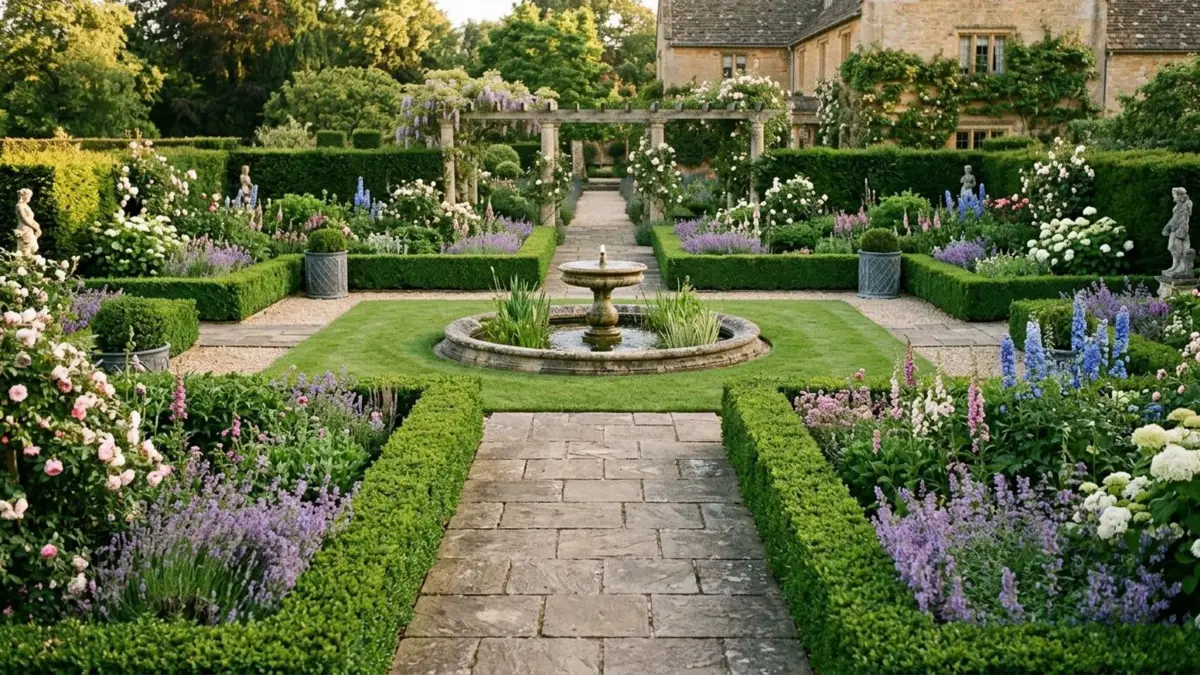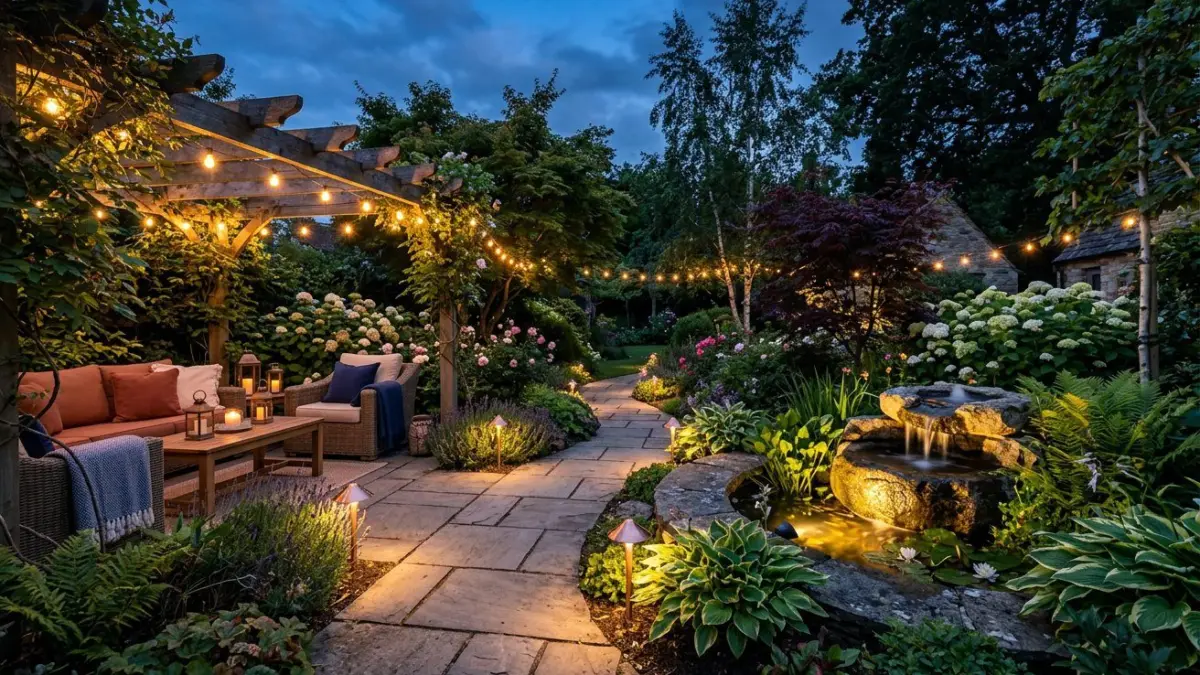
Small gardens do not need small ideas — they need precise ones. Every professional trick for tight spaces shares one goal: make the eye travel and the space multi-purpose. Here are the moves that genuinely work.
The Space-Doubling Toolkit
- Grow up: walls, trellises and arches are free land
- Diagonal sight lines make squares feel deep
- Rooms, not one box: hide the far corner to create journey
- Big pots, few kinds: scale reads as calm, clutter as shrinkage
Trick One — Go Vertical
A wall of climbing jasmine or beans is a green mural that costs zero floor space. Trellises, wall pots and arches turn fences into garden — the container techniques that make wall-growing work come from our container guide, and vining crop picks from the same playbook.
Trick Two — Steal Depth with Lines and Layers
Lay your main path or paving on the diagonal and the garden reads longer. Then plant in three tiers — tall at the back, mid, low at the front — softening boundaries so the eye rolls over them instead of stopping. Layering is the core move from our border design guide, and it earns its keep double in small spaces.
Trick Three — Create a Destination
A garden you see entirely in one glance is finished before it begins. Hide the far corner behind a trellis or tall pot and put something worth reaching there — a bench, a bird bath, a fire bowl. The curved-path principle and “destination” concept come from classic landscape design, and they transform courtyards the same way they do estates.
Trick Four — Right-Size Everything
Contrary to instinct, tiny pots and fussy details make small gardens feel smaller. A few large containers, one shade tree multi-trunked (see the small-shade picks in our shade tree guide), and restrained color (two or three hues per the palette method in our color theory guide) make the space read deliberate and calm.
Trick Five — Multi-Function Everything
Bench with storage, table that is a potting station, herbs as edging (our herb guide picks double as ornamentals), edible climbing on the fence. In small gardens every element should hold two jobs.
Common Mistakes to Avoid
- Border-of-the-worlds: tiny lawn strip plus skinny beds — commit to either lawn or garden.
- Overcrowding for instant fullness — plants triple in size; space for year three.
- Ignoring light pockets: map sun first, exactly as in our vegetable site guide.
Frequently Asked Questions
What colors make a small garden look bigger?
Cool colors — blues, purples, soft whites — recede, and pale paving reflects light. Put hot colors near the house where they energize without shrinking depth; the science is in our color guide.
How do I fit vegetables into an ornamental small garden?
Mix them in: rainbow chard and chili as bedding plants, cherry tomatoes on the arch, salad as border edging — the “potager” approach from our container guide.
Next in the hub: keep the lawn portion perfect with lawn care basics, or explore the full garden design hub.
The Desire-Line Audit for small garden design
Before any path or patio is planned, watch where feet actually go: worn shortcuts across lawns, the gate people really use, the corner that collects chairs. Desire lines are the garden’s own design document, written by use. Professional redesigns begin by photographing these traces for a week — then either paving the line the feet chose or building a destination worth rerouting them for.
Fighting desire lines with fences and signs never works for long. Every element placed against them requires maintenance forever; every element placed along them maintains itself.
The Maintenance Budget for small garden design
Every design carries a hidden operating cost measured in weekly minutes. Lawn: the highest at 30–60. Flower borders: 15–30 in season. Trees and mulched shrub beds: minutes. Hardscape with container accents: near zero. Honest designers budget this column first — a beautiful plan demanding hours you do not have becomes a source of guilt, not joy.
The working formula: list the plan’s elements, write each one’s weekly minutes, total them against your true availability, then trade down elements until the budget balances. The garden that gets tended is the one designed to be tended.
Deep Dive: What Experienced Growers Know About small garden design
The borrowed-view trick enlarges gardens without moving walls: plant so the eye reads a neighbor’s tree or a distant roofline as part of your composition, then frame it with an arch or a gap in the border. Closing your own boundaries with green while leaving one deliberate window makes a courtyard feel twice its size — the eye travels outward instead of bouncing off fences. Choose what you frame as carefully as what you plant.
Key Takeaways
- Sight Line: The uninterrupted view that carries the eye; designed, not accidental.
- Destination: A reason to walk somewhere — bench, birdbath, fire bowl — that creates journey.
- Garden Room: A partially enclosed zone that reads as its own space.
- Hardscape: The built surfaces — paths, walls, paving — that carry the garden's bones.
More Questions About Small Garden Design
How do I fit seating and planting in 20 square meters?
Built-in bench along one edge — storage beneath — planting in front of it. Seating inside the green beats a patio surrounded by it.
What's the biggest small-garden color mistake?
Hot colors at the far end — they advance and shrink the view. Cool blues and whites at the back, hot near the house.
Can a small garden feel private?
Layered screening: tall slender plants, a slatted screen, and mid-level shrubs stagger so no single fence line carries the whole job.
Field Questions Answered
Where should the seating go?
Where the evening light falls and the best view faces — then build the garden toward that chair. The seat is the design's center of gravity.
How do I design on a slope?
Terraces, steps, and water-wise planting bands; never fight water downhill — route it, slow it, and plant the bands it crosses.
Is it worth hiring a designer for a small garden?
For one consultation with a master plan, often yes — small gardens concentrate every mistake. The plan guides years of your own labor.
What paving suits hot climates?
Light colors that stay walkable, permeable joints that cool, and shade from a structure or tree over the main seating surface.
Common Mistakes to Avoid with Small Garden Design
- Buying plants before the light map exists.
- One of everything at the nursery; no repetition, no rhythm.
- Hardscape laid flat — puddles, ice, mosquitoes.
- Paths too narrow, then cut across forever after.
- Tiny pots and fussy décor shrinking an already small garden.
Further Field Questions
Where should the seating go?
Where the evening light falls and the best view faces — then build the garden toward that chair. The seat is the design's center of gravity.
How do I design on a slope?
Terraces, steps, and water-wise planting bands; never fight water downhill — route it, slow it, and plant the bands it crosses.
Is it worth hiring a designer for a small garden?
For one consultation with a master plan, often yes — small gardens concentrate every mistake. The plan guides years of your own labor.
What paving suits hot climates?
Light colors that stay walkable, permeable joints that cool, and shade from a structure or tree over the main seating surface.
How do I make a rental garden portable?
Containers, trellis panels in freestanding frames, and a lighting kit on solar. Design everything to survive the move — because it must.
When should trees be part of the design?
First — they take longest and shape everything: shade, views, scale. The tree decision is the plan's opening move, not its decoration.
Further Field Questions
Where should the seating go?
Where the evening light falls and the best view faces — then build the garden toward that chair. The seat is the design's center of gravity.
How do I design on a slope?
Terraces, steps, and water-wise planting bands; never fight water downhill — route it, slow it, and plant the bands it crosses.
Is it worth hiring a designer for a small garden?
For one consultation with a master plan, often yes — small gardens concentrate every mistake. The plan guides years of your own labor.
What paving suits hot climates?
Light colors that stay walkable, permeable joints that cool, and shade from a structure or tree over the main seating surface.
How do I make a rental garden portable?
Containers, trellis panels in freestanding frames, and a lighting kit on solar. Design everything to survive the move — because it must.
When should trees be part of the design?
First — they take longest and shape everything: shade, views, scale. The tree decision is the plan's opening move, not its decoration.
Further Field Questions
Where should the seating go?
Where the evening light falls and the best view faces — then build the garden toward that chair. The seat is the design's center of gravity.
How do I design on a slope?
Terraces, steps, and water-wise planting bands; never fight water downhill — route it, slow it, and plant the bands it crosses.
Is it worth hiring a designer for a small garden?
For one consultation with a master plan, often yes — small gardens concentrate every mistake. The plan guides years of your own labor.
What paving suits hot climates?
Light colors that stay walkable, permeable joints that cool, and shade from a structure or tree over the main seating surface.
How do I make a rental garden portable?
Containers, trellis panels in freestanding frames, and a lighting kit on solar. Design everything to survive the move — because it must.
When should trees be part of the design?
First — they take longest and shape everything: shade, views, scale. The tree decision is the plan's opening move, not its decoration.
Further Field Questions
Where should the seating go?
Where the evening light falls and the best view faces — then build the garden toward that chair. The seat is the design's center of gravity.
How do I design on a slope?
Terraces, steps, and water-wise planting bands; never fight water downhill — route it, slow it, and plant the bands it crosses.
Is it worth hiring a designer for a small garden?
For one consultation with a master plan, often yes — small gardens concentrate every mistake. The plan guides years of your own labor.
What paving suits hot climates?
Light colors that stay walkable, permeable joints that cool, and shade from a structure or tree over the main seating surface.
How do I make a rental garden portable?
Containers, trellis panels in freestanding frames, and a lighting kit on solar. Design everything to survive the move — because it must.
When should trees be part of the design?
First — they take longest and shape everything: shade, views, scale. The tree decision is the plan's opening move, not its decoration.
Further Field Questions
Where should the seating go?
Where the evening light falls and the best view faces — then build the garden toward that chair. The seat is the design's center of gravity.
How do I design on a slope?
Terraces, steps, and water-wise planting bands; never fight water downhill — route it, slow it, and plant the bands it crosses.
Is it worth hiring a designer for a small garden?
For one consultation with a master plan, often yes — small gardens concentrate every mistake. The plan guides years of your own labor.
What paving suits hot climates?
Light colors that stay walkable, permeable joints that cool, and shade from a structure or tree over the main seating surface.
How do I make a rental garden portable?
Containers, trellis panels in freestanding frames, and a lighting kit on solar. Design everything to survive the move — because it must.
When should trees be part of the design?
First — they take longest and shape everything: shade, views, scale. The tree decision is the plan's opening move, not its decoration.