Quick answers
- Where should I start when adding water and lighting to a garden?
- Start with how you use the garden in the evening. Decide where you sit, walk and look from, then add one water feature and a simple layer of path and accent lighting around those spots.
- Do I need a big garden for a water feature?
- No. A bubble fountain, wall spout, container pond or bird bath works in a courtyard or on a balcony, and still adds sound, reflection and wildlife.
- Is garden lighting expensive to run?
- Not with LEDs. A typical low-voltage LED scheme uses less electricity than one old light bulb in the house, and solar lights cost nothing to run.
- What is the biggest safety risk with water and lighting?
- Electricity near water. Use low-voltage lighting where possible, protect all mains circuits with an RCD/GFCI, use outdoor-rated equipment and hire an electrician for fixed wiring.
Key takeaways
- Design for the evening. Plan seating, views and routes first, then place water and light to serve them.
- Choose water for sound and movement. Even a tiny fountain masks noise and attracts wildlife.
- Light in layers: path light for safety, accent light for drama, soft ambient light for mood.
- Use warm white LEDs, hide the fixtures and keep brightness low.
- Keep electricity safe: low-voltage where possible, RCD/GFCI everywhere, a professional for mains.
- Plan maintenance from the start: clean pumps, panels and lenses, and winter-proof the equipment.
Table of contents28 sections
- The big idea: design for the evening
- Part three: the evening garden plan
- Part four: planting for the night
- Part five: safety first
- Common mistakes and how to avoid them
- Tools and materials: what to buy and what to skip
- How the evening garden changes through the year
- Budget guide
- Do water features attract mosquitoes?
- How much does it cost to run a garden pump?
- Can I use solar lights for everything?
- What colour of light is best?
- How deep should a pond be?
- Will lighting harm wildlife?
- Can I install garden lighting myself?
- How do I stop algae in my fountain or pond?
- What should I do with my water features in winter?
- Is it safe to have a pond with young children around?
- Explore the eight guides
- Conclusion: begin with one evening
The hours after sunset are the ones many people actually spend in their gardens. We come home from work, the heat eases and the garden becomes a place to eat, talk and unwind. Yet most gardens are designed for daylight and simply go dark. Two ingredients change that completely: water and light. Water adds sound, movement and reflection; light turns a flat, dark space into a layered, welcoming scene.
This guide is the foundation of the Water Features & Lighting pillar. It explains how to think about an evening garden, how to choose and place water features, how to build a layered lighting scheme, how to keep everything safe and how to look after it through the year. It then points to eight focused guides for each topic. Read it once to get the whole picture, then use the links to go deeper where you need to.
It is written for beginners with a small patio as well as for gardeners planning a pond and a full lighting scheme. The principles are the same at any scale: choose carefully, keep it simple and put safety first.
The big idea: design for the evening
A good evening garden is not a daytime garden with a few lights added. It has its own logic. During the day we see colour and detail; at night we see shapes, contrasts, reflections and pools of light separated by darkness. Our eyes adapt to low light, so we need much less brightness than we imagine, and over-lighting destroys the very mood we want.
Start from how you will use the garden after dark:
- Where do you sit? Dining table, bench, hammock, doorstep. These are your viewpoints.
- What will you look at? A tree, a wall, a fountain, a pond, a pot. These are your focal points.
- Where do you walk? Paths, steps, gates, the way to the shed or bins. These are your routes.
- What do you hear? Traffic, neighbours, air conditioners. Water can mask unwanted sound.
- Who else uses the space? Children, pets, wildlife, neighbours looking in.
Sit where you would sit on a summer evening and look outward. What would you like to see? That view is the starting point of your lighting plan. See Garden Lighting Design for the full method.
Why water matters
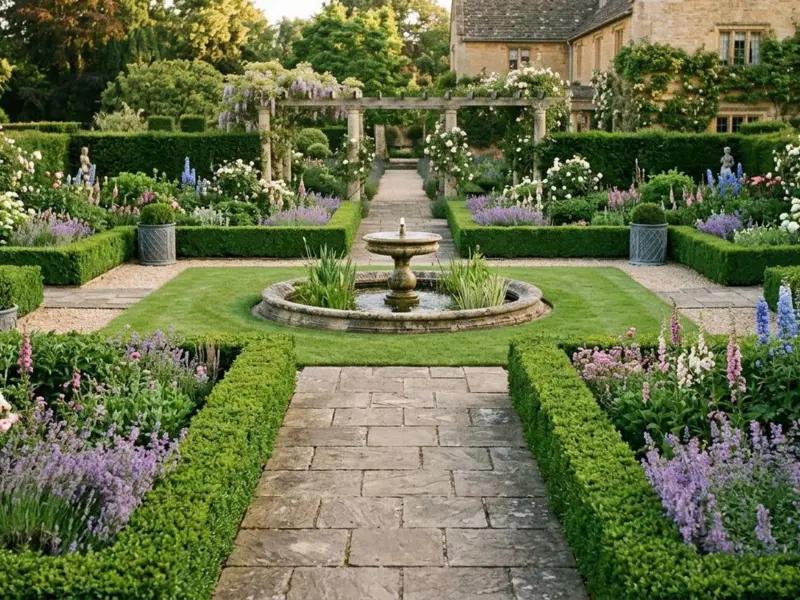
Water is the most powerful element you can add to a garden. It brings gentle sound that relaxes people and masks background noise, surfaces that reflect sky, plants and lights, and life: birds, bees, dragonflies, frogs and beneficial insects. In hot climates it also cools the air and adds humidity. The tradition of the Persian and Mughal charbagh, with its cooling channels and fountains, shows how long gardeners have understood this.
Choosing the right type
| Feature | Best for | Space | Effort | See |
|---|---|---|---|---|
| Bird bath | Wildlife, tiny spaces | Very small | Very low | Small water features |
| Bubble fountain or wall spout | Sound, safe for children | Small | Low | Small water features |
| Container water garden | Plants and insects in a pot | Small | Low | Small water features |
| Formal raised pool | Reflection, courtyards | Medium | Medium | Pond basics |
| Wildlife pond | Biodiversity, naturalistic gardens | Medium to large | Medium | Pond basics |
| Ornamental pond with fish | Colour, movement | Medium to large | High | Pond basics |
Placing water
- Choose a spot visible from the seating area and from windows, ideally with sky or light behind it for reflection.
- Keep water in part shade (about 4–6 hours of sun) to control algae and evaporation.
- Stay away from overhanging deciduous trees and from underground services.
- Plan a safe power route from the start: pumps need electricity.
The basics of keeping water healthy
Whatever its size, a water feature stays clean when four things are balanced: light (not too much sun), plants (to shade and compete with algae), circulation (a pump to move water and add oxygen) and nutrients (low, from rainwater and minimal feeding). Get these right and you will rarely need to clean. Details are in Water Features for Small Gardens and Pond and Water Garden Basics.
The three layers
Think in layers, just as you do with planting:
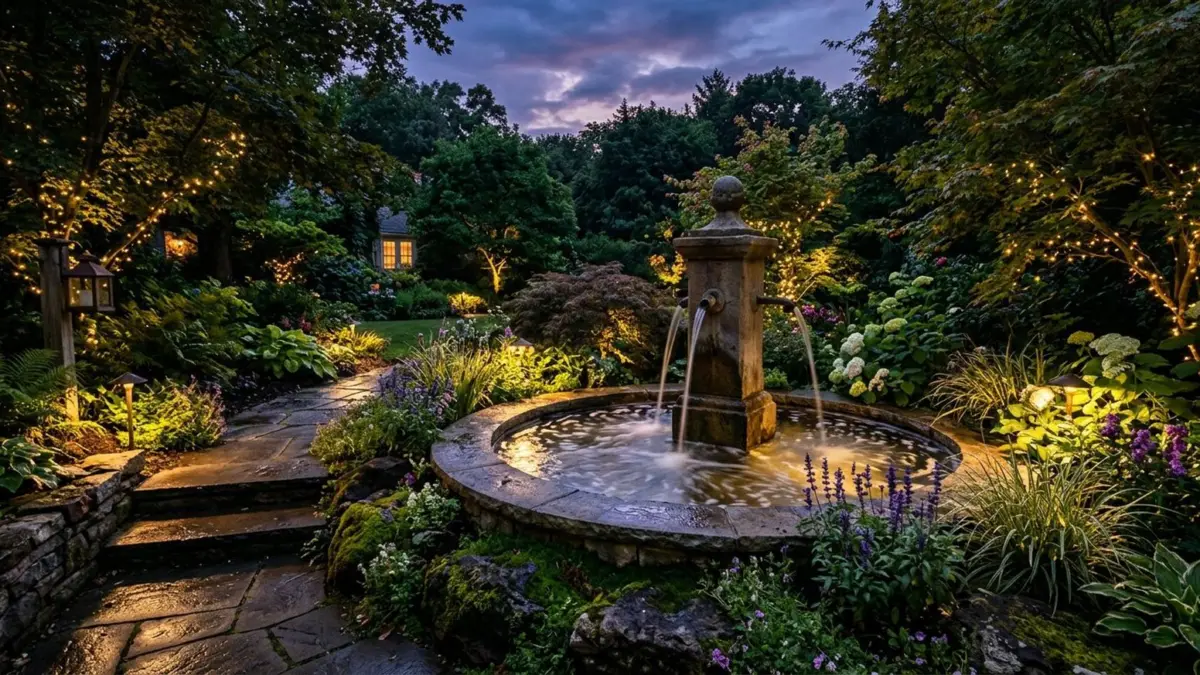
- Ambient light is the soft background glow that makes the space inviting: lanterns, festoon lights, candlelight.
- Task and path light keeps people safe at steps, paths, doors and gates (see Lighting for Safety and Security).
- Accent light picks out trees, sculpture, textured walls and water, giving the garden depth.
Techniques
The most useful are uplighting (spot aimed up into a tree or wall), moonlighting (a fixture high in a tree aimed down to create soft, dappled light), grazing (close to a textured wall), silhouetting (light behind a sculptural plant) and underwater lighting for ponds. Used sparingly, two or three techniques create a rich result.
Colour, brightness and control
- Warm white (2700–3000K) LEDs flatter plants, wood and stone.
- Low brightness: 50–150 lumens for path lights, 100–300 for accent spots, more only for sensor-activated security lights.
- Hide the source, show the effect, and avoid glare at eye level.
- Use timers, dusk-to-dawn sensors and dimmers so the lighting works without you and switches off late at night.
Power options
| System | Strength | Limits |
|---|---|---|
| 12V low-voltage LED | Safe, flexible, cheap to run; the best choice for most gardens | Needs a transformer and cable runs |
| Mains (120/230V) | Powerful, for large fixtures and sockets | Must be installed by a qualified electrician |
| Solar | No cables or running cost; quick to install | Dim, depends on sunshine (see Installing Solar Garden Lights) |
Part three: the evening garden plan
Bringing water, light and planting together is easiest if you plan in zones. Each zone has a job, and each uses water and light differently.
| Zone | Purpose | Water | Light | Planting |
|---|---|---|---|---|
| Arrival and entrance | Welcome and safety | Wall spout or pot fountain (optional) | Soft wall light and path lights; motion sensor on side routes | Fragrant evergreens, pots |
| Dining and seating | Relax and entertain | Bubbler or small pool within earshot | Ambient string lights or lanterns; dimmable | Scented plants and jasmine; see Creating a Moon Garden |
| Focal point | Drama and depth | Pond, rill or urn | Uplighting or underwater lights | Specimen tree or sculptural plants |
| Routes and steps | Safety | None | Low shielded path lights; step lights | Low, tidy edging |
| Wild corner | Wildlife | Wildlife pond or shallow dish | Dark or very low light | Native plants, night-scented flowers |
Part four: planting for the night
Plants carry the evening garden. Pale flowers and silver leaves reflect low light; night-scented species release fragrance after dark; ornamental grasses move in the lamplight and cast shadows. The classic approach is the moon garden: white and silver plants such as white roses, jasmine, nicotiana, moonflower, evening primrose, lamb’s ears, artemisia and dusty miller, with fragrant night bloomers like raat ki rani and tuberose in warm climates. Full plant lists and layouts are in Creating a Moon Garden.
Around ponds, combine marginal and bog plants such as iris, marsh marigold, primula and ferns, and add water lilies and oxygenating plants in the water. Wildlife will follow.
Part five: safety first
Water, electricity and darkness are all hazards, and an evening garden combines them. The rules are simple, and following them removes nearly all the risk.
- Protect every outdoor circuit with an RCD/GFCI (30 mA or lower) and test it monthly.
- Prefer low-voltage (12V) lighting for DIY projects and use a qualified electrician for anything on mains power.
- Use outdoor-rated equipment: at least IP44, IP65 for exposed positions and IP68 for anything submerged.
- Protect cables in conduit or armoured, buried to the depth your local rules require, and mark the route.
- Keep sockets and transformers out of puddles and away from the pond edge.
- Light steps, level changes and water edges so nobody slips or falls in.
- Child safety: choose bubblers or pebble pools, or fit a rigid safety grid or fence on ponds.
The full checklist is in Outdoor Electrical Safety, and practical lighting for steps, doors and sensors is in Lighting for Safety and Security.
Common mistakes and how to avoid them
- Over-lighting. Lighting everything evenly flattens the garden. Light a few features and let the rest fall into shadow.
- Glare. Bright fixtures at eye level dazzle and make darkness beyond them seem blacker. Shield and aim downward.
- Cool white lamps. They make plants look grey and feel clinical. Choose warm white.
- Putting water in full sun under trees. You will fight algae and leaves all year.
- Oversized pumps. They splash and waste energy. Choose an adjustable pump sized to the feature.
- Forgetting the power plan. Decide cable routes and sockets before building.
- Ignoring wildlife. Constant bright light and chemicals harm night insects, bats and amphibians.
- No maintenance plan. Pumps clog, panels get dirty and bulbs fail. Put reminders in the calendar.
Tools and materials: what to buy and what to skip
| Item | Why | Priority |
|---|---|---|
| Low-voltage LED kit with transformer and timer | The backbone of a safe, flexible lighting scheme | Essential |
| RCD/GFCI adapter or protected socket | Protection for pumps, lights and tools | Essential |
| Submersible pump with flow control | For fountains and pond circulation | Essential for water features |
| Pond liner (butyl/EPDM) and underlay | Durable water containment | Essential for ponds |
| Warm white spotlights and path lights | Accent and safety lighting | Essential |
| Solar fairy lights and lanterns | Ambient glow without wiring | Useful |
| Motion sensor floodlight | Security at side passages and driveways | Useful |
| Barley straw or pond filter | Algae control | Optional |
| Cheap decorative stake lights with no lumen rating | Give little useful light | Skip |
| High-wattage floodlights for general lighting | Glare, waste, neighbour complaints | Skip |
How the evening garden changes through the year
- Spring: restart pumps, clean filters, divide pond plants, check cables and fittings, and clean solar panels.
- Summer: long dusk and warm nights, so the evening garden is at its busiest. Top up water, watch algae, shade water in extreme heat and enjoy the night-scented plants.
- Autumn: net leaves from ponds, cut back plants and bring tender equipment indoors before frost.
- Winter: longer nights mean lights work harder. Drain or protect fountains and pumps against freezing, clear snow from solar panels and add festive lighting (see Seasonal Lighting Displays).
In hot climates, the heat peak and the monsoon create different tasks: more frequent water top-ups, shade for pumps, and extra care that outdoor electrics are protected from heavy rain and humidity.
Budget guide
- Small: bird bath, bubble fountain and a few solar lights; quick to set up and low cost.
- Medium: a 12V LED path and accent scheme, a container pond or wall feature, and some night-scented planting.
- Large: a lined pond with filtration, a full lighting scheme with zones and timers, and professional electrical work for sockets and cables.
Whatever the budget, install the safety essentials first (RCD/GFCI, outdoor-rated equipment), then add atmosphere.
Do water features attract mosquitoes?
Only still water does. Moving water from a fountain or bubbler rarely breeds mosquitoes. In containers, change the water weekly or use Bti dunks, which are safe for wildlife and pets.
How much does it cost to run a garden pump?
A typical small pump uses 10–40 watts, costing a few cents a day if left on continuously. Use a timer to run it only when you want to enjoy it.
Can I use solar lights for everything?
Solar lights are great for accents and ambient glow but not reliable for safety-critical lighting such as steps and doors. Combine solar with a low-voltage or mains system.
What colour of light is best?
Warm white (2700–3000K) for most gardens. Use a single accent colour for festive displays.
How deep should a pond be?
A deep zone of 60–90 cm in cold climates, 45–60 cm in warm ones, with shallow shelves for plants. See Pond and Water Garden Basics.
Will lighting harm wildlife?
Bright, continuous or blue-rich light can disturb insects, birds and bats. Use warm, shielded, low-level lighting on timers, and keep some areas dark.
Can I install garden lighting myself?
Low-voltage systems are suitable for DIY. Any mains-voltage fixed wiring should be done by a qualified electrician.
How do I stop algae in my fountain or pond?
Limit sun, add plants, circulate water, avoid overfeeding fish and use rainwater to top up. Barley straw can help in spring.
What should I do with my water features in winter?
In freezing climates, drain fountains, store pumps indoors in water and keep a small ice-free area in fish ponds. In mild climates, simply reduce pump runtime.
Is it safe to have a pond with young children around?
Open water is a drowning risk. Choose bubblers or pebble pools, or fit a rigid safety grid or fence, and supervise children.
Explore the eight guides
Each guide below goes deep on one part of the evening garden. Read them in order or jump to what you need.
- Garden Lighting Design: layers, techniques, colour and placement.
- Installing Solar Garden Lights: where, how and when they work.
- Water Features for Small Gardens: fountains, bubblers and bird baths.
- Pond and Water Garden Basics: planning, plants and maintenance.
- Lighting for Safety and Security: path lights, steps and sensors.
- Creating a Moon Garden: white, silver and scented plants for night.
- Outdoor Electrical Safety: GFCI, weatherproofing and professionals.
- Seasonal Lighting Displays: festive lighting without clutter.
For the design context, see Garden Design & Landscaping and Water Features & Garden Lighting; for planting, Flower Gardening; and for the yearly rhythm, Seasonal Gardening.
Conclusion: begin with one evening
You do not need a big budget or a big garden to transform your space after dark. Start with one evening. Sit where you usually sit as the light fades, and notice what you see, hear and feel. Add one source of water sound and a few warm lights at the right places, and keep everything safe. Then watch what happens: the family stays out longer, wildlife arrives and the garden you thought was finished for the day becomes the best part of it.
All Water Features & Lighting guides
Garden Lighting Design: Types, Placement and Mood
Plan a garden lighting scheme in layers: path, accent and ambient light. Learn the main techniques (uplighting, moonlighting, grazing), warm colour temperatures, fixture spacing and how…
Installing Solar Garden Lights: Where, How and When They Work
Solar lights are the easiest way to add evening glow. Learn where to place them for full charge, how to choose quality fixtures, how to install…
Water Features for Small Gardens: Fountains, Bubblers and Bird Baths
You do not need a pond to enjoy water in the garden. Learn how to choose and install bubble fountains, wall spouts, container water gardens and…
Pond and Water Garden Basics: Planning, Plants and Maintenance
Build a wildlife pond or ornamental water garden that stays clear and balanced. Learn site choice, depth zones, liners, plants, fish, a simple filter setup and…
Lighting for Safety and Security: Path Lights, Steps and Motion Sensors
Light the places that matter: steps, paths, entrances and dark corners. Learn how to place path lights, choose motion sensors, avoid glare and keep neighbours happy…
Creating a Moon Garden: White and Silver Plants That Glow at Night
Design a garden made for evenings: pale flowers, silver foliage and night-scented plants that glow under moonlight and attract moths. Includes plant lists, layout ideas and…
Outdoor Electrical Safety: GFCI, Weatherproofing and When to Call a Professional
Garden lighting, pumps and sockets mix electricity with water. Learn the essentials: RCD/GFCI protection, IP ratings, low-voltage systems, cable protection and which jobs must be left…
Seasonal Lighting Displays: Festive Lights Without the Clutter
Create beautiful festive lighting for Christmas, Diwali, Eid, Ramadan, New Year or any celebration: plan a restrained design, choose outdoor-rated LEDs, wrap trees safely and keep…