Quick answers
- How do I choose a garden style?
- Look at your house, your climate and how much time you have. A style that echoes your home's architecture and suits your climate looks right and is easier to maintain.
- Which garden style is the lowest maintenance?
- Modern minimalist, Mediterranean and naturalistic or prairie styles need the least upkeep. Formal and cottage styles are the most demanding.
- Can I mix garden styles?
- Yes, if you keep one dominant style and separate others with clear transitions such as hedges, gates or changes in level. Repeating materials and colours ties it all together.
- What is a charbagh garden?
- A four-part garden divided by water channels and paths, a style developed in Persia and perfected in Mughal India and Pakistan. It uses symmetry, shade and running water to create a cool, ordered oasis.
Key takeaways
- Pick one dominant style. A clear style gives a garden character and discipline.
- Let your house guide you. Architecture, materials and setting suggest what will look natural.
- Match style to climate and time. A cottage garden needs weeding; a gravel garden does not.
- Formal styles need maintenance; naturalistic styles need restraint.
- Use materials and colours to link mixed areas.
- Traditional regional styles, such as the charbagh, are well suited to hot, dry climates.
Table of contents13 sections
- Styles at a glance
- Formal gardens
- Cottage and informal gardens
- Modern and minimalist gardens
- Japanese gardens
- Mediterranean and gravel gardens
- Woodland and shade gardens
- Naturalistic and prairie planting
- The charbagh: a style for hot climates
- How to choose and combine
- Slip-ups to steer clear of
- Shortcuts worth knowing
- Where to go from here
A garden style is a set of design choices that fit together: layout, planting, materials and mood. Choosing a style is not about following fashion; it is about giving your garden a clear identity so each decision, from paving to plants, has an easy answer. Without a style, gardens tend to drift into a collection of unrelated ideas.
This guide explains the main styles, what defines them and who they suit. It is part of the Garden Design pillar, and works with Garden Design Principles and Small Garden Design Ideas.
Styles at a glance
| Style | Key features | Maintenance | Best for |
|---|---|---|---|
| Formal | Symmetry, clipped hedges, straight lines, gravel and lawn | High | Period houses, larger plots |
| Cottage | Abundant mixed planting, curved paths, roses, self-seeders | High to medium | Traditional homes, wildlife lovers |
| Modern / minimalist | Clean lines, limited palette, hard landscaping, structural plants | Low to medium | Contemporary houses, small spaces |
| Japanese | Rocks, water, moss, pruned pines and maples, raked gravel | Medium | Shady, quiet corners, courtyards |
| Mediterranean | Gravel, terracotta, lavender, olive, rosemary, sun-loving plants | Low | Hot, dry, sunny sites |
| Woodland | Shade trees, ferns, hostas, spring bulbs, leaf mould paths | Low | Shady gardens, informal plots |
| Naturalistic / prairie | Grasses and perennials in drifts, seed heads for winter | Low | Open sunny sites, wildlife gardens |
| Potager (kitchen garden) | Raised beds, ornamental vegetables, herbs, flowers | Medium to high | Cooks, families |
| Charbagh (Mughal) | Four-part layout, central water channel, shade trees, fragrant flowers | Medium | Hot, dry climates; courtyards and large lawns |
Formal gardens
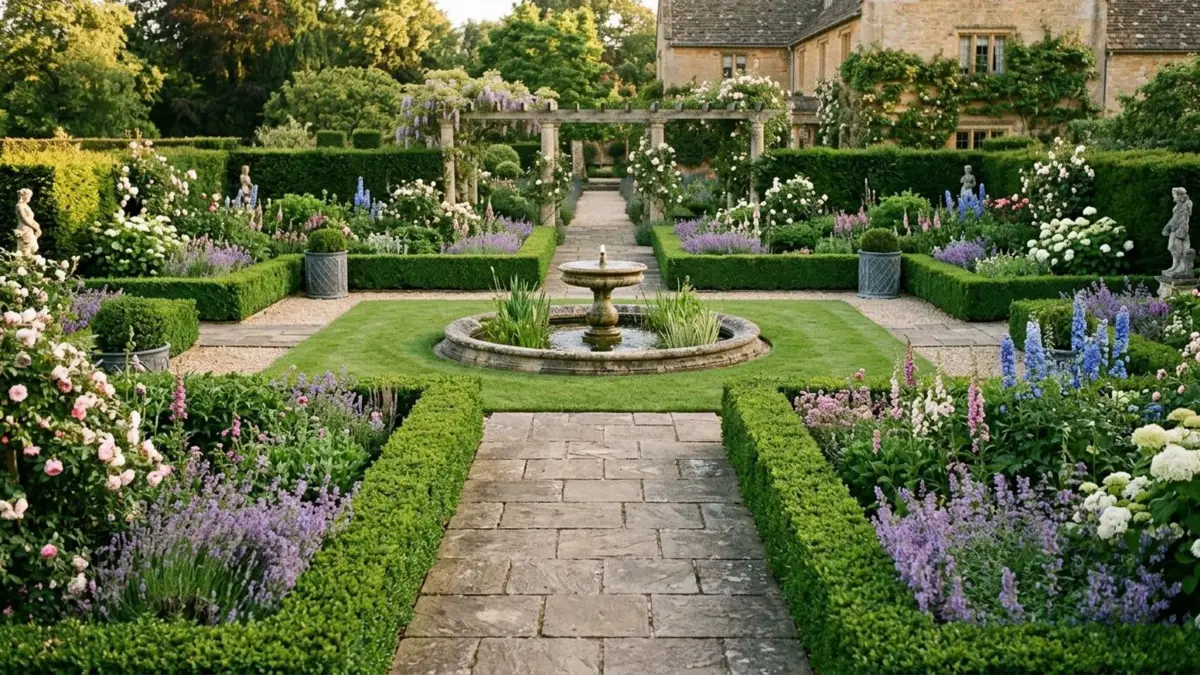
Formal gardens express order: straight paths, symmetrical beds, clipped box and yew, topiary, a central fountain. Planting is restrained, often green with a limited palette of one or two colours. The look is timeless but demands regular clipping, edging and mowing to keep the lines crisp.
Cottage and informal gardens
The cottage style is generous and romantic: roses on arches, foxgloves, delphiniums and lavender spilling over paths, with vegetables and herbs mixed among the flowers. It looks effortless but needs regular staking, deadheading and editing. See How to Grow Roses and Flowers That Attract Pollinators.
Modern and minimalist gardens
Clean geometry, large paving slabs, steel or timber planters, and a tight palette of plants such as grasses, evergreens and a few sculptural specimens. Less is more here, so quality of materials matters. These gardens suit contemporary architecture and small urban spaces.
Japanese gardens
Japanese gardens aim for calm and a sense of nature distilled. Key elements are carefully placed stones, still or flowing water, raked gravel, moss, pines pruned in cloud shapes and maples. They use restraint: few materials, few plant types and plenty of empty space.
Mediterranean and gravel gardens
For hot, dry sites, this style makes a virtue of drought. Use gravel mulches, terracotta pots, silver-leaved plants such as lavender, santolina and rosemary, olive trees and sun-lovers like cistus and thyme. Once established, they need little water. See Drip Irrigation & Smart Watering for efficient irrigation.
Woodland and shade gardens
Under trees, plant in the same layers as a natural woodland: canopy, shrubs, ferns and perennials such as hostas and hellebores, and spring bulbs that flower before the canopy closes. Mulch with leaf mould. Low maintenance once settled. See Shade-Loving Flowers.
Naturalistic and prairie planting
Drifts of grasses and tough perennials such as echinacea, rudbeckia and salvia, left standing through winter for structure and wildlife. The look is soft, movement-filled and low input, but needs to be designed carefully so it feels intentional rather than untidy.
The charbagh: a style for hot climates
The charbagh (“four gardens”) is a Persian design, adopted in Mughal gardens across India and Pakistan. A square or rectangle is divided into four by water channels or paths meeting at a central pool or pavilion. Shade trees, fruit trees, roses, jasmine and scented plants fill the quarters, while moving water cools the air. It is an excellent model for courtyard and walled gardens in hot, dry regions, and it works beautifully at small scale with a central fountain and four planting beds.
How to choose and combine
- Look at your home. Period houses suit formal or cottage styles; modern buildings suit minimalist and naturalistic styles.
- Consider climate and soil. Work with your conditions rather than against them.
- Be honest about time. Choose a style whose upkeep you will actually do.
- Pick one dominant style. Use the others for small, clearly defined areas.
- Link with materials and colour. The same paving, edging or pot colour across zones holds mixed styles together.
Slip-ups to steer clear of
- Copying a style that does not suit the climate
- Mixing too many styles with no transitions
- Choosing a high-maintenance style without the time to maintain it
- Ignoring the architecture of the house
Shortcuts worth knowing
- Collect photos of gardens you love and look for patterns; they reveal your natural style.
- Visit local public gardens to see which plants and materials thrive in your area.
- Start with the hard landscape; it determines style more than planting.
Where to go from here
Apply the principles in Garden Design Principles, plan paths and structures with Garden Paths & Hardscaping, and add atmosphere with Water Features & Garden Lighting. Back to Garden Design & Landscaping.
More in Garden Design
Small Garden Design Ideas: 10 Tricks That Double Your Space
Vertical growing, sight lines, diagonal paths, scale play and the 'garden rooms' method, make a tiny courtyard feel twice its size.
Lawn Care Basics: A Season-by-Season System
Mow high, water deep, feed light: the three laws of a great lawn, plus weed and bare-patch repair without turning your yard into a chemistry project.
Garden Paths & Hardscaping: Build the Bones of Your Garden
Materials compared, curves vs straights, drainage and edging, and how to lay a simple gravel or stepping-stone path over a weekend.