Quick answers
- Where do I start when designing a garden?
- Start with analysis, not plants. Understand your site: sun, soil, wind, views, privacy needs, and how you want to use the space.
- What is the most important design principle?
- Unity: the sense that everything belongs together. Unity comes from repetition, a limited palette, and a clear concept.
- How do I make a small garden look bigger?
- Create depth with layered planting, use curved paths to hide the full extent, frame views, and keep the planting simple.
- What garden style is right for me?
- The right style is the one that reflects your taste and suits your site. Let your instinct guide you.
Key takeaways
- Start with analysis, not plants. Understand your site before choosing a single plant.
- Unity is the most important principle. Repetition, limited palette, and clear concept create a garden that feels intentional.
- Scale matters more than you think. Plants grow. Paths need to be wide enough for two people.
- Create mystery and movement. A garden that reveals itself in stages feels larger and more interesting.
- Choose a style that reflects you and suits your site. Your garden, your rules.
- Structure before flowers. Paths, fences, walls, and large plants create the framework.
- Invest in quality hardscape. A well-built path lasts decades and defines the garden.
- Maintain what you build. A garden too complex for your maintenance capacity will decline.
Table of contents47 sections
- Design Is the Difference Between Plants and a Garden
- How to Use This Hub
- The Seasonal Rhythm of Garden Design & Landscaping
- Your First 30 Days with Garden Design & Landscaping
- The Science, Briefly
- 10 Mistakes That Sink Gardeners in This Topic
- Myths Worth Retiring
- The Toolkit: What You Actually Need
- Plain-Language Glossary
- Regional Notes
- How This Hub Connects to the Rest of the Site
- The Deeper Why: Design Is Time Travel
- Advanced Field Notes
- Common Objections, Answered
- Three Field Confessions
- The 7-Day Starter Plan
- What single design change transforms a plain garden most?
- How do I make a small garden feel bigger?
- Is gravel or mulch better for paths?
- What's the most common lawn mistake?
- How many lights does a garden actually need?
- What's the first thing to change in a bland garden?
- How many hardscape materials is too many?
- Can lighting be installed without an electrician?
- How do I design for both kids and plants?
- What makes a garden look professionally designed?
- Is a water feature worth the maintenance?
- Guides at a Glance
- Revision Cards: The Guides at a Glance
- Seasonal Checklist, Condensed
- Pace Yourself: The Long View
- Advanced Vocabulary, Applied
- Study Notes: The Guides in Brief
- Frequently Asked: The Index
- Practice Drills for This Week
Plants are the paint; design is the composition. This hub teaches you to see your outdoor space the way professionals do: as light, lines, layers and color, whether that space is a courtyard, a balcony or a full yard. The six guides cover small-space design, lawn care fundamentals, paths and hardscaping, balcony and terrace gardens, color theory and water features with garden lighting.
Read the hub for the concepts, then execute with the planting skills from the growing guides hub and the plant picks from the flower hub. Design first, plant second; that order is what separates gardens that feel intentional from gardens that feel accumulated.
Design Is the Difference Between Plants and a Garden
Two gardens can own identical plants and feel like different universes. The difference is composition: light read honestly, lines that lead the eye, layers that stack, color used with intent. Design is not decoration added at the end; it is the decision layer that comes before any plant is bought, and it is entirely learnable.
This hub teaches the designer’s moves at every scale: the ten tricks that double a small courtyard, the three laws that keep a lawn healthy without chemistry, the hardscape decisions your feet and your February garden will live with, the balcony built as a real outdoor room, the color wheel applied to actual beds, and the evening transformation of lighting and water.
The unifying principle is that gardens are experienced in sequence, walking, sitting, arriving, and designed accordingly. Destinations, sightlines, and destinations hidden to create journey: these are estate-scale ideas that work identically in a ten-meter courtyard. Design first, plant second; that order is what separates gardens that feel intentional from gardens that feel accumulated.
Start with the small-space guide if your plot is modest, its tricks transfer upward, or the color guide if you are rebuilding beds this season. Both return you here for the rest.
How to Use This Hub
| Guide | What you will learn | Time to apply |
|---|---|---|
| Small Garden Design Ideas | Vertical growing, sight lines, garden rooms, scale play | One planning session |
| Lawn Care Basics | Mow high, water deep, feed light, the three laws | One season of rhythm |
| Garden Paths & Hardscaping | Materials, lines, drainage, the weekend gravel path | One weekend |
| Balcony & Terrace Gardens | Load, wind, three layers, the outdoor room | One setup weekend |
| Garden Color Theory | Palettes, advance/recede, the white garden trick | One season of drifts |
| Water Features & Garden Lighting | Three lighting layers and water that soothes, not chores | One weekend + one evening |
Small Space, Big Moves
The small-garden guide collects the professional space-doublers: vertical growing on walls and arches, diagonal lines that fake depth, three-tier layering that softens boundaries, hidden corners that create journey and destination, and the counterintuitive scale rule: few large elements read calmer and larger than many small ones. Multi-function is the law of the land: bench storage, potting tables that host drinks, edging herbs that are both crop and ornament. Every trick costs planning, none costs real money.
The Three Lawn Laws
Lawns fail by doing the opposite of three habits: mowing high (never more than a third of blade height, taller grass shades weed seeds and survives heat), watering deep and rare (weekly soaks that train roots down, mornings only), and feeding light at the right moments. The guide reads weeds as diagnosis, clover means hungry soil, daisies mean compaction, and repairs bare patches immediately, because bare soil fills with something, and you choose what.
Bones Before Blooms
Hardscape is the garden’s February appearance and its daily foot-feel. The materials comparison, gravel’s cheap drainage, stepping stones’ charm, brick’s formality, pairs with the line lesson: curves hide ends and enlarge gardens, straights lend speed and formality, and honestly walkable widths prevent the worn-shortcut confession. Drainage is the invisible layer (slope hard surfaces away from the house), and softening edges with planted seams keeps hardscape from reading as parking lot.
The Outdoor Room
Balconies and terraces are design at maximum concentration: structure first (load limits, wind screens), sun mapped honestly, then three layers, deck-tile floors, railing planters, vertical screens, and finally the chair, because a garden you cannot sit in is a chore. The guide’s wind rules matter most upstairs: break the breeze before styling, water daily in the container rhythm, and choose light-colored, low-profile pots that neither cook nor sail.
Color With Intent
The color guide converts the artist’s wheel into bed-level decisions: hot colors advance and energize near patios; cool colors recede and enlarge small gardens; palettes of two or three hues plus green, repeated in drifts, read as intent while singles read as noise. The classic combinations, purple and yellow, the blue-white-silver moonlight border, the hot tropical border, each come with plant lists and placement logic, and seasonal color drift is planned per month so the bed never holds one long silence.
The Evening Garden
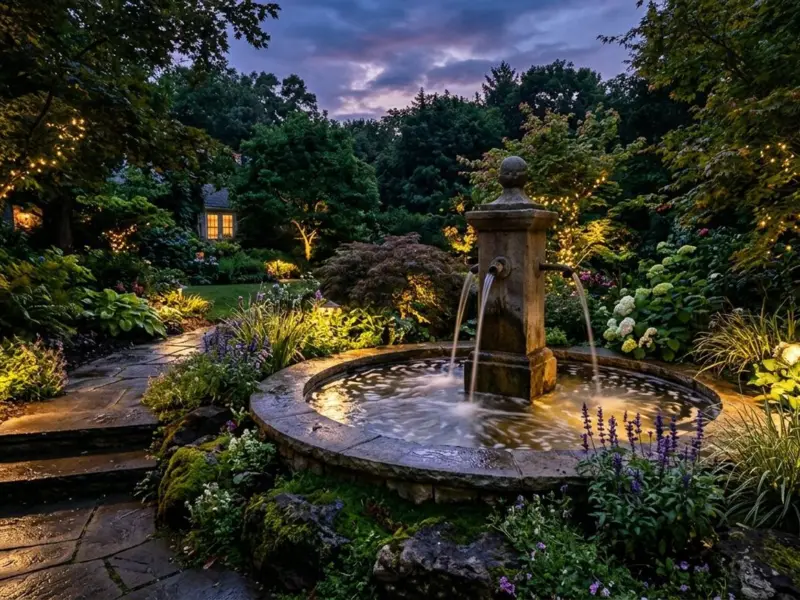
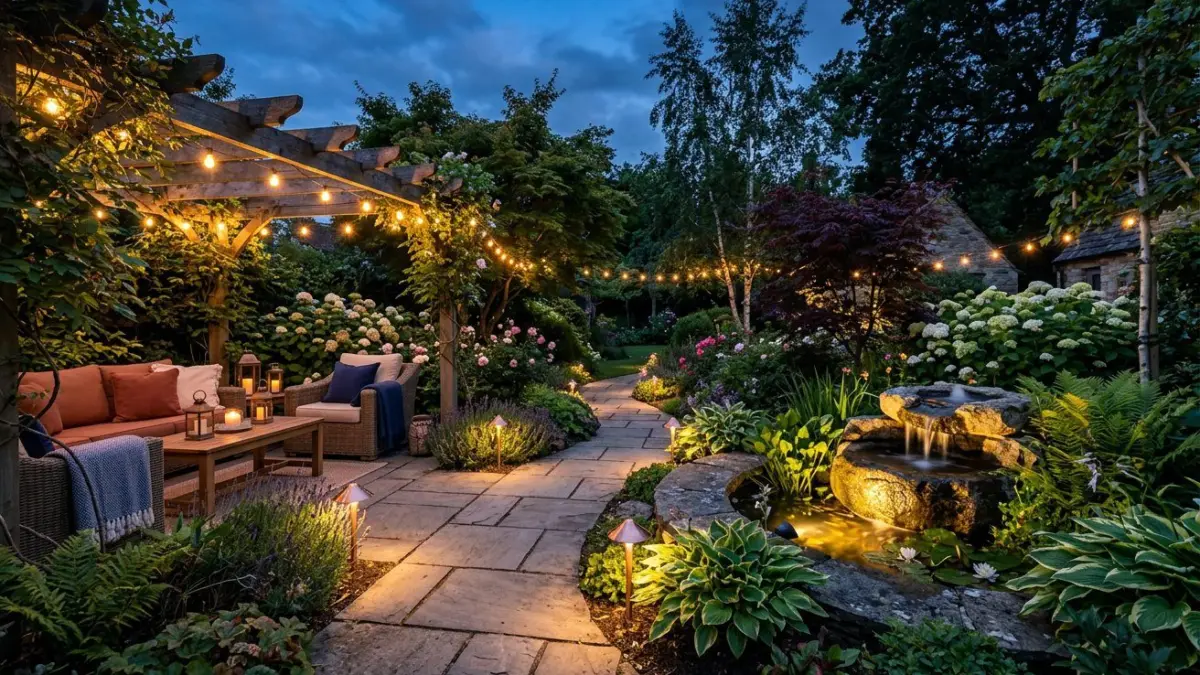
Lighting and water turn the after-work garden into your best room. The three lighting layers, path pools for safety, uplit accents for drama, warm ambient for living, obey one rule: less, better, warm-white only. Water follows effort-matching: a bubbler urn for sound with a bucket footprint, a pond as a chosen ecosystem project, always moving water and always sited where you actually sit. The payoff is a garden used at 8pm instead of merely seen at noon.
The Seasonal Rhythm of Garden Design & Landscaping
Late winter. The design season: walk the space, photograph it weekly, and draft the year’s projects on paper while nothing distracts. Order materials before spring premiums.
Spring. Build season: paths laid, lawns renovation-raked and top-dressed, borders re-edged, balconies restyled as nights warm. Plant the structure plants early so they root before heat.
Summer. Live in the design and note its failures honestly, the path everyone refuses, the bench nobody uses. Water the lawn by law, deadhead the color drifts, and enjoy the lighting after sunset.
Autumn. Second build window: hardscape as soil cools, bulbs threaded through borders for spring, evergreen structure planted so winter bones improve. Mulch everything before leaves finish falling.
Your First 30 Days with Garden Design & Landscaping
Weekend one: photograph the space hourly for one day (light map), sketch its current lines, and mark where you actually walk. Every redesign starts with the truth.
First month: build one weekend project, a gravel path, one three-tier corner, or a railing planter row, and install lighting along one route only. Live with it before adding more.
First season: commit to a two-color-plus-green palette, rebuild one bed with triangles and drifts, and create one hidden destination. By season’s end the garden should photograph like a plan, because it now is one.
The Science, Briefly
Design’s effects are measurable. Cool-color recession exploits optics: short-wavelength blues scatter and read farther, which enlarges small gardens literally as well as perceptually. Turf physiology underwrites the mowing law: cutting more than a third of blade height removes the leaf area fueling root regrowth, which is why scalped lawns weaken while tall lawns shade out weed germination. Perceived water sound masks urban noise at frequencies traffic dominates: the reason a small bubbler makes a courtyard feel quieter than decibels explain.
10 Mistakes That Sink Gardeners in This Topic
- Buying plants before the light map exists.
- One of everything at the nursery; no repetition, no rhythm.
- Hardscape laid flat: puddles, ice, mosquitoes.
- Paths too narrow, then cut across forever after.
- Tiny pots and fussy décor shrinking an already small garden.
- Mowing short 'to mow less', weeds arrive to take the invitation.
- String lights over cool-white floods; mood dies at 4000K.
- Water features under trees: leaf-straining maintenance forever.
- Building the balcony garden before checking the load and the wind.
- Forgetting winter: structure plants are what the garden wears in January.
Myths Worth Retiring
“Design is only for big gardens.” Small spaces benefit most: every mistake is closer to the chair. Concentration is the point, not the obstacle.
“Lawns need chemicals to stay green.” They need height, deep water and moderate feeding; chemistry treats symptoms the three laws prevent.
“Curves are informal, straight is boring.” Both are honest choices: formality is a style, not a failure. The crime is a curve that decorates instead of leading.
“Lighting means floodlights.” Floods are for security perimeters. Garden lighting is pools, accents and warm ambient, darker, better.
The Toolkit: What You Actually Need
- Graph paper and a tape measure, the entire professional kit for a master plan
- A hose used to lay out curves on the ground before any digging
- Landscape fabric, steel edging and a rake for the weekend gravel path
- A moisture probe for the lawn's honest weekly read
- String lights rated outdoors, warm-white only
- A solar test: one afternoon watching where shadows actually fall
- Quality secateurs and a leaf rake for the maintenance rhythm
- A camera: monthly photos from the same two spots reveal the design's progress
Plain-Language Glossary
- Sight line
- The uninterrupted view that carries the eye; designed, not accidental.
- Destination
- A reason to walk somewhere, bench, birdbath, fire bowl, that creates journey.
- Garden room
- A partially enclosed zone that reads as its own space.
- Hardscape
- The built surfaces, paths, walls, paving, that carry the garden's bones.
- Drift
- A repeated planting group of one species; rhythm in plant form.
- Advance/recede
- Hot colors pull forward, cool colors push back, space-shaping by hue.
- Dripline
- The outer leaf circle of trees; the lawn's shade boundary.
- Topdressing
- A thin compost layer over lawns or beds that feeds without digging.
- Scalping
- Mowing too low; the original lawn sin.
- Ambient layer
- The low, warm light people actually sit in.
- Bubbler
- A small self-contained water feature producing real sound.
- Microclimate
- The pocket climate a wall, shade or paving creates, plant for it.
Regional Notes
Hot and dry: design for shade first: structures, trees and pergolas are the garden’s architecture; gravel and stone are climate-appropriate, not lazy. Humid tropics: growth speed demands planning for year-two size and constant editing; covered outdoor rooms matter more than lawns. Cold climates: the winter view is the design exam, structure plants, evergreens and hardscape proportions carry eleven weeks of bare bones. Coastal: wind shaping, salt-tolerant palettes and views worth borrowing define the brief.
How This Hub Connects to the Rest of the Site
Design is the client for every other hub: it orders trees from the tree hub, borders from flowers, lawns from the lawn guide, and infrastructure from soil and water. Every planting skill on this site performs on the stage the design hub builds.
The Deeper Why: Design Is Time Travel
Every design decision is a message to your future self. The path laid one meter too narrow is an argument you will have weekly for a decade; the tree planted without mature-size thought is a argument your roof joins in year twelve. This is why design feels slow and abstract in the planning weekend and inevitable afterward; it is the only gardening that happens entirely in advance, and its mistakes are the only ones that compound in concrete.
The flip side is why this hub matters more than any planting guide: a modest design, correct, elevates modest plants into a garden, while excellent plants in a broken design never recover their cost. Buy the design weekend before the plant shopping spree; it is the only purchase in this entire site that improves everything else it touches.
Advanced Field Notes
- Photograph from the sofa: the views you live with are framed from seating, not standing, design the sightlines from where you actually sit.
- One specimen, not ten accents: a single sculptural plant at a path’s bend outperforms scattered decorative purchases; focal points work by scarcity.
- Plant evergreens at a 1:4 ratio, one evergreen to four deciduous perennials, and the border keeps its bones while everything else sleeps.
- Night-design the route you walk to the bins: utility paths lit warm and low are the design touch residents praise most and guests never notice, which is the point.
- Leave one quarter wild: an unmown strip, a brush pile, a log, the design that includes mess hosts the ecosystem the rest of the garden quietly rents from.
Common Objections, Answered
“Design feels rigid: I like discovering as I go.” Then design the frame and improvise the filling: hardscape lines, tree positions, and destinations planned; everything between them free. Structure and spontaneity are not rivals; one hosts the other.
“My garden is too small for zones.” Zones scale down but never disappear, a corner bench IS a destination, a railing IS a boundary. Concentration makes design matter more, not less.
“I’ll design it after the plants grow in.” Plants grow into their positions, not into a plan, and moving a mature border costs triple. The planning weekend is the cheapest labor the garden will ever receive.
Three Field Confessions
The path everyone refused. A gently curving path, laid exactly where the plan said, and every foot in the household cut the diagonal instead. The desire line won within a season; the path now runs where the feet drew it, and visitors assume it was always so. Design argues with use; use wins.
The bench with no view. Placed for symmetry on the plan, it faced a fence. Nobody sat. Turned ninety degrees to face the borrowed view of a neighbor’s pear tree in blossom, it became the most-used seat on the property. The view was always the point; the plan had not asked it.
The floodlight mistake. One security-grade flood that turned the garden into a car park every evening. It took a season and a string of warm low lights to learn the first rule by breaking it: darkness is the canvas, and the lights are the brushstrokes.
The 7-Day Starter Plan
Day 1: photograph the space hourly for one day, the light map is the design’s foundation. Day 2: measure and sketch boundaries, doors, and existing plants on graph paper. Day 3: photograph or mark the desire lines, where feet and eyes actually travel. Day 4: place the seat: evening light, best view, chosen first. Day 5: trace-paper sketches: three zones maximum, one destination, lines that lead. Day 6: write the maintenance budget and phase the plan into seasons. Day 7: buy or order exactly one phase-one project’s materials.
A week from blank yard to a phased master plan with its first project underway, the professional sequence, compressed but intact.
What single design change transforms a plain garden most?
A destination: hide the far corner and put a bench or feature there. Journey and arrival turn planting into a place.
How do I make a small garden feel bigger?
Diagonal lines, three-tier planting, cool colors at the far end, and few large pots instead of many small ones. Clutter shrinks; calm enlarges.
Is gravel or mulch better for paths?
Gravel for main routes, firm and drainable; mulch for casual bed-side strolls, soft, cheap, soil-feeding, needs topping up.
What's the most common lawn mistake?
Mowing too short. Raise the deck and most lawn problems shrink within a season.
How many lights does a garden actually need?
Fewer than you think: path pools every 2-3 meters on one route, one uplit tree, one warm ambient cluster where you sit.
What's the first thing to change in a bland garden?
Add one destination and the path to it. Journey and arrival create 'garden' out of 'yard' faster than any planting scheme.
How many hardscape materials is too many?
Two plus a natural accent, three surfaces compete and the eye reads clutter. Repeat each material at least twice.
Can lighting be installed without an electrician?
Solar for ambient, low-voltage 12V kits for accents, both safely DIY. Anything mains-voltage belongs to a professional.
How do I design for both kids and plants?
Tough lawn or play surface as one zone, raised or fenced beds elsewhere, and impact-tolerant planting at edges. Kids' routes are desire lines too.
What makes a garden look professionally designed?
Repetition, restraint, and mature-size planning: few plants repeated in drifts, three materials maximum, space for everything to grow into itself.
Is a water feature worth the maintenance?
A bubbler or wall spillway, yes, minutes weekly. A pond: only as a chosen hobby. Match the water to the effort you will actually enjoy.
Guides at a Glance
- Small Garden Design Ideas: Vertical growing, sight lines, garden rooms, scale play
- Lawn Care Basics, Mow high, water deep, feed light, the three laws
- Garden Paths & Hardscaping: Materials, lines, drainage, the weekend gravel path
- Balcony & Terrace Gardens: Load, wind, three layers, the outdoor room
- Garden Color Theory: Palettes, advance/recede, the white garden trick
- Water Features & Garden Lighting: Three lighting layers and water that soothes, not chores
What does “Sight line” mean in practice?
The uninterrupted view that carries the eye; designed, not accidental.
What does “Destination” mean in practice?
A reason to walk somewhere, bench, birdbath, fire bowl, that creates journey.
What does “Garden room” mean in practice?
A partially enclosed zone that reads as its own space.
What does “Hardscape” mean in practice?
The built surfaces, paths, walls, paving, that carry the garden's bones.
What does “Drift” mean in practice?
A repeated planting group of one species; rhythm in plant form.
What does “Advance/recede” mean in practice?
Hot colors pull forward, cool colors push back, space-shaping by hue.
Revision Cards: The Guides at a Glance
Small Garden Design Ideas: Vertical growing, sight lines, garden rooms, scale play. Budget: One planning session.
Lawn Care Basics, Mow high, water deep, feed light, the three laws. Budget: One season of rhythm.
Garden Paths & Hardscaping: Materials, lines, drainage, the weekend gravel path. Budget: One weekend.
Balcony & Terrace Gardens: Load, wind, three layers, the outdoor room. Budget: One setup weekend.
Garden Color Theory: Palettes, advance/recede, the white garden trick. Budget: One season of drifts.
Water Features & Garden Lighting: Three lighting layers and water that soothes, not chores. Budget: One weekend + one evening.
Seasonal Checklist, Condensed
- Late winter. The design season: walk the space, photograph it weekly, and draft the year’s projects on paper while nothing distracts.
- Spring. Build season: paths laid, lawns renovation-raked and top-dressed, borders re-edged, balconies restyled as nights warm.
- Summer. Live in the design and note its failures honestly, the path everyone refuses, the bench nobody uses.
- Autumn. Second build window: hardscape as soil cools, bulbs threaded through borders for spring, evergreen structure planted so winter bones improve.
Pace Yourself: The Long View
- Weekend one: photograph the space hourly for one day (light map), sketch its current lines, and mark where you actually walk.
- First month: build one weekend project, a gravel path, one three-tier corner, or a railing planter row, and install lighting along one route only.
- First season: commit to a two-color-plus-green palette, rebuild one bed with triangles and drifts, and create one hidden destination.
Advanced Vocabulary, Applied
- Dripline: The outer leaf circle of trees; the lawn's shade boundary.
- Topdressing: A thin compost layer over lawns or beds that feeds without digging.
- Scalping: Mowing too low; the original lawn sin.
- Ambient Layer: The low, warm light people actually sit in.
- Bubbler: A small self-contained water feature producing real sound.
- Microclimate, The pocket climate a wall, shade or paving creates, plant for it.
Study Notes: The Guides in Brief
- Small Space, Big Moves: The small-garden guide collects the professional space-doublers: vertical growing on walls and arches, diagonal lines that fake depth, three-tier layering that softens boundaries, hidden corners that create journey and destination, and the counterintuitive scale rule: few large elements read calmer and larger than many small ones.
- The Three Lawn Laws: Lawns fail by doing the opposite of three habits: mowing high (never more than a third of blade height, taller grass shades weed seeds and survives heat), watering deep and rare (weekly soaks that train roots down, mornings only), and feeding light at the right moments.
- Bones Before Blooms: Hardscape is the garden's February appearance and its daily foot-feel.
- The Outdoor Room: Balconies and terraces are design at maximum concentration: structure first (load limits, wind screens), sun mapped honestly, then three layers, deck-tile floors, railing planters, vertical screens, and finally the chair, because a garden you cannot sit in is a chore.
- Color With Intent: The color guide converts the artist's wheel into bed-level decisions: hot colors advance and energize near patios; cool colors recede and enlarge small gardens; palettes of two or three hues plus green, repeated in drifts, read as intent while singles read as noise.
- The Evening Garden: Lighting and water turn the after-work garden into your best room.
Frequently Asked: The Index
- What single design change transforms a plain garden most?
- How do I make a small garden feel bigger?
- Is gravel or mulch better for paths?
- What's the most common lawn mistake?
- How many lights does a garden actually need?
- What's the first thing to change in a bland garden?
- How many hardscape materials is too many?
- Can lighting be installed without an electrician?
- How do I design for both kids and plants?
- What makes a garden look professionally designed?
- Is a water feature worth the maintenance?
Practice Drills for This Week
- Drill 1: Sight Line: find this concept in your own garden this week and write one line about it in the log.
- Drill 2: Destination: find this concept in your own garden this week and write one line about it in the log.
- Drill 3: Garden Room: find this concept in your own garden this week and write one line about it in the log.
- Drill 4: Hardscape: find this concept in your own garden this week and write one line about it in the log.
- Drill 5: Drift: find this concept in your own garden this week and write one line about it in the log.
- Drill 6: Advance/Recede: find this concept in your own garden this week and write one line about it in the log.
- Drill 1: Sight Line: find this concept in your own garden this week and write one line about it in the log.
- Drill 2: Destination: find this concept in your own garden this week and write one line about it in the log.
- Drill 3: Garden Room: find this concept in your own garden this week and write one line about it in the log.
- Drill 4: Hardscape: find this concept in your own garden this week and write one line about it in the log.
- Drill 5: Drift: find this concept in your own garden this week and write one line about it in the log.
- Drill 6: Advance/Recede: find this concept in your own garden this week and write one line about it in the log.
All Garden Design guides
Small Garden Design Ideas: 10 Tricks That Double Your Space
Vertical growing, sight lines, diagonal paths, scale play and the 'garden rooms' method, make a tiny courtyard feel twice its size.
Lawn Care Basics: A Season-by-Season System
Mow high, water deep, feed light: the three laws of a great lawn, plus weed and bare-patch repair without turning your yard into a chemistry project.
Garden Paths & Hardscaping: Build the Bones of Your Garden
Materials compared, curves vs straights, drainage and edging, and how to lay a simple gravel or stepping-stone path over a weekend.
Balcony & Terrace Gardens: The Complete Setup Guide
Weight limits, wind, railing planters, privacy screens and the perfect container lineup, turn 10 square meters into a layered outdoor room.
Garden Color Theory: Paint Your Beds Like an Artist
The color wheel applied to real beds: monochrome elegance, complementary drama, analogous calm, plus the white-garden trick and seasonal color drift.
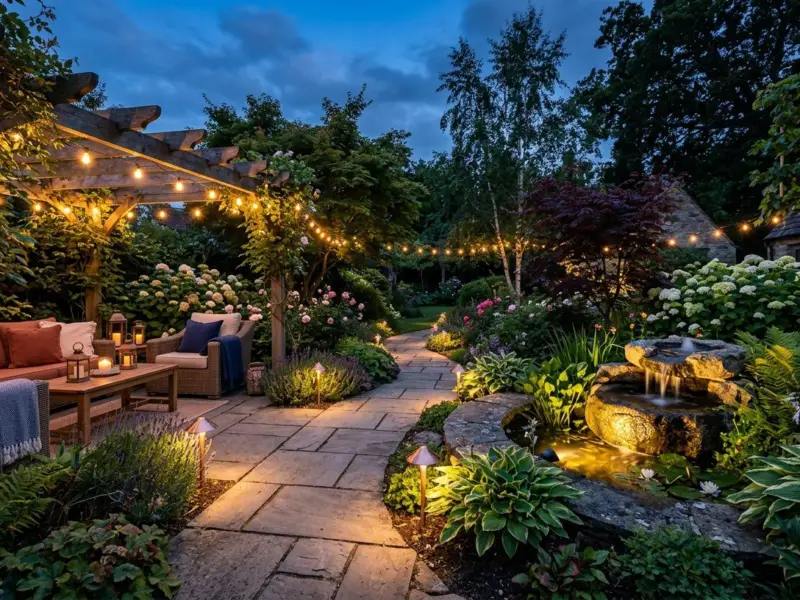
Water Features & Garden Lighting: The Evening Transformation
Solar vs wired lighting, layering light like a pro, and choosing a water feature that soothes without becoming a chore, design your after-dark garden.
Garden Design Principles: Balance, Scale, Rhythm and Unity
The handful of design principles professionals use to make gardens look right: balance, proportion, rhythm, focal points, contrast and unity. Learn them once and apply them…
Garden Styles Explained: Formal, Cottage, Modern, Japanese and More
A clear guide to the main garden styles: formal, cottage, modern, Japanese, Mediterranean, woodland, naturalistic and the Mughal charbagh. Learn their key features and how to…