How to Plant Seeds Step by Step (Complete Beginner Guide)

Every great garden starts with a seed — and most beginner failures happen in the first ten days. The good news: sowing seed successfully is a repeatable skill, not luck. This guide gives you the exact method used by nursery growers, simplified for home gardens and containers.

Seed Sowing at a Glance

  • Depth rule: sow at 2–3× the seed’s own diameter
  • Fine seeds (petunia, mint): surface-sow, press gently, no covering
  • Temperature: most seeds germinate at 18–24°C
  • Watering: mist or bottom-water; never blast with a hose

Step 1 — Prepare a Fine, Loose Seedbed

Seeds cannot push through compacted crusty soil. Loosen the top 10 cm and break down lumps, or fill trays with a light, sterile seed-starting mix. Firm it gently — you want contact, not concrete.

Step 2 — Sow at the Right Depth and Spacing

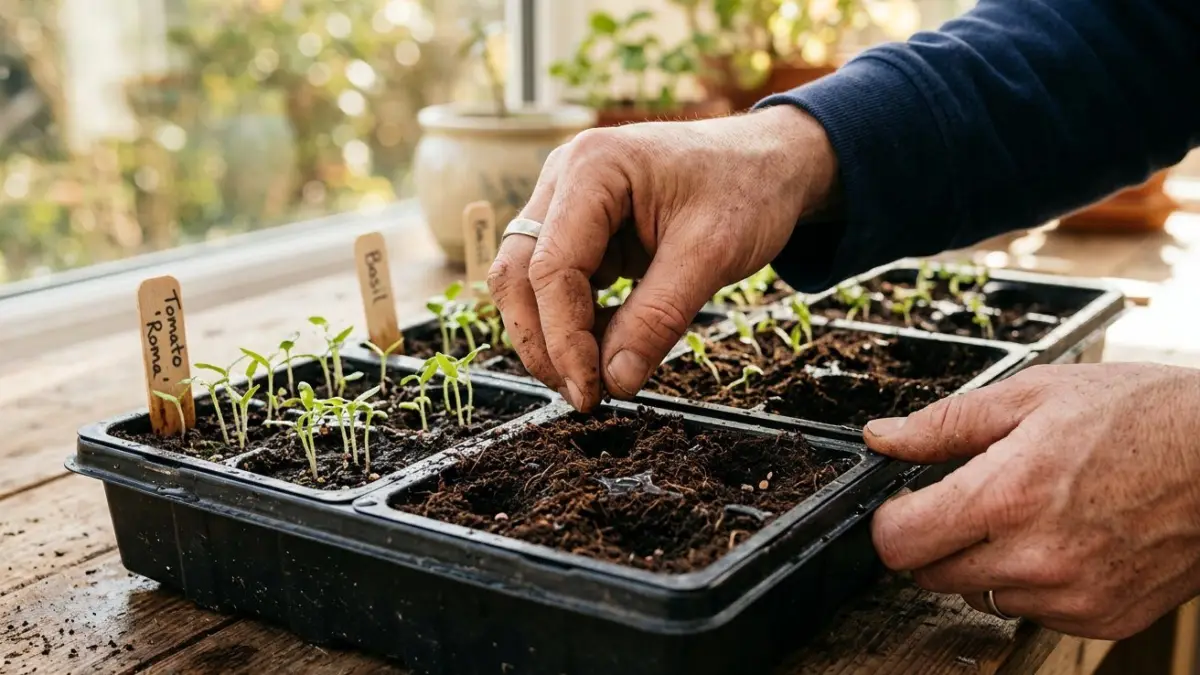
Plant too deep and the seedling exhausts itself before light; too shallow and it dries out. Follow the 2–3× diameter rule, sprinkle a thin layer of mix over the row, and label everything immediately. Future-you will thank you.

Step 3 — Water Gently and Keep It Consistent

The number one seed killer is alternating soaking and drying. Water with a fine mist or let trays soak from below for ten minutes. Cover with plastic wrap or a propagator lid until sprouts appear, then remove it the same day to prevent damping-off fungus. Our complete watering guide covers this in depth.

Step 4 — Light Immediately

As soon as green appears, seedlings need 12–16 hours of bright light. A sunny windowsill works; a cheap LED grow light works better and prevents leggy, pale seedlings.

Common Mistakes to Avoid

  • Sowing a whole packet in one pot — thin ruthlessly; crowded seedlings all lose.
  • Using garden soil in trays — it compacts and carries damping-off disease.
  • Sowing cool-season and warm-season crops on the same day; check our seasonal planting calendar first.

Frequently Asked Questions

Why are my seeds not germinating at all?

Usually one of three reasons: the seed was too old (viability drops after 2–3 years for many vegetables), the soil was too cold, or it dried out during germination. Test old seed on a damp paper towel before sowing a whole row.

Can I sow seeds straight into the garden?

Yes — direct sowing works beautifully for carrots, beans, sunflowers, radish and zinnias. Prepare the bed finely, keep it consistently moist, and thin seedlings once they show two true leaves.

Next step: once your seedlings have two sets of true leaves, move on to transplanting seedlings without shock, and explore the full plant growing guides hub for the rest of the journey.

Water Logic for seed starting

Plant stage Soil check Water move
Seed sown, not sprouted Surface never dry Mist twice daily or bottom-soak trays
Seedling, true leaves showing Top 1 cm dry Gentle can, daily-ish in heat
Established in bed Top 4 cm dry Deep soak, then wait
Flowering/fruiting Never swings Steady rhythm — swings cost the crop
Dormant/cool season Barely moist Long gaps; check before pouring

Print this table, tape it inside the shed door, and override it only with your own finger’s verdict. Water is the variable gardeners control most often and understand least; the table turns it into a lookup instead of a guess.

The Observation Habit That Grows with seed starting

Gardening’s deepest skill is noticing. The trained eye reads a leaf’s angle before its color, soil’s smell before its texture, and a plant’s posture before either. Build the habit with three anchors: same walking route, same time of day, one written line per walk. Within a month the route becomes a baseline — you will spot the droop, the yellow freckle, the chewed edge, days before a casual glance would.

Photography sharpens it further: one photo per plant per week, same angle. The camera holds weeks still for comparison in a way memory will not, and the archive becomes your personal field guide — every past mistake annotated, every recovery documented, every variety’s habits recorded for next season’s smarter choices.

Deep Dive: What Experienced Growers Know About seed starting

The germination zone concept changes beginners’ results fastest: every species has a temperature band where enzymes run fastest, printed in the fine data of serious seed catalogs. Lettuce sprouts happily at 10–20°C but sleeps above 25; tomatoes demand 18–29. Matching tray to seed — a cool windowsill for lettuce, warm top-of-fridge for peppers — compresses emergence from three weeks to four days and outruns rot entirely.

Key Takeaways

  • Cotyledon: The seed's first embryonic leaves — fuel packaging, not true foliage.
  • True Leaves: The second-generation leaves that look like the adult plant; a transplant-readiness signal.
  • Damping Off: Fungal collapse of seedlings at the soil line; prevented by airflow, clean media and careful water.
  • Hardening Off: Gradual outdoor acclimation that thickens cuticles and conditions roots before transplanting.

More Questions About Seed Starting

Should I soak seeds before sowing?

Big, hard-coated seeds (peas, beans, okra) benefit from an overnight soak; fine seeds and carrots do not — wet carrot seed is unplantable.

How deep is too deep?

Beyond three times the seed's diameter, reserves run out before light arrives. When in doubt, shallower — surface-sow with a dust of vermiculite.

Do seeds need light to germinate?

Most don't until they emerge, but lettuce, petunia and many herbs are light-triggered — those go on the surface, pressed in, never buried.

Field Questions Answered

How long should a seedling stay in its tray?

Until its second set of true leaves — roots filling the cell but not circling. Holding longer stunts; moving earlier wastes the tray's protection.

What time of day is best for sowing?

Evening for outdoor beds — seeds settle overnight in cool moisture. Indoor trays don't care; consistency beats timing.

Can I reuse seed trays every year?

Yes after scrubbing and a 10% bleach or hydrogen-peroxide soak — damping-off pathogens persist in last year's grime.

Why do seedlings need a fan?

Gentle air movement stiffens stems, dries foliage, and prevents fungal pockets — the cheapest 'hardening' that works indoors from day one.

Common Mistakes to Avoid with Seed Starting

  • Sowing the entire packet at once and thinning never — crowded seedlings share one small shadow.
  • Using garden soil in trays: compaction plus damping-off organisms in one move.
  • Skipping hardening off because the seedlings look strong — leaves lie until the first full-sun afternoon.
  • Watering on autopilot instead of by finger test; calendars have never met your soil.
  • Burying the root flare of transplants and trees — suffocation on a years-long fuse.

Further Field Questions

How long should a seedling stay in its tray?

Until its second set of true leaves — roots filling the cell but not circling. Holding longer stunts; moving earlier wastes the tray's protection.

What time of day is best for sowing?

Evening for outdoor beds — seeds settle overnight in cool moisture. Indoor trays don't care; consistency beats timing.

Can I reuse seed trays every year?

Yes after scrubbing and a 10% bleach or hydrogen-peroxide soak — damping-off pathogens persist in last year's grime.

Why do seedlings need a fan?

Gentle air movement stiffens stems, dries foliage, and prevents fungal pockets — the cheapest 'hardening' that works indoors from day one.

How do I water seedlings on vacation?

Bottom-water trays in a shallow bath, or capillary mats. A week is survivable; ten days needs a plant-sitter or self-watering setup.

Is bottom heat worth it for every seed?

Only warm-season crops — peppers and tomatoes halve germination time; lettuce and peas prefer cool and sprout anyway.

Further Field Questions

How long should a seedling stay in its tray?

Until its second set of true leaves — roots filling the cell but not circling. Holding longer stunts; moving earlier wastes the tray's protection.

What time of day is best for sowing?

Evening for outdoor beds — seeds settle overnight in cool moisture. Indoor trays don't care; consistency beats timing.

Can I reuse seed trays every year?

Yes after scrubbing and a 10% bleach or hydrogen-peroxide soak — damping-off pathogens persist in last year's grime.

Why do seedlings need a fan?

Gentle air movement stiffens stems, dries foliage, and prevents fungal pockets — the cheapest 'hardening' that works indoors from day one.

How do I water seedlings on vacation?

Bottom-water trays in a shallow bath, or capillary mats. A week is survivable; ten days needs a plant-sitter or self-watering setup.

Is bottom heat worth it for every seed?

Only warm-season crops — peppers and tomatoes halve germination time; lettuce and peas prefer cool and sprout anyway.

Further Field Questions

How long should a seedling stay in its tray?

Until its second set of true leaves — roots filling the cell but not circling. Holding longer stunts; moving earlier wastes the tray's protection.

What time of day is best for sowing?

Evening for outdoor beds — seeds settle overnight in cool moisture. Indoor trays don't care; consistency beats timing.

Can I reuse seed trays every year?

Yes after scrubbing and a 10% bleach or hydrogen-peroxide soak — damping-off pathogens persist in last year's grime.

Why do seedlings need a fan?

Gentle air movement stiffens stems, dries foliage, and prevents fungal pockets — the cheapest 'hardening' that works indoors from day one.

How do I water seedlings on vacation?

Bottom-water trays in a shallow bath, or capillary mats. A week is survivable; ten days needs a plant-sitter or self-watering setup.

Is bottom heat worth it for every seed?

Only warm-season crops — peppers and tomatoes halve germination time; lettuce and peas prefer cool and sprout anyway.

Further Field Questions

How long should a seedling stay in its tray?

Until its second set of true leaves — roots filling the cell but not circling. Holding longer stunts; moving earlier wastes the tray's protection.

What time of day is best for sowing?

Evening for outdoor beds — seeds settle overnight in cool moisture. Indoor trays don't care; consistency beats timing.

Can I reuse seed trays every year?

Yes after scrubbing and a 10% bleach or hydrogen-peroxide soak — damping-off pathogens persist in last year's grime.

Why do seedlings need a fan?

Gentle air movement stiffens stems, dries foliage, and prevents fungal pockets — the cheapest 'hardening' that works indoors from day one.

How do I water seedlings on vacation?

Bottom-water trays in a shallow bath, or capillary mats. A week is survivable; ten days needs a plant-sitter or self-watering setup.

Is bottom heat worth it for every seed?

Only warm-season crops — peppers and tomatoes halve germination time; lettuce and peas prefer cool and sprout anyway.

Further Field Questions

How long should a seedling stay in its tray?

Until its second set of true leaves — roots filling the cell but not circling. Holding longer stunts; moving earlier wastes the tray's protection.

What time of day is best for sowing?

Evening for outdoor beds — seeds settle overnight in cool moisture. Indoor trays don't care; consistency beats timing.

Can I reuse seed trays every year?

Yes after scrubbing and a 10% bleach or hydrogen-peroxide soak — damping-off pathogens persist in last year's grime.

Why do seedlings need a fan?

Gentle air movement stiffens stems, dries foliage, and prevents fungal pockets — the cheapest 'hardening' that works indoors from day one.

How do I water seedlings on vacation?

Bottom-water trays in a shallow bath, or capillary mats. A week is survivable; ten days needs a plant-sitter or self-watering setup.

Is bottom heat worth it for every seed?

Only warm-season crops — peppers and tomatoes halve germination time; lettuce and peas prefer cool and sprout anyway.

Further Field Questions

How long should a seedling stay in its tray?

Until its second set of true leaves — roots filling the cell but not circling. Holding longer stunts; moving earlier wastes the tray's protection.

What time of day is best for sowing?

Evening for outdoor beds — seeds settle overnight in cool moisture. Indoor trays don't care; consistency beats timing.

Can I reuse seed trays every year?

Yes after scrubbing and a 10% bleach or hydrogen-peroxide soak — damping-off pathogens persist in last year's grime.

Why do seedlings need a fan?

Gentle air movement stiffens stems, dries foliage, and prevents fungal pockets — the cheapest 'hardening' that works indoors from day one.

How do I water seedlings on vacation?

Bottom-water trays in a shallow bath, or capillary mats. A week is survivable; ten days needs a plant-sitter or self-watering setup.

Is bottom heat worth it for every seed?

Only warm-season crops — peppers and tomatoes halve germination time; lettuce and peas prefer cool and sprout anyway.