Palms are not trees botanically — and they let you know it in care requirements. One growing point (the heart), no bark, no branch collar, no secondary thickening. Treat a palm like an oak and you will slowly starve it; treat it like the giant grass-relative it is and it thrives.
Palm Care Fundamentals
- Feed with palm-specific fertilizer — high K + magnesium
- Never cut green fronds — each one feeds the heart
- Transplant in warm season, water intensely for 6 weeks
- Frost rescue: wrap the crown, never the fronds with plastic in sun
Feeding: The Deficiency Triad
Yellowing older fronds usually mean potassium or magnesium deficiency — the classic palm problem, made worse by ordinary lawn fertilizer. Use a slow-release palm formula with micronutrients two or three times in the warm season. General feeding principles still apply — see our fertilizer comparison — but palms specifically need that extra potassium.
Frond Rules — Less Is More
Remove only dead, brown fronds, cut a hand-width from the trunk. Green fronds are solar panels; over-trimming (“hurricane cutting”) starves the palm and weakens the trunk. If a frond hangs below horizontal, it can usually go; anything above stays.
Transplanting and First-Year Care
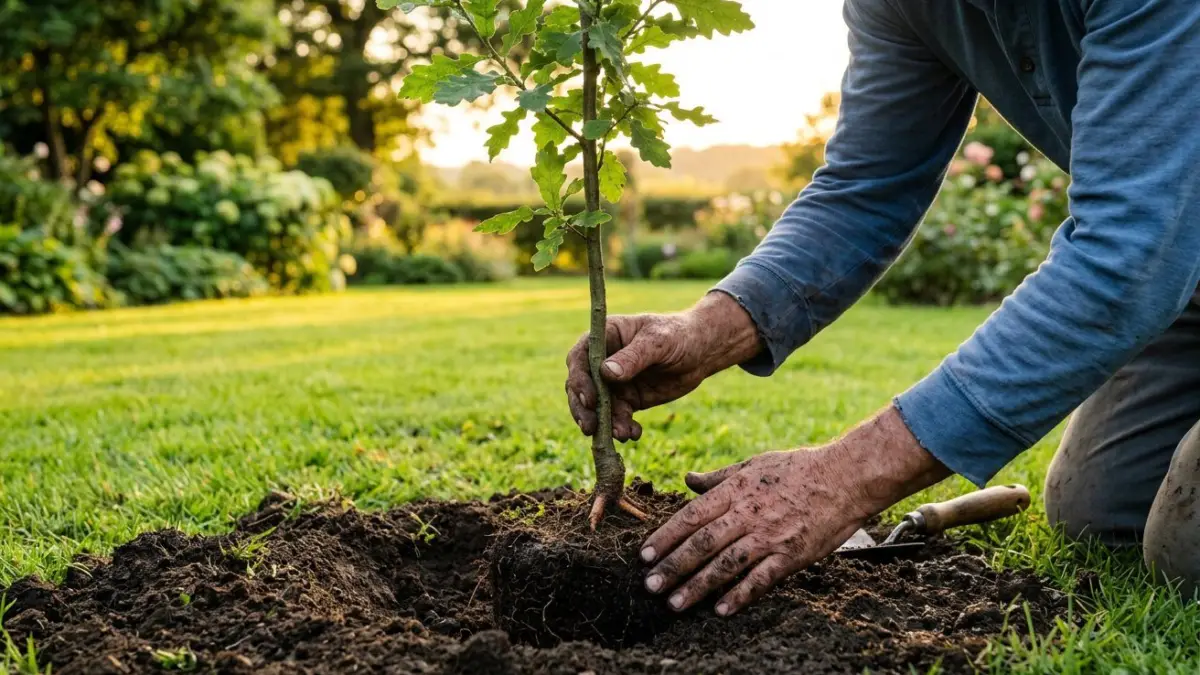
Palms transplant best in warm, humid months, and — unlike shade trees — they tolerate root ball reduction professionally. Plant at the same depth they grew, keep the soil moist for six weeks (their roots barely sleep during establishment), then settle into the deep-infrequent pattern of our tree watering guide.
Tropical Cousins: Banana, Frangipani, Brugmansia
Bananas are heavy feeders and drinkers — compost-rich soil and weekly deep water. Frangipani want sharp drainage and full sun; in cool seasons they drop leaves and look dead (they are not — this is the dormancy logic from our calendar guide). Protect all tropicals from cold wind first, frost second.
Common Mistakes to Avoid
- Skinning trunks of old frond bases — the “pineapple cut” permanently weakens palms.
- Planting the heart below soil when transplanting; the crown must stay dry and high.
- Assuming yellow fronds mean overwatering — test the soil first with our method from the watering guide.
Frequently Asked Questions
Why are my palm’s tips browning?
Usually potassium deficiency, salty water buildup, or wind burn. Flush the soil deeply, feed with a palm formula, and browning should halt on new growth. Old fronds never re-green.
Can I save a frost-burned palm?
Often yes — the heart decides. Leave damaged fronds on until warm weather (they insulate), keep soil lightly moist, and wait for the spear to push a new leaf. Two patient months answers the question.
Next: lock in your tree’s health with watering and mulching, or visit the trees hub for the whole path.
The First-Year Calendar for palm care
New trees run on a twelve-month contract. Months 1–3: root ball moisture checks twice weekly; berm basin watering deep; zero fertilizer; mulch ring maintained. Months 4–6: weekly checks; first flush of growth inspected for pests; stakes inspected and loosened if tight. Months 7–9: heat is the exam — deep soaks at the first morning wilt, never daily sprinkles; no pruning beyond broken wood. Months 10–12: taper watering to train roots outward; remove stakes; first formative corrections only if a leader or crossing branch demands it.
The calendar’s quiet genius is subtraction: every month you successfully do less, the tree does more.
Reading Tree Stress Before It Shows for palm care
Trees telegraph trouble a season early to anyone reading: smaller-than-normal leaves mean roots struggling; early autumn color in late summer means stress banking; sparse bud set in spring announces last summer’s drought; epicormic shoots (sprouts along the trunk) mean the canopy is failing to feed itself. Walk each tree monthly with those four signals in mind — ten seconds per tree — and problems arrive as adjustments rather than emergencies.
The one signal that overrides everything: the flare. Soil or mulch creeping over it undoes years of health silently, so the monthly walk ends where the tree begins.
Deep Dive: What Experienced Growers Know About palm care
Palms transport nutrients through their single growing point — the heart — which explains every palm rule at once. Over-trimming fronds starves the heart; buried crowns rot it; spear-pull (the newest leaf sliding out loosely) is its distress telegram. Feed for the deficiencies palms actually show: potassium and magnesium, the older-frond yellowing pair that general lawn fertilizer actively worsens with its potassium-competition. A palm-specific feed with micronutrients two or three times in warm weather is not marketing — it is the only diet matching palm biology.
Key Takeaways
- Compartmentalization: The process by which trees wall off decay behind chemical barriers.
- Chill Hours: Winter hours below ~7°C that stone fruits count before spring bloom.
- Water Sprout: Vigorous vertical regrowth after heavy topping cuts; weakly attached.
- Thinning Cut: A whole-branch removal to its origin; opens canopy and calms growth.
More Questions About Palm Care
Should I remove brown frond tips?
Cosmetic only — trim the dead part following the leaf shape. Green tissue is working solar panel; never remove it for tidiness.
How do I save a frost-hit palm?
Leave damaged fronds as insulation until warm weather returns, keep soil lightly moist, and wait on the spear: if a new leaf pushes within two months, the heart survived.
Can I plant palms in cool coastal climates?
Species choice decides — trachycarpus and butia handle real cold; royals and foxtails do not. Match the palm's homeland winter to yours.
Field Questions Answered
When is a tree officially 'established'?
When it survives a normal dry spell without supplemental water — usually two to three seasons after planting.
Should I prune a newly planted tree to 'balance' it?
No — leaves feed the roots that establish it. Remove only broken or crossing wood; shaping waits for year two or three.
How close can I plant a tree to a wall?
Half the mature canopy width, minimum — closer only with proven deep-rooted, well-mannered species like olive or crape myrtle.
Do trees need fertilizer every year?
Healthy trees in mulched soil usually feed themselves; feed only on a diagnosed deficiency. Fertilizer on stressed trees delays the real fix.
Common Mistakes to Avoid with Palm Care
- Planting with the root flare buried under backfill or mulch.
- Dug a deep narrow hole instead of a wide shallow one.
- Staking tight and forgetting it — sway builds trunk taper; rigid stakes build dependency.
- Amending only the planting hole, creating a pot in the ground roots refuse to leave.
- Pruning more than a quarter of the canopy in one year, forcing weak regrowth.
Further Field Questions
How close can I plant a tree to a wall?
Half the mature canopy width, minimum — closer only with proven deep-rooted, well-mannered species like olive or crape myrtle.
Do trees need fertilizer every year?
Healthy trees in mulched soil usually feed themselves; feed only on a diagnosed deficiency. Fertilizer on stressed trees delays the real fix.
Can I plant under an established tree?
Only tough dry-shade plants, in raised pockets of compost — never dig into the root zone or the canopy's feeder roots pay for it.
How much does a tree actually drink?
A mature shade tree can transpire 200–400 liters on a hot day — the case for deep, infrequent watering that reaches, not sprinkles that tease.
When is a tree officially 'established'?
When it survives a normal dry spell without supplemental water — usually two to three seasons after planting.
Should I prune a newly planted tree to 'balance' it?
No — leaves feed the roots that establish it. Remove only broken or crossing wood; shaping waits for year two or three.
Further Field Questions
How close can I plant a tree to a wall?
Half the mature canopy width, minimum — closer only with proven deep-rooted, well-mannered species like olive or crape myrtle.
Do trees need fertilizer every year?
Healthy trees in mulched soil usually feed themselves; feed only on a diagnosed deficiency. Fertilizer on stressed trees delays the real fix.
Can I plant under an established tree?
Only tough dry-shade plants, in raised pockets of compost — never dig into the root zone or the canopy's feeder roots pay for it.
How much does a tree actually drink?
A mature shade tree can transpire 200–400 liters on a hot day — the case for deep, infrequent watering that reaches, not sprinkles that tease.
When is a tree officially 'established'?
When it survives a normal dry spell without supplemental water — usually two to three seasons after planting.
Should I prune a newly planted tree to 'balance' it?
No — leaves feed the roots that establish it. Remove only broken or crossing wood; shaping waits for year two or three.
Further Field Questions
How close can I plant a tree to a wall?
Half the mature canopy width, minimum — closer only with proven deep-rooted, well-mannered species like olive or crape myrtle.
Do trees need fertilizer every year?
Healthy trees in mulched soil usually feed themselves; feed only on a diagnosed deficiency. Fertilizer on stressed trees delays the real fix.
Can I plant under an established tree?
Only tough dry-shade plants, in raised pockets of compost — never dig into the root zone or the canopy's feeder roots pay for it.
How much does a tree actually drink?
A mature shade tree can transpire 200–400 liters on a hot day — the case for deep, infrequent watering that reaches, not sprinkles that tease.
When is a tree officially 'established'?
When it survives a normal dry spell without supplemental water — usually two to three seasons after planting.
Should I prune a newly planted tree to 'balance' it?
No — leaves feed the roots that establish it. Remove only broken or crossing wood; shaping waits for year two or three.
Further Field Questions
How close can I plant a tree to a wall?
Half the mature canopy width, minimum — closer only with proven deep-rooted, well-mannered species like olive or crape myrtle.
Do trees need fertilizer every year?
Healthy trees in mulched soil usually feed themselves; feed only on a diagnosed deficiency. Fertilizer on stressed trees delays the real fix.
Can I plant under an established tree?
Only tough dry-shade plants, in raised pockets of compost — never dig into the root zone or the canopy's feeder roots pay for it.
How much does a tree actually drink?
A mature shade tree can transpire 200–400 liters on a hot day — the case for deep, infrequent watering that reaches, not sprinkles that tease.
When is a tree officially 'established'?
When it survives a normal dry spell without supplemental water — usually two to three seasons after planting.
Should I prune a newly planted tree to 'balance' it?
No — leaves feed the roots that establish it. Remove only broken or crossing wood; shaping waits for year two or three.
Further Field Questions
How close can I plant a tree to a wall?
Half the mature canopy width, minimum — closer only with proven deep-rooted, well-mannered species like olive or crape myrtle.
Do trees need fertilizer every year?
Healthy trees in mulched soil usually feed themselves; feed only on a diagnosed deficiency. Fertilizer on stressed trees delays the real fix.
Can I plant under an established tree?
Only tough dry-shade plants, in raised pockets of compost — never dig into the root zone or the canopy's feeder roots pay for it.
How much does a tree actually drink?
A mature shade tree can transpire 200–400 liters on a hot day — the case for deep, infrequent watering that reaches, not sprinkles that tease.
When is a tree officially 'established'?
When it survives a normal dry spell without supplemental water — usually two to three seasons after planting.
Should I prune a newly planted tree to 'balance' it?
No — leaves feed the roots that establish it. Remove only broken or crossing wood; shaping waits for year two or three.
Further Field Questions
How close can I plant a tree to a wall?
Half the mature canopy width, minimum — closer only with proven deep-rooted, well-mannered species like olive or crape myrtle.
Do trees need fertilizer every year?
Healthy trees in mulched soil usually feed themselves; feed only on a diagnosed deficiency. Fertilizer on stressed trees delays the real fix.
Can I plant under an established tree?
Only tough dry-shade plants, in raised pockets of compost — never dig into the root zone or the canopy's feeder roots pay for it.
How much does a tree actually drink?
A mature shade tree can transpire 200–400 liters on a hot day — the case for deep, infrequent watering that reaches, not sprinkles that tease.
When is a tree officially 'established'?
When it survives a normal dry spell without supplemental water — usually two to three seasons after planting.
Should I prune a newly planted tree to 'balance' it?
No — leaves feed the roots that establish it. Remove only broken or crossing wood; shaping waits for year two or three.