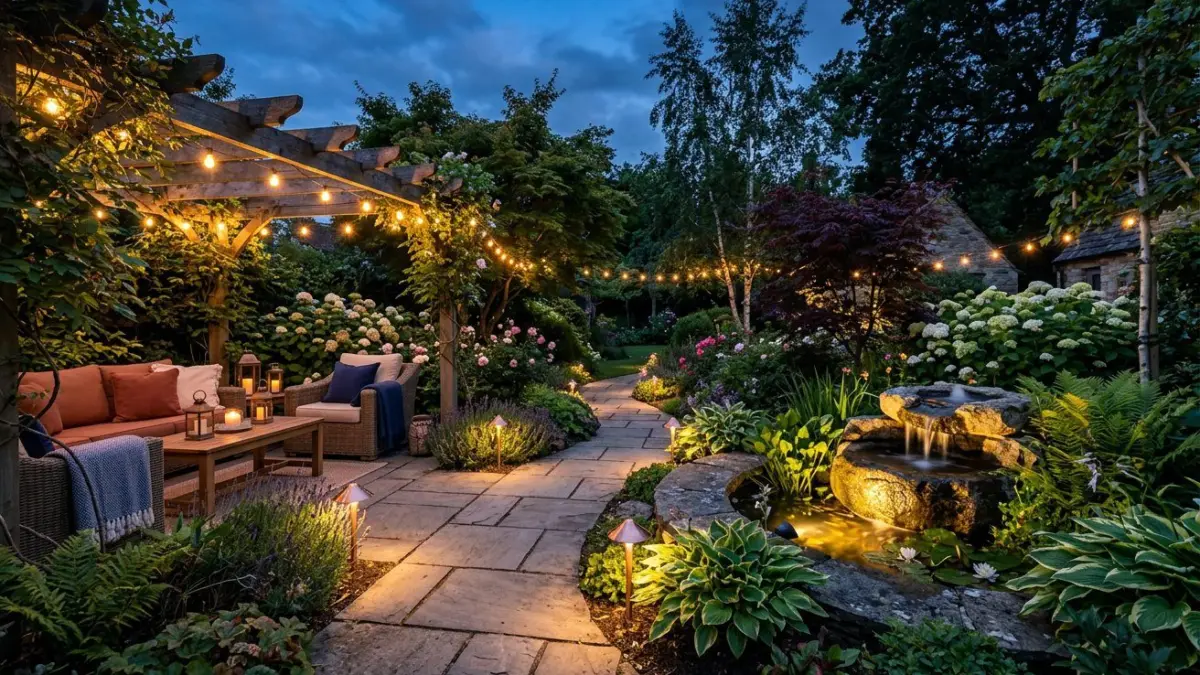
Quick answers
- What are the basic principles of garden design?
- Balance, scale and proportion, rhythm (repetition), contrast, focal points, unity and simplicity. Together they give a garden order, flow and a sense of intention.
- Where do I start designing my garden?
- Start with the structure: measure the space, note sun and shade, decide how you want to use it, then plan paths, seating and large plants before adding smaller ones.
- How many plant varieties should I use?
- Fewer than you think. Repeating a limited palette of 5–8 plants looks calmer and more professional than one of everything.
- How do I create a focal point?
- Use a striking tree, sculpture, water feature, bench or pot at the end of a path or sightline, and keep the surroundings simple so the eye lands there.
Key takeaways
- Design the structure first. Paths, edges and large plants hold a garden together.
- Repeat to create rhythm. Repeating shapes, colours and plants links the whole space.
- Use fewer plants in larger groups. Drifts beat dotted singles.
- Give the eye one focal point at a time, and a place to rest around it.
- Balance does not mean symmetry. Visual weight can be equal without being identical.
- Edit with courage. Simplicity is the hardest and most effective principle.
Table of contents13 sections
Walk into a beautiful garden and you feel it immediately: the space seems calm, generous and effortlessly right. Walk into a poor one and something is off, even if each plant is lovely. The difference is rarely the plants. It is design. Professional garden designers work from a short list of principles that anyone can learn and apply.
This guide explains each principle with practical examples and a simple process for designing your own space. It forms part of the Garden Design pillar and works alongside Garden Color Theory, Garden Paths & Hardscaping and Small Garden Design Ideas.
1. Balance
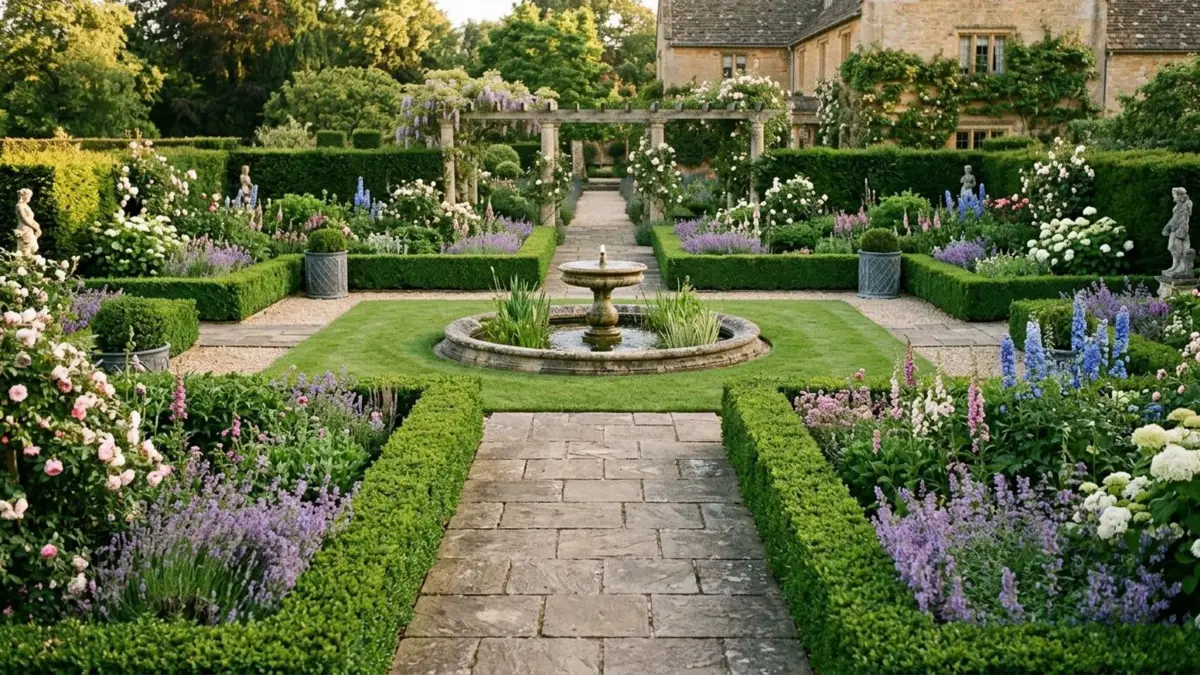
Balance means the garden feels stable rather than lopsided. Symmetrical balance mirrors one side with the other, as in formal gardens with a central path and matching beds. Asymmetrical balance uses different elements of equal visual weight: a large tree on one side balanced by a group of smaller shrubs and a bench on the other. Informal gardens use asymmetry, which feels more natural.
2. Scale and proportion
Elements should relate sensibly to the size of the garden and the house. A giant tree overwhelms a small courtyard; tiny plants vanish in a large lawn. As a rule of thumb, make paths at least 90 cm wide for comfortable walking and borders at least 1.2 m deep so you can layer plants.
3. Rhythm and repetition
Rhythm leads the eye along. Repeat a plant, a colour or a shape at intervals: a clipped box ball every three metres, a drift of the same grass at each end of a border. Repetition makes a garden feel designed rather than collected.
4. Contrast and variety
Without contrast a garden is dull. Combine shapes (spiky with rounded), textures (fine grasses with bold hosta leaves) and colours (see Garden Color Theory). Contrast works best within a framework of repetition: variety against unity.
5. Focal points
A focal point rewards the eye: a specimen tree, an urn, a sculpture, a water feature (see Water Features & Garden Lighting). Place it where paths end or sightlines meet, and give it breathing space. One strong focal point per view is better than five competing ones.
6. Unity
Unity is the sense that everything belongs together. Choose a limited palette of materials (one paving stone, one wood), repeat them, and let planting styles match the architecture of your house. Unity makes a garden restful.
7. Simplicity
The most common design mistake is too much: too many plants, ornaments and materials. Edit until each element has a job. Empty space (lawn, gravel, water) is not wasted; it lets the planting breathe.
Principles at a glance
| Principle | Ask yourself | Quick fix |
|---|---|---|
| Balance | Does one side feel heavier? | Add a tree, pot or bench to the lighter side |
| Scale | Do things feel too big or too small? | Widen paths, enlarge beds, resize plants and pots |
| Rhythm | Is anything repeated? | Repeat 2–3 key plants along the border |
| Contrast | Is everything the same shape or texture? | Add a spiky or bold-leaved plant |
| Focal point | Where does the eye land? | Create or clear one focal point |
| Unity | Do materials and styles match? | Reduce to one or two paving and fencing materials |
| Simplicity | Is it cluttered? | Remove a third of the ornaments and varieties |
A simple design process
- Observe and measure. Draw the plot to scale on graph paper. Mark the house, doors, windows, sun and shade through the day, existing trees, slopes and utilities.
- Write your needs. Seating, dining, play, a vegetable patch, storage, wildlife, privacy. Decide what you must have and what you would like.
- Draw bubble zones. Sketch rough circles for each use and join them with paths. Keep it loose.
- Add the structure. Fix paths, edges, seating areas and any hardscape (see Garden Paths & Hardscaping).
- Plant in layers. Trees and large shrubs first, then smaller shrubs, perennials and groundcover (see Trees and Annuals vs Perennials).
- Mark out on the ground. Use a hose or string to outline beds and paths and live with it for a week before digging.
- Build in phases. Structure first, planting next, ornaments last.
Plant in layers and drifts
Layering gives depth: tall plants at the back (or centre of island beds), medium in the middle, low at the front. Plant perennials and grasses in drifts of odd numbers (3, 5, 7). A single plant looks like a mistake; a group looks like a decision.
Habits that undermine results
- Starting with plants instead of structure
- Making paths too narrow and beds too shallow
- Planting one of everything
- Putting ornaments everywhere, so none stand out
- Ignoring views from the house: design the garden to be seen from the windows too
Quick wins to try first
- Take photos of your garden from the windows and crop them to look at proportions objectively.
- Use a limited colour palette of three main colours plus green.
- Curved edges should be gentle and generous; fussy wiggles look messy.
- Plan for year-round interest with evergreens, bark, seed heads and winter structure.
What to read next
Choose a style with Garden Styles Explained, make the most of limited space with Small Garden Design Ideas and pick colours using Garden Color Theory. Back to Garden Design & Landscaping.
More in Garden Design
Garden Styles Explained: Formal, Cottage, Modern, Japanese and More
A clear guide to the main garden styles: formal, cottage, modern, Japanese, Mediterranean, woodland, naturalistic and the Mughal charbagh. Learn their key features and how to…
Small Garden Design Ideas: 10 Tricks That Double Your Space
Vertical growing, sight lines, diagonal paths, scale play and the 'garden rooms' method, make a tiny courtyard feel twice its size.
Lawn Care Basics: A Season-by-Season System
Mow high, water deep, feed light: the three laws of a great lawn, plus weed and bare-patch repair without turning your yard into a chemistry project.