Quick answers
- What single change most improves beginner success rates?
- Sowing by soil temperature with a thermometer instead of by calendar date. It fixes germination speed and reduces rot in one stroke.
- How do I know if my seed is still viable?
- Place ten seeds on a damp paper towel in a warm spot for a week. Eight sprouting means ~80% viability: sow thickly or buy fresh accordingly.
- Is bottom watering always better?
- It is best for trays and dense foliage, keeping leaves dry and damping-off risk low. Established pots water normally from the top until drainage.
- Why do my seedlings stretch even on a bright windowsill?
- Glass filters light; add a LED grow light 10-15 cm above the tray for 14-16 hours. The stretch is the plant chasing light.
Key takeaways
- Learn the fundamentals first. Tools and gadgets depend on six basic skills that compound over years.
- Sow by soil temperature, not the calendar. A thermometer outperforms a heat mat for germination reliability.
- Water by soil feel, not by schedule. The finger test integrates everything a calendar misses.
- Match pot and mix to plant strategy. Succulents need different drainage than moisture-lovers.
- Propagate by species timing, not by hype. Species timing matters more than any additive.
- Use the calendar as a starting point, not a rule. Your garden microclimate shifts the dates.
- Keep a garden log from day one. Your own records beat any guide by year two.
- Build skill, not inventory. A well-used trowel beats a garage full of half-used gadgets.
Table of contents49 sections
- Why Fundamentals Beat Fancy Tools
- How to Use This Hub
- The Seasonal Rhythm of Plant Growing Guides
- Your First 30 Days with Plant Growing Guides
- The Science, Briefly
- 10 Mistakes That Sink Gardeners in This Topic
- Myths Worth Retiring
- The Toolkit: What You Actually Need
- Plain-Language Glossary
- Regional Notes
- How This Hub Connects to the Rest of the Site
- The Deeper Why: Skills as Compounding Assets
- Advanced Field Notes
- Common Objections, Answered
- Three Field Confessions
- The 7-Day Starter Plan
- What single change most improves beginner success rates?
- How do I know if my seed is still viable?
- Is bottom watering always better?
- Why do my seedlings stretch even on a bright windowsill?
- Can I transplant during bloom?
- What is the ideal seed-starting mix recipe?
- How long can hardened-off seedlings wait to be planted?
- Do I need a greenhouse to start from seed?
- Which plants never tolerate root disturbance?
- How do I keep trays warm without a heat mat?
- Is morning or evening watering really decisive?
- What's the single most underused free resource?
- How do I garden through a heatwave?
- Should I fertilize seedlings?
- What kills more gardens than pests?
- When do I give up on a struggling plant?
- Guides at a Glance
- Revision Cards: The Guides at a Glance
- Seasonal Checklist, Condensed
- Pace Yourself: The Long View
- Advanced Vocabulary, Applied
Welcome to the heart of gardening. This hub gathers the six foundational skills that separate thriving gardens from struggling ones: sowing seed correctly, transplanting without shock, watering the right way, choosing pots and potting mix, propagating your own plants and timing everything to the season.
Work through the guides below in order if you are new; they are sequenced exactly as a plant’s life unfolds. If you already know the basics, jump straight to the skill you want to sharpen. Every guide links back here and to its companions, so you can build knowledge step by step.
Once you are comfortable with these fundamentals, continue to our tree care hub or the vegetable and herb hub to put your skills to work.
Why Fundamentals Beat Fancy Tools
Walk through any garden show and you will see the same scene: gardeners crowded around gadget stalls while, a few beds away, someone with a thumb-sized trowel and a twenty-year watering can harvests baskets of vegetables. The difference was never the equipment. It is fluency in six unglamorous skills, sowing, transplanting, watering, potting, propagating and timing, compounded over seasons.
Fundamentals compound because every plant you ever grow passes through them. Learn to sow once, correctly, and ten thousand future seeds benefit. Learn to water by reading soil rather than calendars, and every crop, herb, tree and houseplant you own inherits the skill. This is why professional growers obsess over basics: their entire business is a tower built on the same six bricks assembled here.
The reverse is also true, and every experienced gardener has scars to prove it. A rare heirloom seed sown too deep, a gorgeous shrub planted with a buried root flare, a monstera loved to death with daily glasses of water, expensive inputs cannot rescue broken fundamentals. Master this hub and you will rarely need rescuing.
Treat the six guides below as a curriculum rather than a reading list. They are sequenced the way a plant actually lives: from seed, to pot, to garden, to season’s end. Work through them in order and the later guides will feel obvious; that is the compounding working.
How to Use This Hub
| Guide | What you will learn | Time to apply |
|---|---|---|
| How to Plant Seeds Step by Step | Germination conditions, depth rules, and why most seed failures happen in week one | One evening + 10 days of care |
| How to Transplant Seedlings | Hardening off, root handling, and the evening transplant that prevents shock | One week of hardening off |
| Watering Plants the Right Way | Deep-and-rare rhythm, the finger test, and reading plant signals | A season of practice |
| Choosing Pots and Potting Mix | Material physics, drainage truth, and mixes per plant type | One afternoon |
| Propagation by Cuttings | Nodes, water vs soil rooting, and free plants forever | 2-8 weeks per batch |
| The Seasonal Planting Calendar | The two seasons, frost math, and regional observation | One planning session |
Seed Starting, Decoded
Germination is a chemical event with three dials: moisture, oxygen and temperature. Water swells the seed and dissolves enzyme inhibitors; oxygen fuels the embryo’s first respiration; warmth sets the pace. Most failures come from drowning one dial to please another, soaking soil so densely that oxygen vanishes, or warming trays so dry air crusts the surface. The guide’s 2-3× depth rule exists because a seedling’s fuel reserve is measured in millimeters of travel. Fine, dust-like seeds carry almost no reserve, which is why they germinate on the surface under light. Learning the reserve logic behind the rule lets you improvise for any species, not just the ones on packets.
The Transplant Balancing Act
A seedling is a ratio: top growth to root mass. Nurseries manipulate the ratio with fertilizer and spacing to produce green sales-floor plants, sometimes at the expense of roots. Your job at transplant time is to protect what roots exist while the top readjusts its water budget, which is why hardening off works: it forces the leaf cuticle to thicken and roots to branch before the demand curve spikes. The guide’s evening-transplant rule buys 12 root-recovery hours before the sun invoices the leaves. Tomato burial exploits a unique trait, adventitious root initiation along the stem, turning a leggy seedling into an advantage.
Water as a Root Trainer
Every watering is a message to roots about where to grow. Frequent shallow sips say stay near the surface, where evaporation strikes first; rare deep soaks say descend, where moisture is stable. This is why watering discipline is really architecture design for the root system. The guide’s finger test is a primitive but honest sensor: it integrates moisture, texture and temperature in a way no schedule can. Pair the rhythm with mulch and compost and the soil itself becomes a reservoir, smoothing the gaps between your visits.
Container Physics
Perched water is the hidden variable in every pot: after saturation, gravity drains a container only until capillary hold equals weight, leaving a saturated layer at the bottom whose depth depends on pore size, not pot height. This is why adding gravel raises the waterline rather than improving drainage, why tall skinny pots dry differently than bowls, and why a mineral-heavy mix for succulents works, large particles create large pores, and large pores drain perched water completely. The guide’s 60/25/15 blend is simply an insurance policy against the two container killers: compaction and perched saturation.
Cloning by Cutting
Rooting a cutting is wound biology: cells at a node redifferentiate into root initials when moisture is constant, oxygen is available and auxin is elevated. Each method in the guide manipulates those variables. Water rooting maximizes moisture at the cost of oxygen, fine for soft-tissue plants that root fast, risky for woody stems that rot first. Soil or perlite rooting flips the trade: less water security, far more oxygen, which woody cuttings need for the long haul. Rooting hormone is commercial auxin; willow water and honey are folk substitutes with mixed evidence. Species timing, softwood, semi-hardwood, hardwood, matters more than any additive.
Timing as a Multiplier
The calendar guide’s two-season model, cool-season leaf and root crops, warm-season fruiting crops, is really a temperature map of plant metabolism. Peas and spinach photosynthesize efficiently in single-digit Celsius; tomatoes sulk below 12°C nights because their pollen fails. Sowing dates are therefore statements about soil temperature, not page numbers on a wall calendar. Learn your last-frost and first-frost dates, watch local phenology signs, and the calendar becomes personal: every bed, wall and courtyard in your garden runs its own microclimate, weeks apart.
The Seasonal Rhythm of Plant Growing Guides
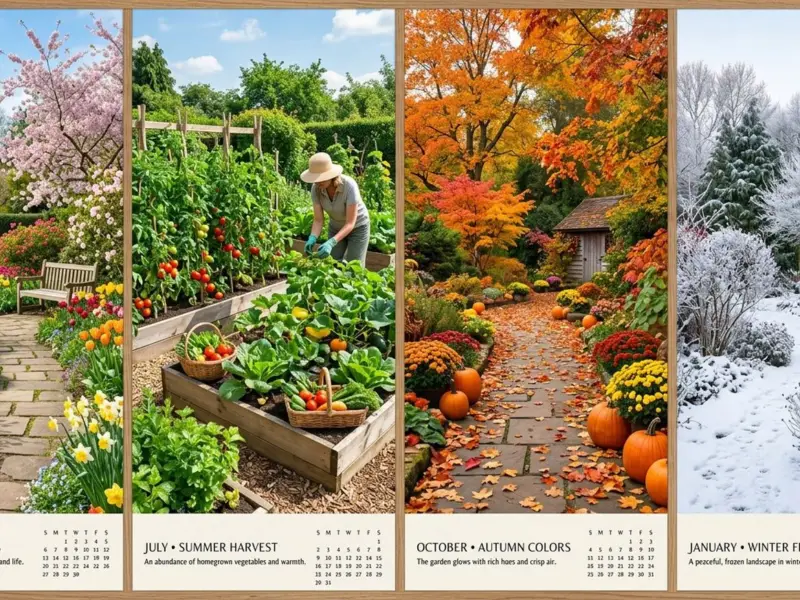
Late winter. The planner’s season. Order seed, test viability on paper towels, scrub trays, and start long-season warm crops indoors under lights. Sharpen tools. Top-dress overwintered beds with finished compost as soil becomes workable.
Spring. Execution season. Direct-sow cool crops the moment soil can be worked; stagger salad sowings fortnightly. Harden off and transplant warm-season starts after frost danger, per the transplant guide. Mulch beds as soil warms, not before, or you insulate cold earth.
Summer. Maintenance season. Water deep and rare, deadhead and harvest relentlessly (both are yield commands, not chores), watch pest pressure weekly, and start autumn brassica seedlings in shade for the coming window.
Autumn. The second spring. Sow cool crops again in most climates, plant spring bulbs and new trees as soil cools, and let the compost bin inherit the season’s cleanup, minus diseased material. Note what worked in a garden notebook while memory is fresh.
Your First 30 Days with Plant Growing Guides
First weekend: run the jar test on your soil, assemble the toolkit below, and sow one tray of something fast, radish or lettuce, to put theory in the ground immediately.
First month: complete the sowing and transplanting guides with a real tray of seedlings, harden them off, and move them into a prepared bed or container. Water with the finger test only; no schedule. Take five minutes weekly to photograph progress: future-you diagnoses better with evidence.
First season: attempt one water-rooted and one soil-rooted cutting batch. Keep a one-line-per-day garden log. At season’s end, read the calendar guide again: it will read differently with a season’s hands behind your eyes, and next year’s plan writes itself.
The Science, Briefly
Three findings from horticultural science quietly power this entire hub. First, root-zone temperature governs germination speed more than air temperature, a heat mat lifting media from 15°C to 22°C can halve emergence time for warm crops. Second, transpiration demand, not soil dryness alone, drives wilt: a seedling in dry wind can collapse in moist soil, which is why windbreaks and hardening off matter as much as the watering can. Third, oxygen is a root food: roots consume it directly, so compacted or waterlogged media starves them even when nutrition is perfect. Every technique here, fluffy seedbeds, gritty mixes, deep-and-rare watering, is oxygen logistics in disguise.
10 Mistakes That Sink Gardeners in This Topic
- Sowing the entire packet at once and thinning never, crowded seedlings share one small shadow.
- Using garden soil in trays: compaction plus damping-off organisms in one move.
- Skipping hardening off because the seedlings look strong, leaves lie until the first full-sun afternoon.
- Watering on autopilot instead of by finger test; calendars have never met your soil.
- Burying the root flare of transplants and trees, suffocation on a years-long fuse.
- Choosing pots for looks first: no drainage hole, no deal.
- Reusing diseased potting mix year over year, inoculating each new season with the last one's failures.
- Taking cuttings from flowering shoots: the plant is spending, not rooting.
- Sowing warm-season crops at the first sunny spell instead of by soil temperature.
- Never writing anything down; every season relearns the same lessons at full price.
Myths Worth Retiring
“A gravel layer improves pot drainage.” Physics says otherwise: gravel raises the perched water table upward, shrinking the aerated zone roots need. A mesh over the hole is all a pot needs.
“Misting raises humidity meaningfully.” The film of water evaporates within minutes; relative humidity barely registers. Grouping plants or running a humidifier does the real work.
“Leggy seedlings need fertilizer.” They need light: legginess is a stretch for photons, not hunger. Feeding accelerates the stretch.
“Bigger pot means bigger plant, faster.” Oversized containers hold weeks of unwanted moisture around small root balls; rot beats growth. Step up in modest increments.
The Toolkit: What You Actually Need
- A quality hand trowel: the single most-used tool you will own
- Fine-mist sprayer plus a long-spout watering can for gentle, targeted water
- Seed trays with clear lids, or any shallow container with drainage you can cover
- A simple soil thermometer: takes the guesswork out of every sowing date
- Sharp bypass pruners for cuttings and cleanup (plus isopropyl alcohol for wiping)
- Coarse perlite or pumice, coco coir and a bag of quality compost for mixing
- Plant labels and a waterproof pencil, memory is not a labeling system
- A cheap LED grow light if your brightest window still grows leggy seedlings
Plain-Language Glossary
- Cotyledon
- The seed's first embryonic leaves, fuel packaging, not true foliage.
- True leaves
- The second-generation leaves that look like the adult plant; a transplant-readiness signal.
- Damping off
- Fungal collapse of seedlings at the soil line; prevented by airflow, clean media and careful water.
- Hardening off
- Gradual outdoor acclimation that thickens cuticles and conditions roots before transplanting.
- Node
- The stem junction where leaves, buds and roots originate, the only place a cutting roots.
- Perched water
- The saturated layer at a container bottom, defined by pore size rather than pot height.
- Adventitious root
- A root arising from non-root tissue, like a buried tomato stem.
- Seed viability
- The share of seed still alive and able to germinate; decays with age and storage heat.
- Bottom heat
- Gentle warmth under trays that accelerates germination of warm-season species.
- Succession sowing
- Staggered repeat sowings that convert one harvest moment into a rolling supply.
- Hardening
- See hardening off: the off matters: it happens before the move, not after.
- Cuticle
- The leaf's waxy armor, thickened by hardening off against sun and wind.
Regional Notes
Hot and dry climates: shift the whole calendar earlier, cool crops in autumn through spring, summer reserved for okra, amaranth and melons; mulch stops being optional; and afternoon shade cloth extends lettuce season by months. Humid tropics: disease pressure rewrites priorities: airflow spacing, morning watering and resistant varieties matter more than fertility; the wet season grows soil cover, the dry one grows crops. Cold climates: the indoor seed-starting runway stretches to 8-10 weeks, cold frames add a month at each end, and soil temperature rules absolutely. Coastal: mild but windy: staking, windbreaks and salt-tolerant variety choices shape success more than temperature ever will.
How This Hub Connects to the Rest of the Site
This hub interlocks with the rest of the site as the foundation layer. The kitchen garden hub applies these skills to food; the flower hub to bloom; tree planting extends transplanting to decades; and soil, water and fertilizer deepens the underground half of everything here. When a technique in another hub confuses you, the answer is almost always one of these six fundamentals written smaller.
The Deeper Why: Skills as Compounding Assets
Financial literacy has compound interest; gardening has fundamentals. Every correct sowing compounds into seeds saved from plants you grew yourself, acclimated to your exact conditions, generation by generation. Every watering read by finger calibrates the hand for every plant you will ever hold. Gardeners who master this hub do not merely grow better plants; they grow a better gardener, season upon season, because each skill is a platform the next skill stands on. Propagation assumes healthy parent plants your watering protected; transplanting assumes seedlings your sowing raised strong; the calendar assumes the records your observation habit wrote. This is why experienced gardeners seem to move slowly and accomplish enormous amounts: they stopped paying the interest payments beginners pay forever.
The corollary is liberating: you cannot shortcut this hub, but you never have to repeat it. Six skills, learned once with your hands, are permanent equipment.
Advanced Field Notes
- Pre-germination on paper towels gives carrots and parsnips a week’s head start, visible radicals go to soil with tweezers, spaced, no guessing.
- Bottom-watering trays until emergence nearly eliminates damping-off: the fungus spreads in surface moisture; dry surfaces starve it.
- Pot-bound is a diagnosis, not always an emergency: succulents and peperomias often bloom better snug; repot when growth slows, not when roots peek.
- Water temperature matters: icy tap water shocks tropical roots, room-temperature cans prevent the week-long sulks blamed on ‘transplant shock’.
- Label twice: once at sowing, once at transplant, labels migrate, and duplicates keep the season’s story straight.
Common Objections, Answered
“I kill everything I sow.” Almost always water or light, never luck, the two variables this hub teaches first. Track both for one tray and the curse usually breaks within a month.
“Seed packets make it look easier than it is.” They compress; this hub expands. The depth rule, the temperature bands, the transplant timing, all on the packet in two words each, all explained here so the two words finally mean something.
“Is propagation really worth the effort when plants are cheap?” The arithmetic is generous, but the skill compounds further: a gardener who propagates replaces, gifts, hedges and experiments without the nursery’s permission: and that changes how boldly the whole garden grows.
Three Field Confessions
The tray I almost threw away. A pepper tray sat silent for three weeks, past every published germination window. On day twenty-four, sprouts. Old seed, cool room, slow chemistry; the lesson paid every season since: viability tests on paper towels before trays, and patience before binning.
The tomatoes that sulked for a month. Transplanted on a beautiful warm afternoon into soil that was still 12°C at root depth. They survived, but the two-week head start they should have had never arrived. The thermometer would have said wait; it says wait now, every year.
The cutting that taught humility. Twenty rosemary cuttings, hormone, mist, perfect media, two rooted. The neighbor’s cutting in a jam jar of tap water on a windowsill: rooted in three weeks. Juvenility and luck beat technology more often than the manuals admit, and the loss never taught as much as the jar did.
The 7-Day Starter Plan
Day 1: the jar test plus a soil thermometer reading at sowing depth, two numbers that redirect everything. Day 2: assemble the six-tool kit and set up one tray station with light. Day 3: sow radish and lettuce: the fastest feedback loop in gardening. Day 4: sow one warm crop (tomato or basil) with bottom heat. Day 5: read the watering guide’s finger test against your own pots; correct one habit. Day 6: take one cutting from the easiest plant you own and start it in water. Day 7: write the season plan; what goes where, which week, using the calendar guide’s two-season map.
Seven days later you own every fundamental in motion: seed, water, propagation, timing, records. The rest of gardening is repetition with better data.
What single change most improves beginner success rates?
Sowing by soil temperature with a thermometer instead of by calendar date. It fixes germination speed and reduces rot in one stroke, and it cascades into better transplant timing.
How do I know if my seed is still viable?
Place ten seeds on a damp paper towel in a warm spot for a week. Eight sprouting means ~80% viability: sow thickly or buy fresh accordingly.
Is bottom watering always better?
It is best for trays and dense foliage, keeping leaves dry and damping-off risk low. Established pots water normally from the top until drainage.
Why do my seedlings stretch even on a bright windowsill?
Glass filters light; even a sunny sill delivers a fraction of outdoor intensity. Add a LED grow light 10-15 cm above the tray for 14-16 hours.
Can I transplant during bloom?
Vegetatively, yes with shade and steady water; fruiting plants may abort flowers from the interruption. Transplant before bloom where possible.
What is the ideal seed-starting mix recipe?
Fine, sterile and low-nutrient: coco coir plus perlite in roughly 60/40, no fertilizer until true leaves show.
How long can hardened-off seedlings wait to be planted?
A few days outdoors in their trays, watered daily; beyond that, pot up or plant. Holding too long in small cells stunts roots.
Do I need a greenhouse to start from seed?
No: a bright windowsill plus one cheap LED light covers most needs. Greenhouses help volume, not viability.
Which plants never tolerate root disturbance?
Beans, squash, zinnias and lupines dislike it; sow them in peat or coco pots, or direct-sow where they will live.
How do I keep trays warm without a heat mat?
On top of a fridge, near (not on) a radiator, or in a bright bathroom. Aim 20-24°C; even a few degrees accelerate germination.
Is morning or evening watering really decisive?
In humid climates, yes, wet leaves overnight invite fungus. In arid heat, either end works; avoid midday waste.
What's the single most underused free resource?
Your own records: last year's sowing dates and results beat any published chart within two seasons.
How do I garden through a heatwave?
Cancel all transplanting, mulch everything, water dawn, shade cloth on cuttings and seedlings, and do nothing else. Heatwaves are survival weeks, not progress weeks.
Should I fertilize seedlings?
At quarter strength only after true leaves, early feeding salts tiny roots. The seed carries its own lunch until then.
What kills more gardens than pests?
Watering inconsistency and transplant shock: both invisible, both fatal, both fully preventable with this hub's habits.
When do I give up on a struggling plant?
When it costs more attention than a replacement would, swap it, learn from the soil it failed in, and move on without guilt.
Guides at a Glance
- How to Plant Seeds Step by Step: Germination conditions, depth rules, and why most seed failures happen in week one
- How to Transplant Seedlings: Hardening off, root handling, and the evening transplant that prevents shock
- Watering Plants the Right Way: Deep-and-rare rhythm, the finger test, and reading plant signals
- Choosing Pots and Potting Mix: Material physics, drainage truth, and mixes per plant type
- Propagation by Cuttings: Nodes, water vs soil rooting, and free plants forever
- The Seasonal Planting Calendar: The two seasons, frost math, and regional observation
What does “Cotyledon” mean in practice?
The seed's first embryonic leaves, fuel packaging, not true foliage.
What does “True leaves” mean in practice?
The second-generation leaves that look like the adult plant; a transplant-readiness signal.
What does “Damping off” mean in practice?
Fungal collapse of seedlings at the soil line; prevented by airflow, clean media and careful water.
What does “Hardening off” mean in practice?
Gradual outdoor acclimation that thickens cuticles and conditions roots before transplanting.
What does “Node” mean in practice?
The stem junction where leaves, buds and roots originate, the only place a cutting roots.
What does “Perched water” mean in practice?
The saturated layer at a container bottom, defined by pore size rather than pot height.
Revision Cards: The Guides at a Glance
How to Plant Seeds Step by Step: Germination conditions, depth rules, and why most seed failures happen in week one. Budget: One evening + 10 days of care.
How to Transplant Seedlings: Hardening off, root handling, and the evening transplant that prevents shock. Budget: One week of hardening off.
Watering Plants the Right Way: Deep-and-rare rhythm, the finger test, and reading plant signals. Budget: A season of practice.
Choosing Pots and Potting Mix: Material physics, drainage truth, and mixes per plant type. Budget: One afternoon.
Propagation by Cuttings: Nodes, water vs soil rooting, and free plants forever. Budget: 2-8 weeks per batch.
The Seasonal Planting Calendar: The two seasons, frost math, and regional observation. Budget: One planning session.
Seasonal Checklist, Condensed
- Late winter. The planner’s season.
- Spring. Execution season.
- Summer. Maintenance season.
- Autumn. The second spring.
Pace Yourself: The Long View
- First weekend: run the jar test on your soil, assemble the toolkit below, and sow one tray of something fast, radish or lettuce, to put theory in the ground immediately..
- First month: complete the sowing and transplanting guides with a real tray of seedlings, harden them off, and move them into a prepared bed or container.
- First season: attempt one water-rooted and one soil-rooted cutting batch.
Advanced Vocabulary, Applied
- Adventitious Root: A root arising from non-root tissue, like a buried tomato stem.
- Seed Viability: The share of seed still alive and able to germinate; decays with age and storage heat.
- Bottom Heat: Gentle warmth under trays that accelerates germination of warm-season species.
- Succession Sowing: Staggered repeat sowings that convert one harvest moment into a rolling supply.
- Hardening, See hardening off, the off matters: it happens before the move, not after.
- Cuticle: The leaf's waxy armor, thickened by hardening off against sun and wind.
All Plant Growing Guides guides
How to Plant Seeds Step by Step (Complete Beginner Guide)
Learn exact seed-sowing depth, spacing, timing and aftercare so more of your seeds actually grow, a foolproof step-by-step method for beginners.
How to Transplant Seedlings Without Killing Them
Harden off, timing, root handling and aftercare, everything you need to move seedlings from tray to garden with zero transplant shock.
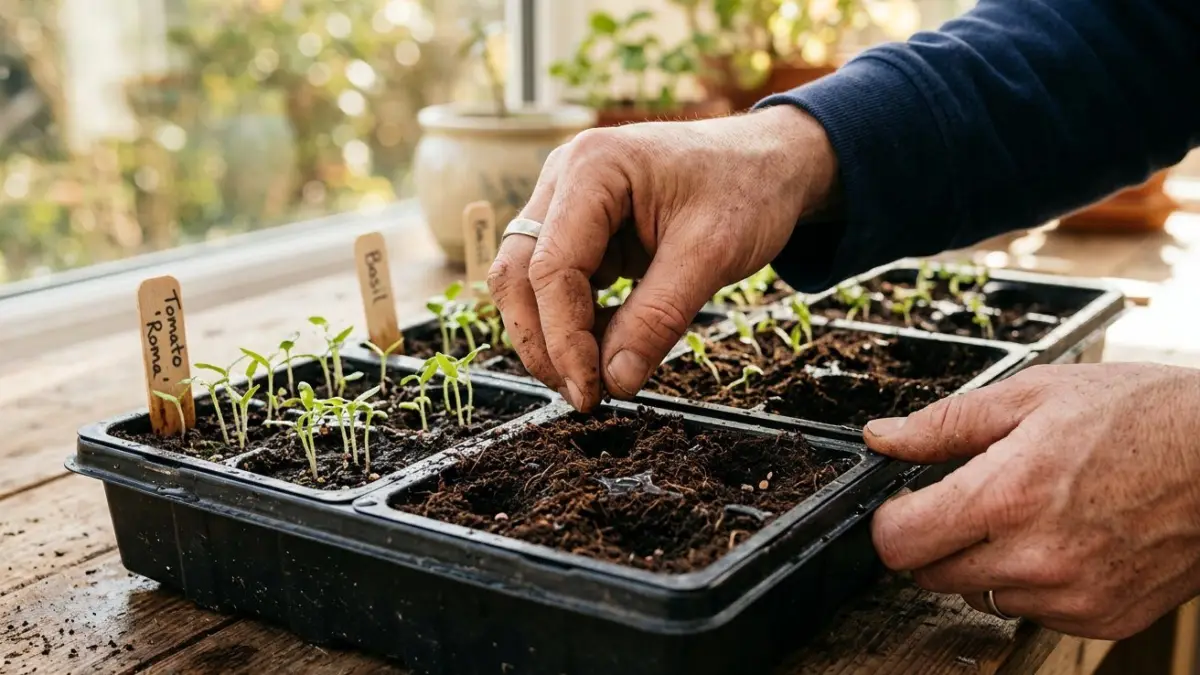
Watering Plants the Right Way: How, When and How Much
Deep-and-rare beats little-and-often. Learn to read your plants, check soil moisture properly, and build a watering rhythm that prevents 90% of garden problems.
Choosing Pots and Potting Mix: A Practical Guide
Terracotta or plastic? Potting soil or garden soil? Size and drainage decoded, pick containers and mixes your plants will genuinely thrive in.
Propagation by Cuttings: Multiply Your Plants for Free
Turn one plant into twenty. Softwood, hardwood and water propagation explained step by step, with the plants that root easiest for guaranteed first success.
The Seasonal Planting Calendar: What to Plant and When
Stop guessing the timing. A clear season-by-season sowing planner for cool-season and warm-season crops and flowers, plus how to read your own climate.
Reading Plant Signals: What Your Plants Are Trying to Tell You
Plants show stress through leaf colour, shape and posture. Use this diagnostic guide to decode yellowing, browning, curling, purpling and leggy growth before small problems become…
The First Garden Plan: What to Plant Where, for Beginners
A realistic, beginner-proof plan for your first garden: choosing a site, sizing a bed, picking easy crops and flowers, and a simple layout and schedule you…